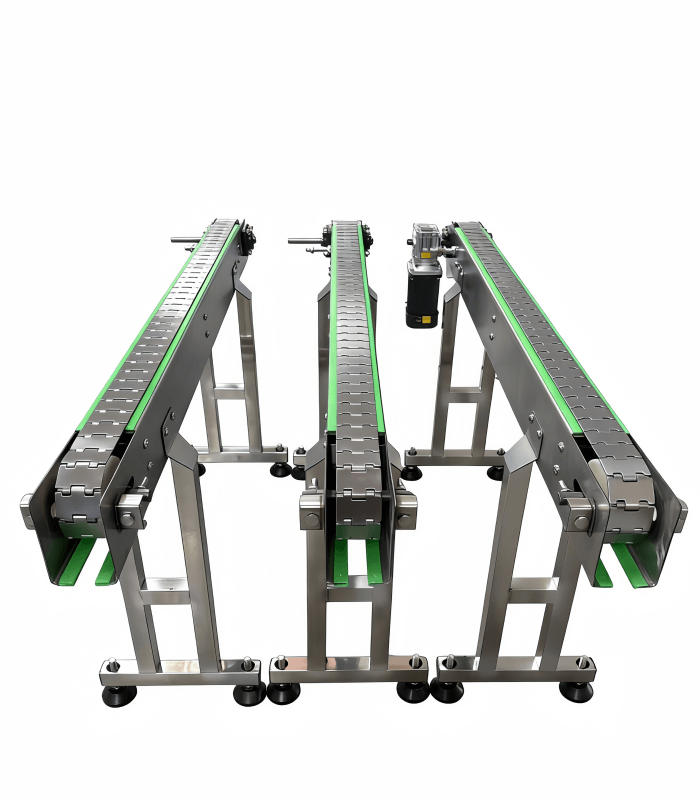
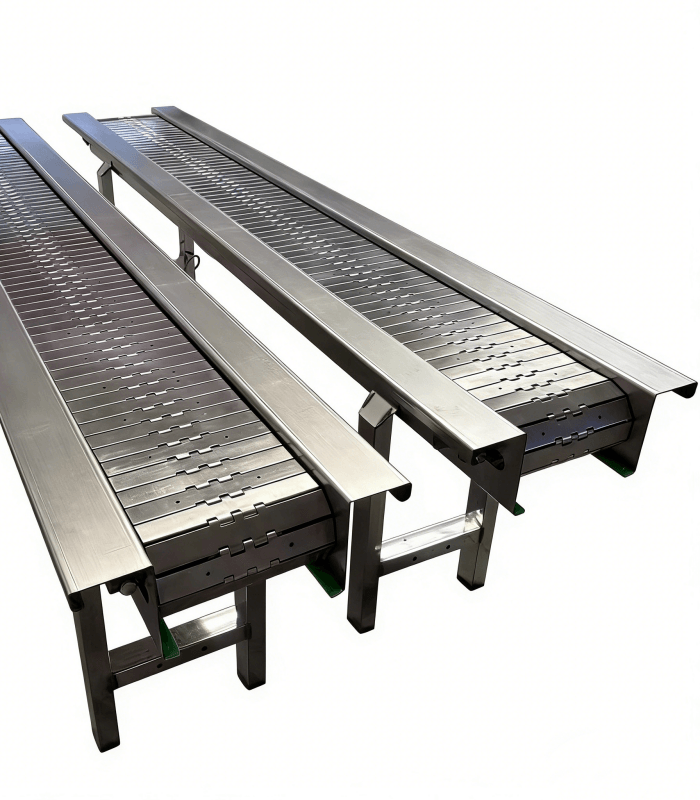
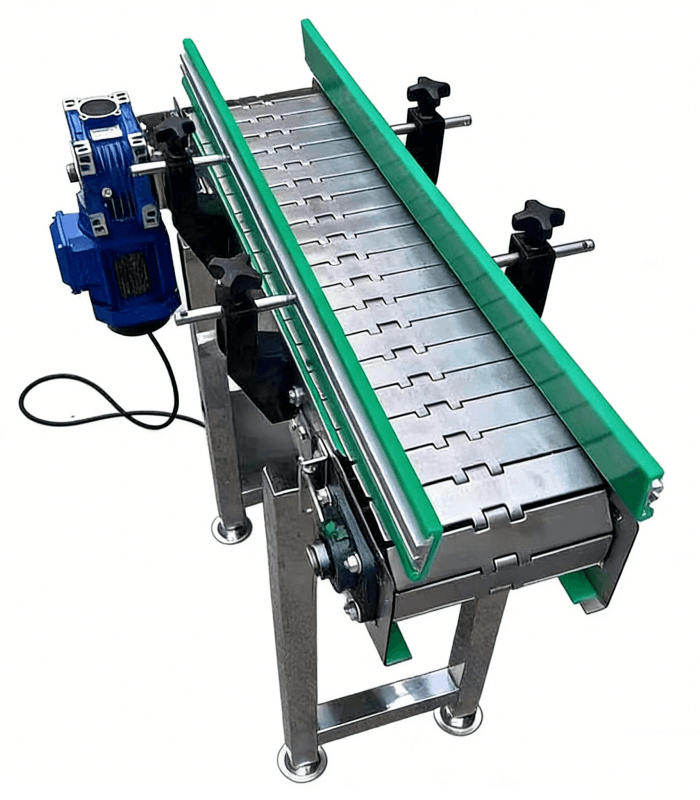
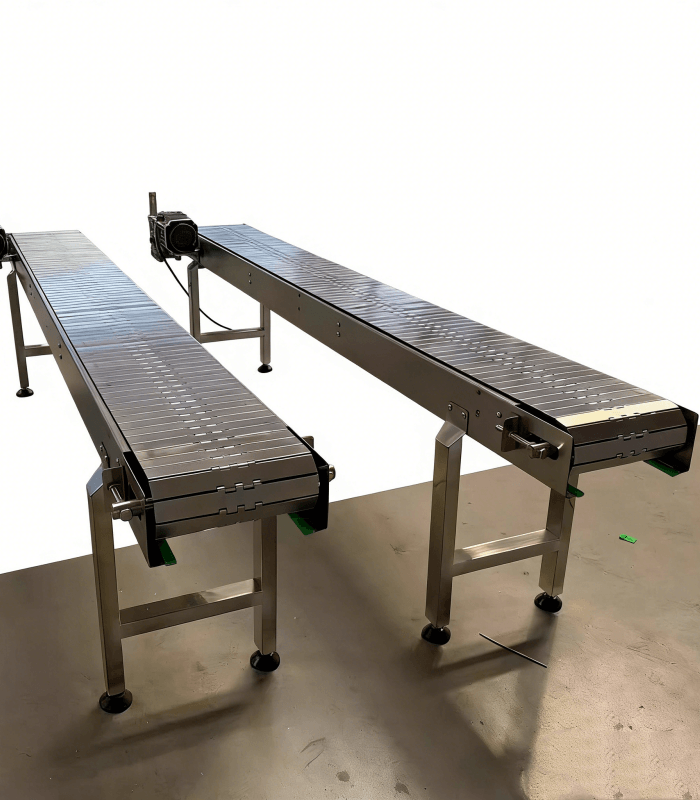
Flat-top chain conveyor, bottling line, chain conveyor
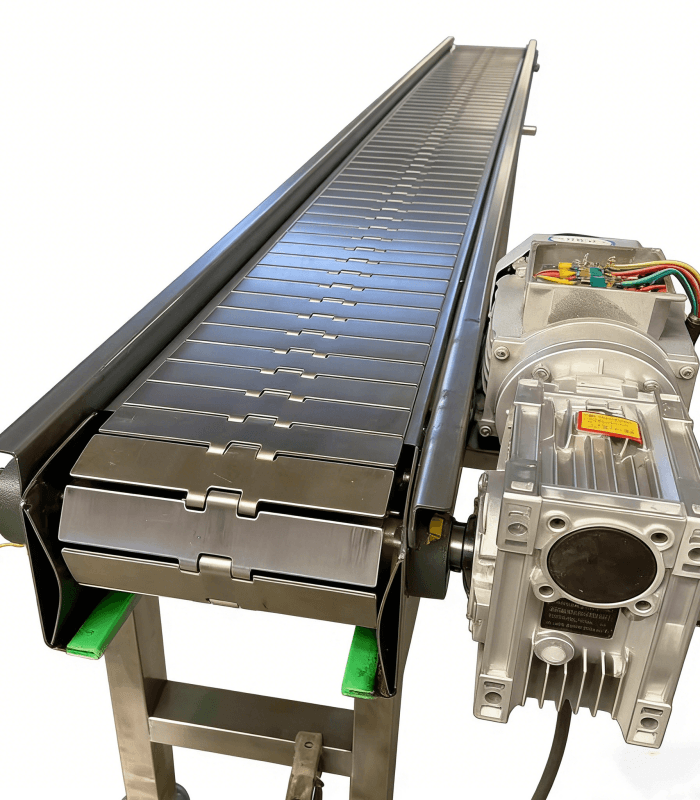
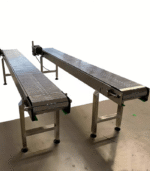
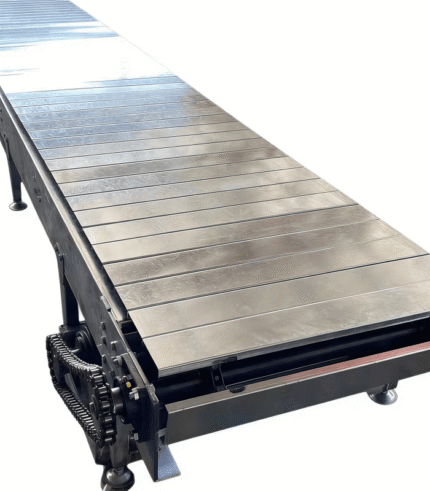
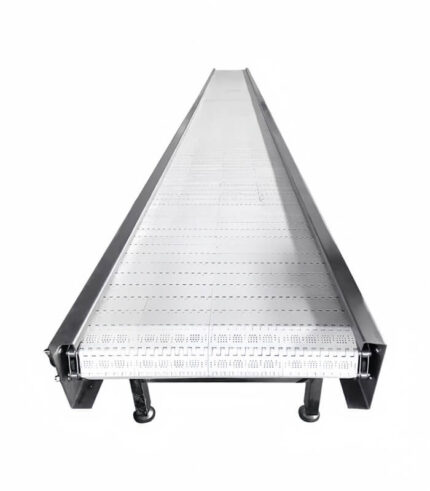
A flat-top chain conveyor is a type of conveying equipment that uses modular flat-top chain plates as the carrying surface. It is capable of straight-line, curved, and inclined conveying, and is suitable for the smooth transport of bottles and cans as well as for use in sanitary applications.
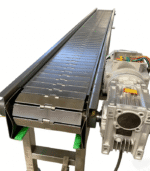
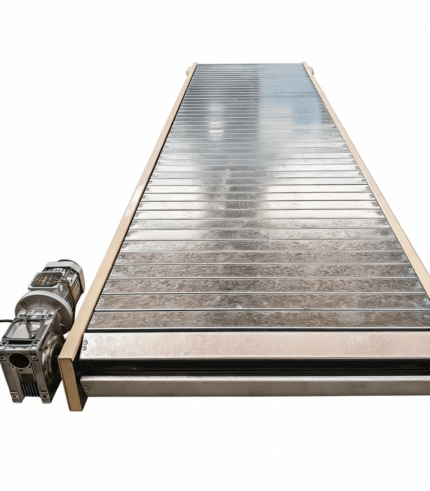
Flat-top chain conveyors are conveying systems that use flat-top chains (slat chains) as the load-bearing surface. Driven by an electric motor and reducer, they operate on dedicated guide rails and are suitable for horizontal conveying, turning, and vertical lifting applications. Below are the detailed product applications, advantages, and manufacturing processes:
—
I. Product Applications
Flat-top chain conveyors are widely used in industries with high requirements for conveying surface flatness, hygiene, and layout flexibility:
1. Food and Beverage Industry: Conveying glass bottles, PET bottles, cans, canned goods, food packaging, etc. The conveying surface is flat and smooth, preventing bottles from tipping over, and can be directly washed with water.
2. Personal Care and Pharmaceutical Industries: Used for the automatic conveying, distribution, and downstream packaging lines of cosmetics, cleaning products, and pharmaceuticals.
3. Light Industry and Electronics: Conveying various plastic containers, paper products, tobacco, machine parts, and parcels.
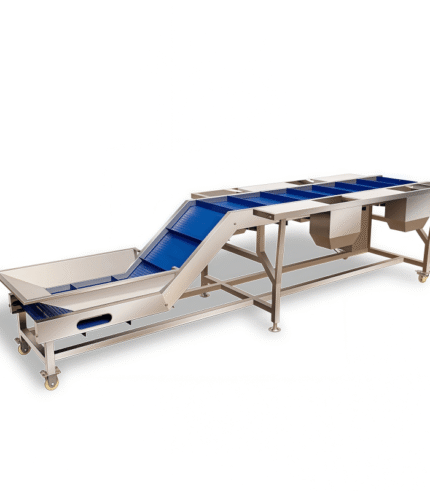
4. Complex Layout Scenarios: Can be integrated with chain or roller conveyors to achieve combined conveying functions such as horizontal turns, lifting, and lowering.
II. Product Advantages
Compared to metal chain plate conveyors, flat-top chain plate conveyors place greater emphasis on a level conveying surface, hygiene and ease of cleaning, and layout flexibility:
1. Flat conveying surface and smooth operation: The top plate provides a continuous, flat bearing surface for materials, with low friction, making it suitable for conveying easily tipping items such as bottles and cans.
2. Simple structure and easy maintenance: The flat-top chain consists only of chain plates and pins, is lightweight, and has low manufacturing and maintenance costs.
3. Flexible and diverse layouts: Can achieve various conveying paths, including straight, curved, and vertical sections. Curved chain plates, when paired with polymer or magnetic guide rails, enable smooth conveying through curves.
4. Hygienic, clean, and corrosion-resistant: Chain plates can be made of stainless steel or POM/PP (thermoplastic), allowing for direct water rinsing or soaking to meet the high hygiene standards of the food and pharmaceutical industries.
5. Diverse material options: Carbon steel, stainless steel, or thermoplastic chains can be selected based on product requirements to accommodate different widths, shapes, and operating conditions.
6. Multi-lane configurations and differential speed conveying: Multiple rows of chain plates can be combined to form wide-body conveyors, enabling differential speed conveying where multiple lanes merge into a single lane or a single lane splits into multiple lanes, thereby creating storage capacity.
III. Manufacturing Process
The core of flat-top chain plate conveyor manufacturing lies in the precise fit between the chain plates and guide rails, as well as the high-precision machining of the frame:
1. Design and Selection Phase
· Determining Parameters: The solution is determined based on the conveyed material (unit weight, specifications), ambient temperature, conveying speed, and layout type (straight/curved/elevated).
· Key Selection Criteria:
· Straight vs. Curved: Select straight flat-top chains or side-curved flat-top chains.
· Chain Plate Materials: Stainless steel (corrosion-resistant, high-temperature resistant), POM/PP (thermoplastic, light-duty, low lubrication requirements), carbon steel (heavy-duty).
2. Component Machining
· Chain Plate Manufacturing:
· Stainless steel chain plates: Formed using precision stamping or laser cutting, with hole position tolerances controlled within ±0.1 mm. The link rings of steel flat-top chains are roll-formed (seamless).
· Engineering Plastic Chain Plates: Molded via casting; can be designed with reinforcing ribs to enhance strength; structure is more complex than steel versions.
· Frame and Guide Rail Machining:
· Frames are fabricated from aluminum profiles, carbon steel (powder-coated/baked enamel), or stainless steel via welding.
· Curved guide rails: Made from polyoxymethylene (POM) or nylon, machined to precise radii to ensure smooth chain plate turning.
· Sprocket machining: 45 steel is gear-cut and carburized and quenched, with a tooth surface hardness of HRC 50–55, ensuring precise meshing with the chain.
3. Core Assembly Processes
· Chain and Chain Plate Assembly: Flat-top chain plates are connected via pins to form a closed loop. For heavy-duty applications, riveting or welding processes may be used to secure the chain plates to the TG158 double-chain, ensuring high strength.
· Guide Rail Installation: Precisely install straight or curved nylon guide rails on the frame to ensure the chain plates run parallel and smoothly.
· Drive and Tensioning: Install the motor-gear unit (left-mounted/right-mounted) and set up a screw tensioning device to adjust the chain tension.
4. Final Assembly and Commissioning
· No-Load Commissioning: Check for misalignment or abnormal noises during chain plate operation, and verify smooth operation in curved sections.
· Load Testing: Simulate operational conditions under load to verify conveying capacity and motor current, ensuring smooth operation.
· Multi-Row Synchronization Commissioning: For wide-body conveyors with multiple rows of chain plates, commission the speed consistency or differential speed function across all rows.
The core feature of flat-top chain conveyors lies in their modular flat-top chain structure. By combining straight and curved chain sections, they can flexibly accommodate various complex paths, including horizontal conveying, turning, and lifting. The following provides a detailed overview from three perspectives: core parameter systems, key component details, and parameters categorized by application.
—
I. General Core Parameter Ranges
Parameter Item General Range Remarks
Chain Pitch 25.4 mm ~ 203.2 mm Commonly 38.1 mm; the larger the pitch, the greater the load capacity
Chain Plate Width 63.5 mm ~ 1200 mm Common specifications: 63.5, 82.5, 101.6, 114.3, 152.4, 190.5, 254, 304.8 mm
Conveyor Speed: 0.4–40 m/min; typical range 0.4–15 m/min; high-speed models can reach 40 m/min
Conveying Capacity: ≤ 800 kg/m²; light-duty models may be below 50 kg/m²; maximum load capacity approximately 800 kg/m²
Operating Temperature: -20°C to +120°C; standard operating conditions; stainless steel offers superior temperature resistance
Single-unit Length: ≤ 50 m; generally ≤ 10 m for single-drive units; multi-drive configurations required for longer distances
II. Key Component Details and Specifications
1. Flat-top Chain Plate (Core Load-bearing Component)
Flat-top chain plates consist of chain plates and pins, featuring a simple structure. They are categorized into two types based on function:
Type Structural Features Applications
Straight Flat-Top Chain Hinge rings on both sides of the chain plate engage with the pins, allowing only linear movement Straight conveying sections
Curved Flat-Top Chain The chain plate uses a special hinge structure to enable horizontal turns Curved conveying sections (requires curved guide rails)
Selection of Chain Plate Materials:
Material Features Applications
Stainless Steel (304/316L) Corrosion-resistant, high-temperature resistant, high strength Food, beverage, pharmaceutical, and chemical industries
POM (Acetal) Self-lubricating, lightweight, low operating noise Light-load applications requiring frequent starts and stops
PP (Polypropylene) Chemical corrosion-resistant, lower cost Cosmetics and detergent industries
Chain Plate Manufacturing Details: The hinge rings of stainless steel flat-top chains are roll-formed (seam structure), which is a weak point; engineering plastic flat-top chains are cast, allowing for the design of reinforcing ribs to enhance strength.
2. Drive and Transmission System
· Drive Method: A motor-gear reducer serves as the power source, transmitting power through the meshing of sprockets and flat-top chains
· Installation Position: Available in left-hand and right-hand configurations (relative to the direction of material flow; right-hand configuration places the drive unit on the right side)
· Speed Control: Variable frequency drive (VFD) or by changing the sprocket tooth ratio
· Power Supply Specifications: Commonly 380V/50Hz
3. Frame and Guide Rails
Component | Material Options | Description
Frame: Carbon steel (powder-coated/baked enamel), stainless steel (304), aluminum alloy. Food-grade applications must use stainless steel or aluminum profiles.
Straight Guide Rails: Ultra-high molecular weight polyethylene (UHMWPE), nylon. Wear-resistant and self-lubricating, supporting the operation of the chain plates.
Curved Guide Rails: Polyoxymethylene (POM), nylon. Machined to precise curvature to ensure smooth turning.
4. Control Methods
· Continuous Operation: Equipment runs continuously, suitable for stable flow conveyance
· Intermittent Operation: Starts and stops according to a set cycle, suitable for assembly line workstations
III. Detailed Parameters by Application
1. Flat-Top Chain Conveyors for the Food/Beverage Industry
Parameter Specifications
Typical Applications Beverage labeling, filling, and washing lines; conveyance of canned and bottled products
Chain Plate Width 82.5, 114.3, 152.4, 190.5, 304.8 mm
Material Requirements 304 stainless steel chain plates + stainless steel/aluminum profile frame
Special Features Capable of variable-speed conveying from multi-lane to single-lane, and pressure-free accumulation
Conveyed Items Glass bottles, cans, PET bottles, canned goods, packaging boxes
2. Flat-Top Chain Conveyors for the Cosmetics/Pharmaceutical Industry
Parameters & Specifications
Typical Applications: Automated conveying and packaging lines for cosmetics, detergents, and pharmaceuticals
Chain Plate Widths: 63.5, 82.5, 101.6, 114.3 mm
Material Requirements: 316L stainless steel or POM plastic steel
Hygienic Features: Smooth, flat conveying surface; suitable for direct water washingIV. Key Parameters for Curving Capabilities
The curving capability of flat-top chain conveyors is one of their core advantages. The following parameters must be specified:
Curving Parameters | Specifications
Curving Chain Plate Width | 82.5, 114.3, 152.4, 190.5, 304.8 mm
Curving Angle | Standard angles such as 90°, 180°, etc.; customizable
Curve Radius Determined by chain plate width and pitch; requires use of dedicated curve guide rails
V. List of Key Selection Parameters
The following information must be specified during procurement or design:
1. Material Characteristics: Unit weight, material dimensions (bottle/can diameter), type of conveyed items
2. Conveying Requirements: Conveying speed (m/min), conveying length (m), whether the layout includes curves or elevation changes
3. Operating Mode: Continuous operation or intermittent operation (cycle control)
4. Environmental Conditions: Indoor/outdoor, humidity, presence of corrosive media, hygiene grade requirements
5. Installation Site: Available space dimensions, drive unit mounted on left/right
6. Speed Control Requirements: Variable frequency speed control or constant speed
3. Flat-Top Chain Conveyors for Light Industry/Electronics
Parameters & Specifications
Typical Applications: Conveying tobacco, paper products, machine parts, and parcels
Chain Plate Width: 152.4, 190.5, 254 mm
Material Requirements: POM plastic steel or carbon steel
Single-Unit Length: Generally ≤10 meters


评价
目前还没有评价