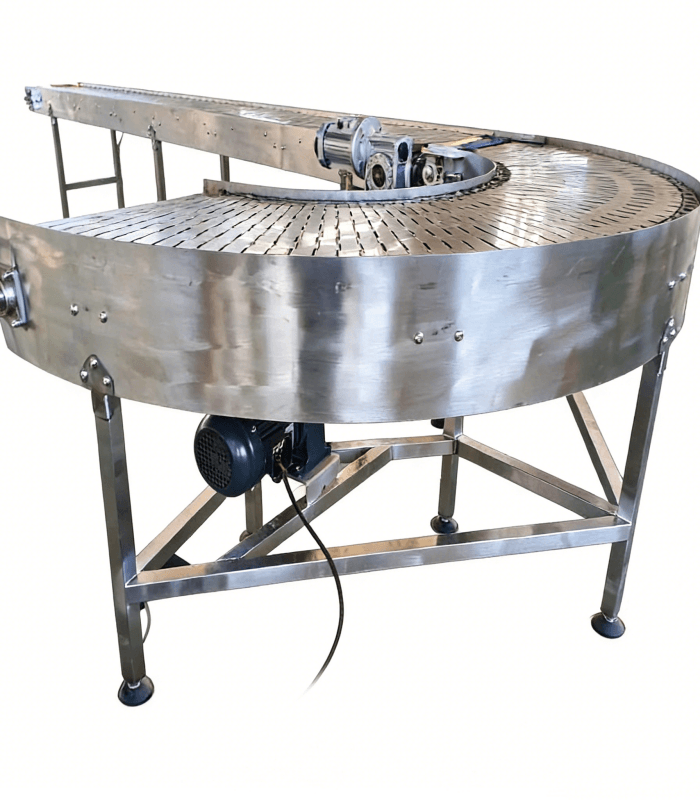
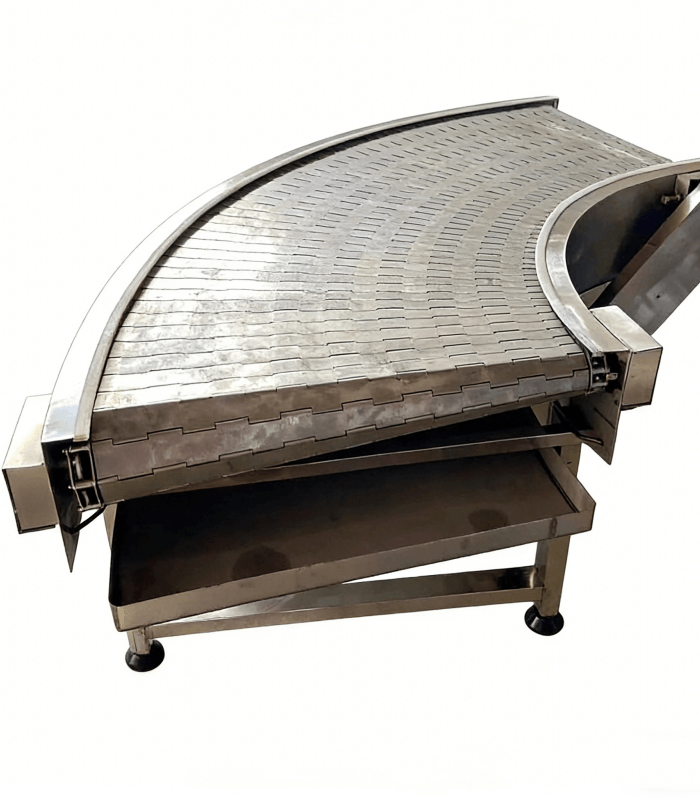
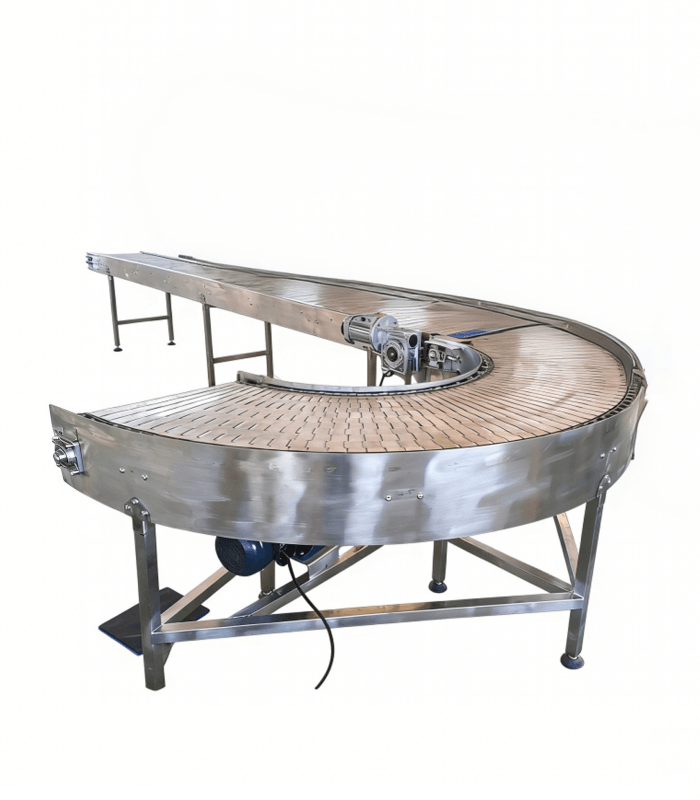
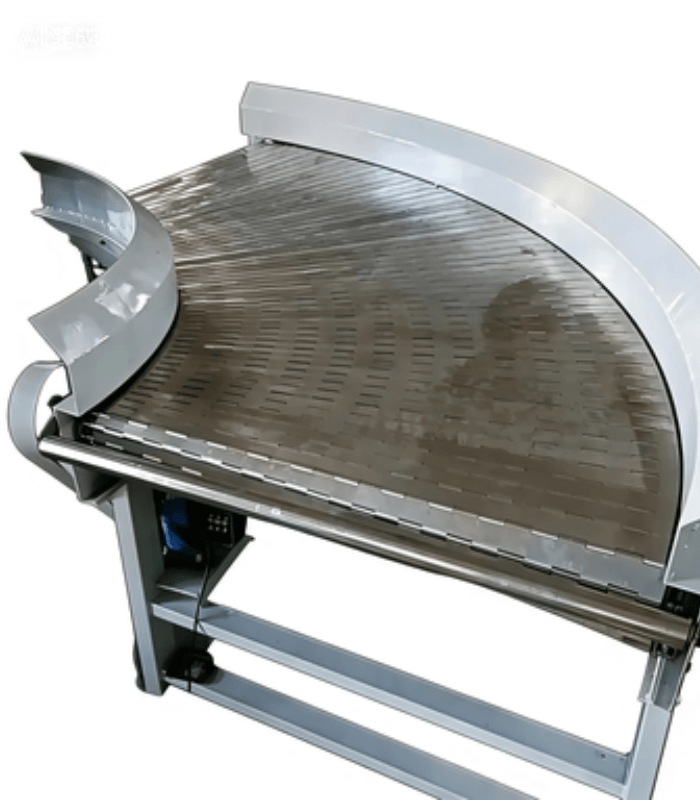
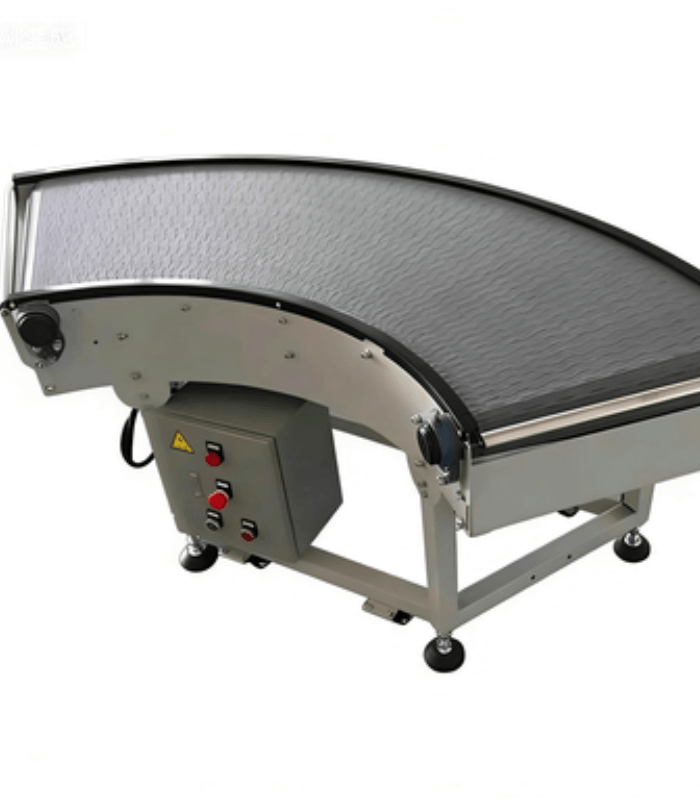
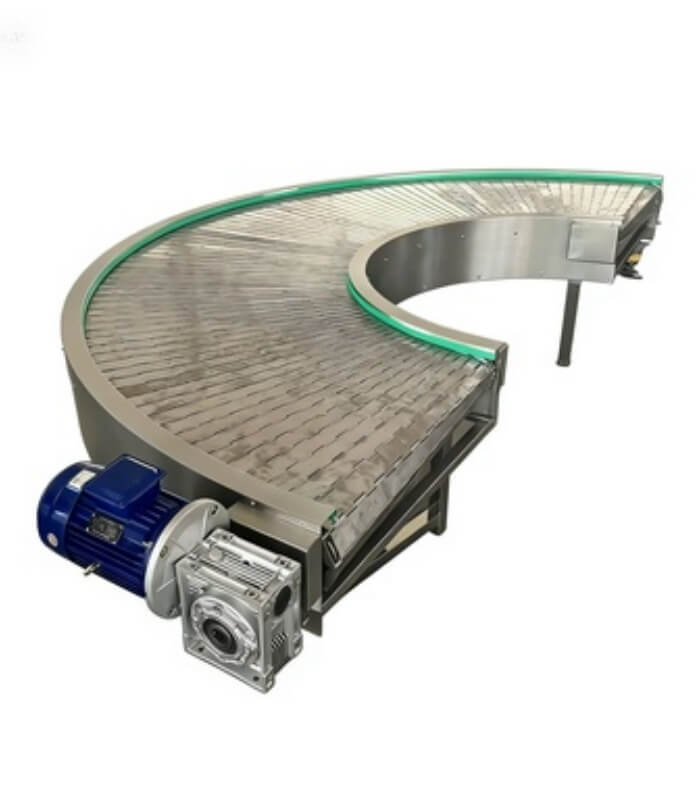
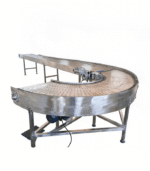
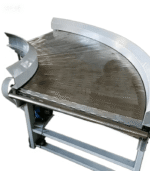
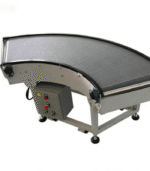
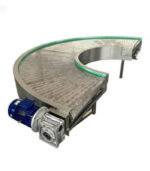
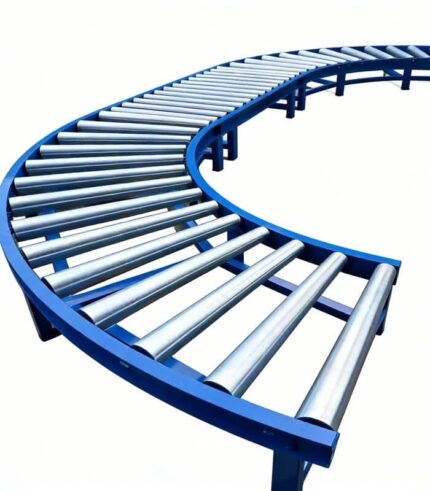
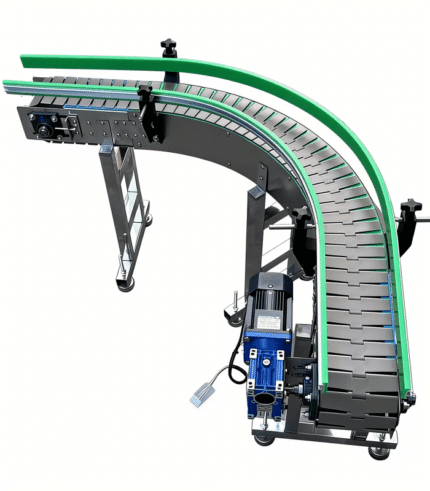
Metal Slat Curve Conveyor, Slat Curve Conveyor, Slat Curve Conveyor
A metal slat chain turning conveyor is a conveying system that uses chains with different pitch lengths on the inner and outer sides, or tapered sprockets, to create a speed differential, thereby enabling smooth, heavy-duty turns at angles such as 90° and 180°.
A metal chain plate turner is a heavy-duty conveying device that utilizes chains with different pitch lengths or tapered sprockets to create a speed differential between the inner and outer sides, enabling curved conveying paths such as 90° and 180° turns.
—
I. Product Applications
Metal chain plate turners are widely used in applications requiring a change in conveying direction, space-saving solutions, and handling of heavy loads:
1. Automotive and Heavy Industry Manufacturing: On assembly lines for automobiles, motorcycles, generators, and other equipment, they are used for the directional conveying of heavy components such as vehicle bodies and engines, enabling unmanned operation and automatic transfer.
2. Food and Beverage Industry: Used for the curved conveyance of materials such as canned goods, glass bottles, PET bottles, and aluminum cans. The chain plate surface is flat and smooth, ensuring a smooth transition.
3. Pharmaceutical and Personal Care Industry: Suitable for the automatic conveyance, distribution, and downstream packaging lines of pharmaceuticals, cosmetics, and cleaning products.
4. Logistics and Warehousing Systems: Used for the turning and conveying of pallets and bins in automated high-bay warehouses and sorting centers.
5. Special-Condition Conveying: Suitable for environments with special requirements such as oil resistance, corrosion resistance, and anti-static properties; also applicable to animal slaughter production lines.
II. Product Advantages
The core advantages of metal chain plate turners lie in their heavy-duty capacity and layout flexibility:
1. High conveying capacity and load-bearing capability: Capable of handling heavy loads, suitable for conveying heavy items such as electric vehicles, motorcycles, and generators, with a maximum load capacity of up to tens of tons.
2. Smooth and precise operation: Relying on the friction between the chain plates and the workpieces to drive movement, the conveying speed is accurate and stable, ensuring precise synchronized conveying and automatic transfer.
3. Flexible Layout and Space-Saving Design: Capable of performing horizontal, inclined, and curved conveying on a single conveyor line. Curved angles include 30°, 45°, 60°, 90°, and 180°, among others, allowing for full and efficient use of space.
4. Easy to Clean and High Hygiene Standards: Chain plates are typically made of stainless steel and can be directly rinsed with water or immersed in water, meeting the strict hygiene requirements of industries such as food, beverage, and pharmaceuticals.
5. Stable structure and long service life: Equipped with high-strength chains and wear-resistant guide rails, the structure is simple yet robust, featuring long maintenance intervals and resistance to aging.
6. Low-noise operation: Incorporating noise-reduction designs such as silent idler wheels, the system operates with minimal noise, making it suitable for environments requiring quiet operation.
III. Product Manufacturing Process
The core of manufacturing metal chain plate turners lies in the design of speed-differential mechanisms and precision machining. The main process flow is as follows:
1. Design and Selection Phase
Key parameters are determined based on customer requirements, including: turning angle (90°, 180°, etc.), turning radius (inner radius R600, R800, R1000, R1200 mm, etc.), chain plate width, conveying speed, load capacity, and environmental requirements.
Core Design Principle: The outer and inner sides of the turner must maintain the same angular velocity, while the linear velocity on the outer side must exceed that of the inner side by a specific ratio to ensure the material turns smoothly along a concentric circle.
2. Machining of Key Components
(1) Turner Chain Plate and Chain System (Core Technology)
Option 1: Different Pitch Chain Configuration
· The inner and outer chains use different pitches
· For example, if a P=12.7mm chain is selected for the inner side and a P=19.05mm chain for the outer side, the outer linear velocity is 1.5 times that of the inner side
· The inner and outer chains are connected to the same conveyor belt; the sprockets have the same number of teeth but different pitches
Conveyor Belt Material Selection:
· Stainless steel (304/316L): Corrosion-resistant and easy to clean; suitable for the food and pharmaceutical industries
· Carbon steel: High strength and low cost; suitable for heavy industrial applications
· Checkered steel plate: Standard type with a tapered structure
Chain type: Standard roller chain with guide wheels to ensure operational precision
(2) Frame and Guide Rail Machining
Component Specifications/Requirements Description
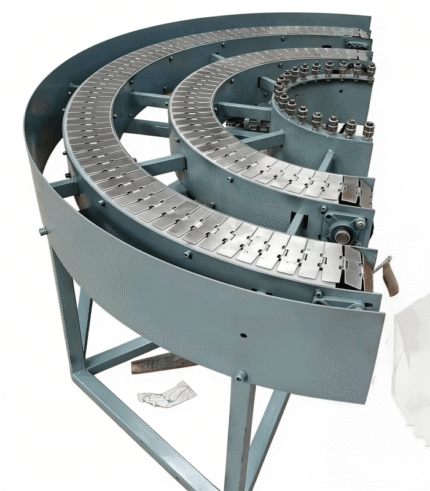
Inner Side Plate/Outer Side Plate: Sector-shaped structure, concentric arrangement; outer side plate radius is greater than inner side plate radius
Curved Guide Rail: Machined as a single piece via wire cutting to ensure curvature accuracy
Support Shaft: Installed at an angle; outer end is lower than inner end, matching the taper
Intermediate Frame: Ensures sufficient support strength; no shaking during continuous operation
Frame Material: Powder-coated carbon steel or stainless steel; customizable as needed
(3) Drive and Transmission System
Item Specifications/Options Description
Drive Unit Motor and gear reducer Mounted at the end of the frame
Motor Brand Imported brands such as SEW Speed adjustable via variable frequency drive
Tensioning Device Lead screw adjustment Ensures sufficient chain tension
Power Supply AC220V / AC380V
Speed Control Method Variable frequency speed control
(4) Smooth-Running Auxiliary Mechanisms
· Elastic Adjustment Mechanism: Located at the ends of the chain plates, it maintains rolling contact with the curved guide rails to absorb impacts caused by centrifugal force and prevent rigid collisions between the chain plates and the guide rails.
· Silent Idler Wheels: Spaced evenly along the support shaft to reduce operating noise.
3. Final Assembly and Commissioning
· Assembly: Position and weld the inner and outer side plates in a concentric fan pattern; install the support shafts (maintaining the inclination angle); install the chain and chain plates; connect the drive unit
· Commissioning:
· No-load commissioning: Power on and run the system to check for smooth chain operation, any deviation, and whether the chain plates slide smoothly along the guide rails
· Load testing: Place standard cargo to test for smooth turning and whether the cargo deviates from the centerline
· Speed adjustment: Use a variable frequency drive to adjust the conveying speed to the target value
· Quality inspection: Non-destructive testing of critical welds; overall system performance testing
4. Method for Determining the Turning Radius
The turning radius can be determined using the graphical method:
1. Draw two parallel line segments, each with a length equal to the pitch of the inner and outer chains
2. The distance between the two line segments is the center-to-center distance of the inner and outer chains
3. Connect the ends of the two line segments and extend the lines
4. The intersection of the extended lines is the center of the concentric circle
5. The distance from the intersection point to the inner line segment is the inner radius
Standard turning radii: Inner radii R600, R800, R1000, R1200 mm, etc.
IV. Summary of Key Parameters
Parameter Dimension Typical Values/Requirements
Turning Angle 30°, 45°, 60°, 90°, 180°
Bend Radius: Inner radius R600–1200 mm (standard), maximum width 2 m
Chain Plate Width: 500–1500 mm (customizable)
Conveyor Speed: ≤20 m/min
Single-Unit Length: ≤70 m
Load Capacity: Up to tens of tons
Chain Plate Material: 304/316L stainless steel, carbon steel, checkered steel plate
Chain Type: Standard roller chain (with guide wheels)
Drive Method: Geared motor (SEW, etc., with variable frequency speed control)
Tensioning Method: Lead screw adjustment
Frame Material: Powder-coated carbon steel, stainless steel
Applications: Food, pharmaceuticals, beverages, automotive, motorcycle, logistics, etc.
V. List of Key Selection Parameters
The following information must be specified during procurement or design:
1. Curve Parameters: Curve angle (90°/180°, etc.), curve radius (inner radius R value), inner and outer arc lengths
2. Conveyed Item Parameters: Item type (boxes/bags, pallets, workpieces, bottles/cans), unit weight, external dimensions
3. Performance Requirements: Conveying speed (m/min), load capacity (kg/item)
4. Environmental Conditions: Indoor/outdoor, humidity, temperature, hygiene grade requirements (stainless steel required for food/pharmaceutical applications)
5. Material Requirements: Chain plate material (stainless steel/carbon steel), frame material
6. Interconnection Requirements: Height, width, and speed compatibility with upstream and downstream conveyor lines
The key feature of a metal chain belt turner lies in its use of chains with different pitch lengths or tapered sprockets to create a difference in linear velocity between the inner and outer sides, thereby enabling smooth turning and conveying along a curved track. The following are detailed specifications and descriptions:
—
I. General Core Parameter Ranges
Parameter Item General Range Remarks
Turn Angle 45°, 90°, 180° 90° and 180° are the most common specifications
Turn Radius R500mm, R600mm, R900mm, R1200mm Inner radius; R500 is limited to specific chain plates
Chain Plate Width 82.5mm, 114.3mm, 152.4mm, 190.5mm Standard width series
Conveyor Speed 0.05 ~ 40 m/min Typically ≤20 m/min
Single-unit length: ≤70 meters (calculated from centerline)
Load capacity: ≤50 kg/m (standard type) ~ tens of tons (heavy-duty type), depending on chain plate specifications
Operating temperature: -2°C ~ +120°C (applicable for stainless steel materials)
Power: 0.37 kW ~ 1.5 kW (standard drive power)
II. Key Component Details and Specifications
1. Curved Chain Plate and Chain System (Core Technology)
The technical solutions for achieving a speed difference between the inner and outer sides in a metal chain plate curver are as follows:
Solution 1: Chains with Different Pitch (Mainstream Technology)
The inner and outer chains use different pitches, which is the core principle for achieving the curve:
Position Chain Pitch Linear Speed Ratio
Inner Chain P=12.7mm Reference
Outer Chain P=19.05mm 1.5 times that of the inner side
Principle: The inner and outer chains are connected to the same chain plate. Although the sprockets have the same number of teeth, their pitches differ, resulting in a higher linear speed on the outer side than on the inner side. This allows the material to turn smoothly along a concentric circle.
Solution 2: Tapered Sprocket Solution
Multiple drive teeth are evenly spaced on the drive shaft, with their radii gradually increasing (the outermost drive tooth has the largest radius, while the innermost has the smallest). The support shaft is installed at an angle (with the outer end lower than the inner end).
Selection of Chain Plate Materials:
Material Features Applications
Stainless Steel (304/316L) Corrosion-resistant, easy to clean, high-temperature resistant Food, pharmaceutical, and beverage industries
Carbon Steel High strength, low cost, can be galvanized/powder-coated Heavy industry, mining, metallurgy
Engineering Plastics Lightweight, self-lubricating, low noise Light-duty, food-grade applications
Conveyor Belt Specifications:
Parameter Specifications
Chain Pitch 19.05 mm ~ 50 mm
Conveyor Belt Pitch 25.4 mm ~ 203.2 mm
2. Frame and Track System
Component Specifications/Requirements Description
Inner Side Plate/Outer Side Plate Sector shapes with equal curvature, arranged concentrically Outer side plate radius > inner side plate radius
Frame Material Carbon steel, 201 stainless steel, 304 stainless steel, aluminum profiles Customizable as needed
Conveyor Surface Height 450 mm ~ 2000 mm Adjustable
Effective Width 200–1200 mm (Max. 2000 mm) Customized to cargo width
Support Frame Multiple support legs of equal height Stable support
Limit and Guide Structures:
· Limit Bearings: Installed on the back of the conveyor chain plate, they contact the outer wall of the outermost guide rail, shifting the load-bearing point from the inner side to the outer side. This ensures smooth and stable conveyance and extends the service life of the chain plate.
· Roller Assembly: Spaced along the conveying direction to support the operation of the chain plate.
3. Curve Limit Components (Adjustable Guardrails)
Modern metal chain conveyor turners are equipped with an adjustable guardrail system:
Component Function Adjustment Method
Outer Guardrail Prevents material from being flung out from the outer side Outer positioning rod extends and retracts to adjust channel width
Inner Guardrail: Maintains stable material entry into the turning section. Adjusted by extending or retracting the inner positioning rod.
Flexible Curved Plate (Heavy-Duty Models): Provides material protection along the curved path. Features a distance-adjustable structure with sliding columns for quick disassembly and replacement.
Adjustment Principle: The outer positioning rod is inserted into the horizontal holes of the outer base and locked in place with an outer locking bolt. Adjusting the guardrail position to accommodate materials of different sizes is achieved by changing the extension length of the positioning rod.
4. Drive and Transmission System
Item Specifications/Options Description
Drive Motor Geared motor (SEW or other brands available) Mounted on the outer side of the inner side plate
Speed Control Fixed speed, stepless speed control, variable frequency speed control Speed ratio can reach up to 5:1
Power Supply Single-phase 220V / Three-phase 380V, 50 Hz
Sprockets Same number of teeth on inner and outer sides, different pitch The core component for achieving speed differences
Standard Turning Radii:
· R500mm (8811 series chain plates only)
· R600mm
· R900mm
· R1200mm
· R≥610mm (standard requirement)
III. Classification Parameters by Turning Angle
Turning Angle Typical Turning Radius (mm) Applicable Scenarios
45° R600–1200 Minor directional adjustments
90° R600–1200 L-shaped production line connections (most common)
180° R600–1200 U-shaped production lines or return lines
IV. List of Key Selection Parameters
The following information must be specified during procurement or design:
1. Curve Parameters
· Turn angle (45°/90°/180°)
· Turn radius (R value, inner radius)
· Inner and outer arc lengths
2. Conveyed Item Parameters
· Item Type (Boxes/Bags, Pallets, Workpieces, Bottles/Jars)
· Unit Weight (kg/piece) or Linear Load (kg/m)
· Dimensions (Length × Width × Height)
3. Performance Requirements
· Conveyor Speed (m/min)
· Speed Control Required (Constant Speed, Variable Frequency, Stepless Speed Control)
4. Environment and Materials
· Indoor/outdoor, humidity, temperature (high-temperature resistance required)
· Sanitary grade requirements (stainless steel required for food/pharmaceutical applications)
· Chain plate material (stainless steel/carbon steel/engineering plastics)
· Frame material (stainless steel/carbon steel/aluminum profiles)
5. Installation Conditions
· Conveyor surface height requirements
· Dimensions for interfacing with upstream and downstream conveyor lines
V. Summary
Parameter Dimension Typical Values/Requirements
Key Selection Criteria: Turning angle, turning radius, cargo weight, hygiene requirements
Turning angle: 45°/90°/180°
Turning radius: R500–1200 mm (standard R600/R900/R1200)
Chain Plate Width 82.5–190.5 mm (standard series), max. 2000 mm
Chain Pitch Inner P=12.7 mm / Outer P=19.05 mm (typical)
Conveyor Speed 0.05–40 m/min (conventional ≤20)
Load Capacity ≤50 kg/m (standard) ~ tens of tons (heavy-duty)
Operating Temperature: -2°C to +120°C
Material Combinations: Food-grade: Stainless steel chain plates + stainless steel frame; Heavy industry: Carbon steel chain plates + powder-coated carbon steel frame
Drive Power: 0.37–1.5 kW
Adjustable Guardrails: Inner and outer guardrails are telescopically adjustable to accommodate materials of various sizes
Single-unit Length: ≤70 meters


评价
目前还没有评价