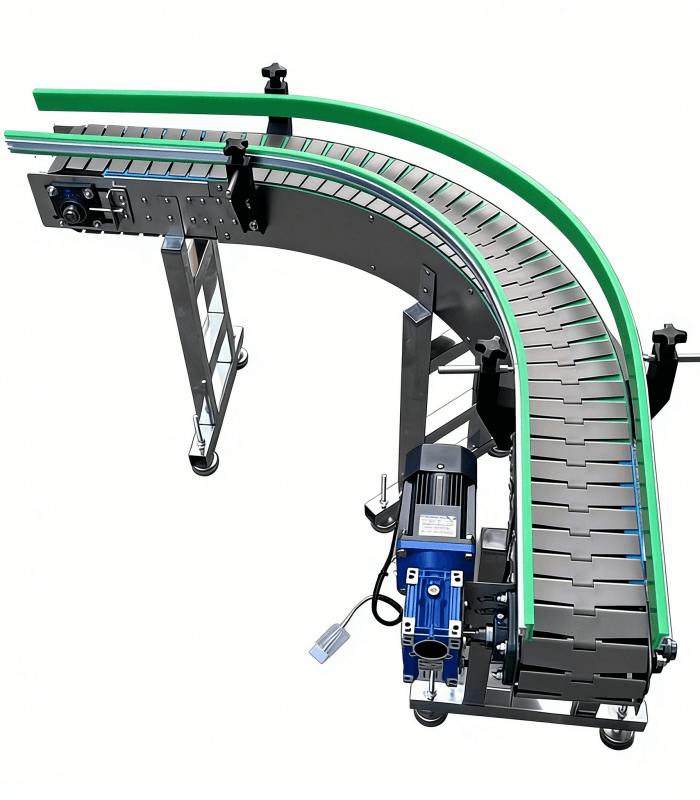
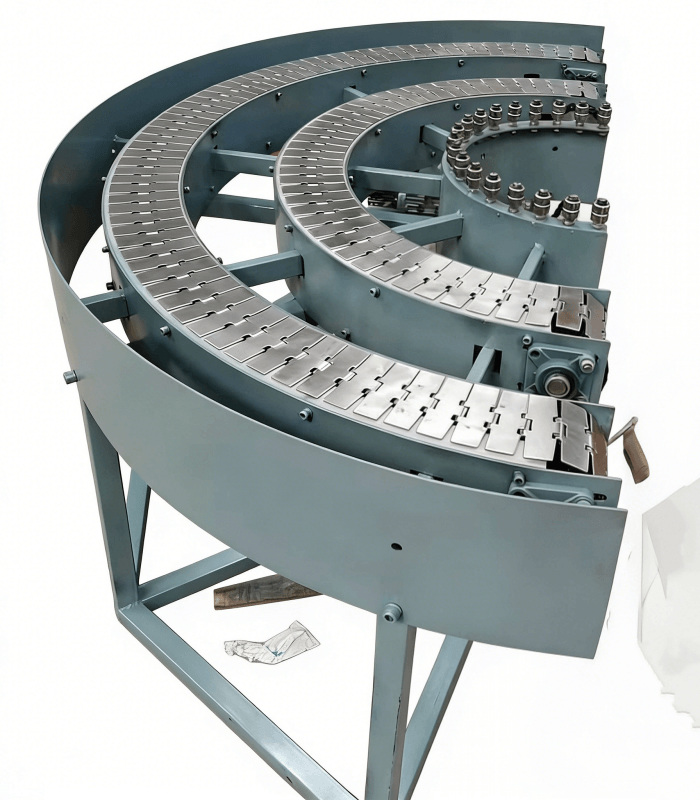
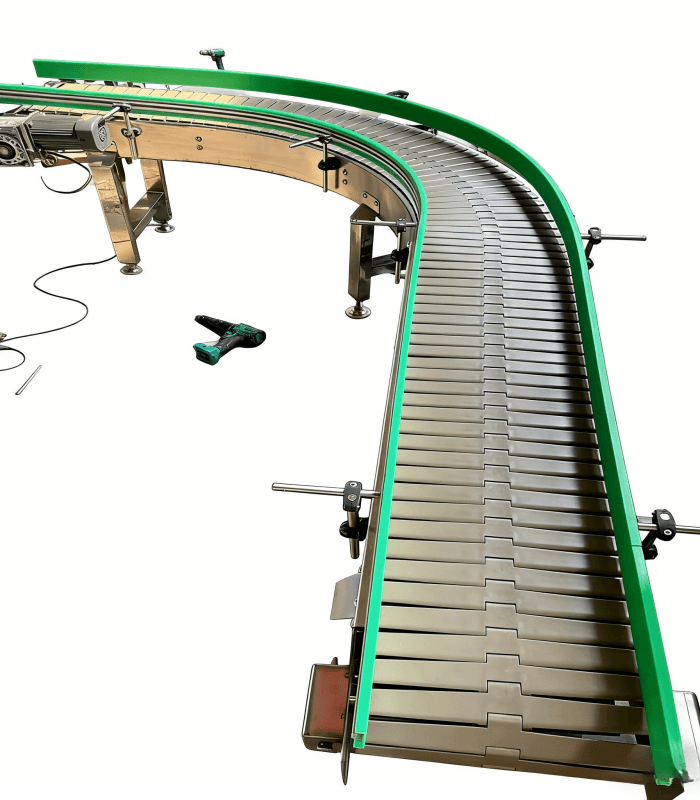
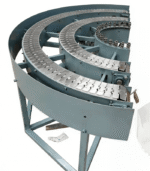
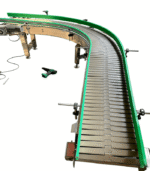
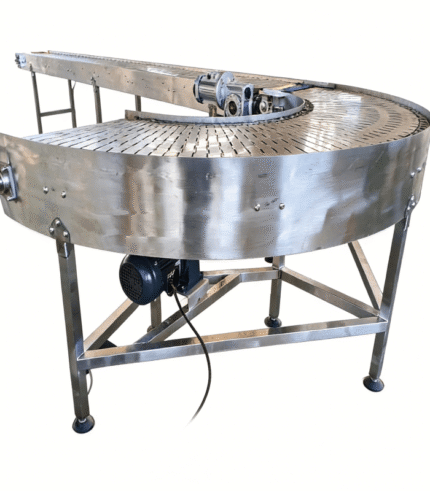
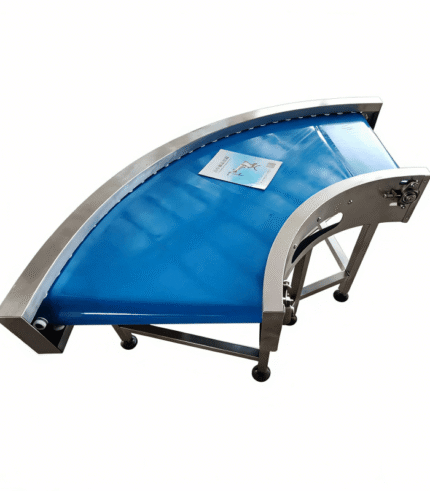
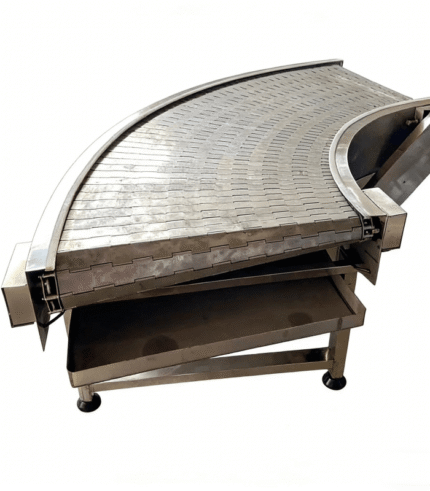
Flat-top chain belt turner, canning production line, flat-top chain belt turner conveyor
The flat-top chain conveyor with curved section is a conveying system that uses a π-shaped curved chain and polymer or magnetic guide rails to achieve curved turns. It features a flat, smooth conveying surface and is suitable for the smooth transfer of materials such as bottles, cans, and boxes.
The flat-top chain conveyor turner is a conveying device that uses π-shaped turning chain plates or magnetic turning guides to achieve curved turns. It features a flat, smooth conveying surface and is suitable for the smooth transfer of materials such as bottles, cans, and boxes.
—
I. Product Applications
Flat-top chain plate turners are widely used in industries that require changes in conveying direction and have high standards for conveying stability and hygiene:
1. Food and Beverage Industry: Conveys glass bottles, PET bottles, cans, and canned goods, ensuring a smooth transition during turns and minimizing the risk of bottles tipping over.
2. Personal Care and Pharmaceutical Industry: Used for the automatic conveying, distribution, and downstream packaging lines of cosmetics, cleaning products, and pharmaceuticals.
3. Light Industry and Packaging: Conveys various types of boxes, paper products, condiments, dairy products, and more.
4. Complex Layout Scenarios: Can be combined with straight conveyors to form L-shaped, U-shaped, S-shaped, and other layouts, effectively utilizing factory floor space.
II. Product Advantages
The core advantages of the flat-top chain plate turner lie in its flat conveying surface, hygienic and easy-to-clean design, and flexible layout:
1. Flat, smooth conveying surface with smooth transitions: The chain plate surface is flat with low friction, ensuring a smooth transition of materials between curved and straight sections, making it particularly suitable for conveying easily tip-over items such as bottles and cans.
2. Diverse materials and strong adaptability: Chain plates are available in various materials, including stainless steel (304/316L) and engineering plastics (POM/PP), allowing selection based on the conveyed materials and process requirements.
3. High load capacity: Capable of handling heavy loads, making them suitable for conveying heavy items such as electric vehicles, motorcycles, and generators.
4. Hygienic and easy to clean: Chain plate conveyors can generally be directly rinsed with water or immersed in water, ensuring easy cleaning and meeting the strict hygiene requirements of the food and beverage industries.
5. Flexible Layout and Space-Saving: A single conveyor line can handle horizontal, inclined, and curved conveying, with turning angles available in 45°, 60°, 90°, and 180° configurations.
6. Accurate and Stable Speed: Conveying speed can be precisely controlled (e.g., via electromagnetic speed regulation), ensuring accurate synchronized conveying.
7. Simple Structure and Easy Maintenance: The equipment features a simple structure with a high degree of modularity, resulting in low maintenance costs.
III. Product Manufacturing Process
The core of manufacturing flat-top chain plate turners lies in the precision machining of the turning guide rails and the design for smooth operation of the chain plate system. The main manufacturing process is as follows:
1. Design and Selection Phase
Key parameters are determined based on customer requirements:
· Turning angle (45°, 60°, 90°, 180°, etc.)
· Turning radius (inner radius R value)
· Chain plate width (82.5, 114.3, 152.4, 190.5, 304.8 mm, etc.)
· Conveying speed, load capacity, and environmental requirements
Selection of turning configurations:
· Winged Turn (π-type chain plate): The chain plate runs within a turning guide rail made of polymer
· Magnetic Turn: Uses stainless steel turning chain plates in conjunction with magnetic turning guide rails to ensure the conveyor chain plate always runs within the guide rails
2. Key Component Manufacturing
(1) Turning Chain Plates and Guide Rail System
Component Specifications/Requirements Description
Straight Chain Plate Width 63.5, 82.5, 101.6, 114.3, 152.4, 190.5, 254, 304.8 mm For straight sections
Curved Chain Plate Width 82.5, 114.3, 152.4, 190.5, 304.8 mm For curved sections
Curved Guide Rails: Machined from a single piece via wire cutting to ensure arc accuracy and smooth operation
Chain Plate Material: 304/316L stainless steel, POM engineering plastic (select as needed)
Frame Material: Aluminum profiles, carbon steel, stainless steel (food-grade stainless steel for versatile applications)
(2) Smooth Operation Auxiliary Mechanism (Patented Technology)
To counteract centrifugal force during turns, the advanced design incorporates an elastic adjustment mechanism:
· Elastic Adjustment Mechanism: Located at the end of the chain plate, it maintains rolling contact with the curved guide rail to absorb impacts caused by centrifugal force and prevent rigid collisions between the chain plate and the guide rail
· Structural Components: Includes mounting plate, sliding sleeve, sliding column, first adjustment spring, ball bearing block, etc.
· Function: Ensures even force distribution on the chain plate during turns, maintains level operation, and extends equipment lifespan
(3) Frame Fabrication
Process Process Requirements Description
Cutting Laser cutting/Plasma cutting Steel plate blanking, high precision
Bending Bent to shape according to design drawings Forms an arched frame
Welding TIG welding/GMAW Frame welding, sturdy and reliable
Legs Stainless steel square tubing (40×60×1.5mm) Provides stable support
4) Drive and Transmission System
Item Specifications/Options Description
Drive Motor Geared Motor Mounted on the frame
Speed Control Method Electromagnetic speed control, variable frequency speed control Speed adjustable
Sprockets and Chain At least two sprockets with chains to drive the chain plates
3. Final Assembly and Commissioning
· Assembly: Install the frame, curved guide rails, drive shaft, sprockets, chain, and conveyor plates in sequence
· Commissioning:
· No-load testing: Power on and run the system to check if the conveyor plates run smoothly, if there is any deviation, and if the elastic adjustment mechanism functions properly
· Load Testing: Place standard cargo (bottles, cans, boxes, or bags) to test whether turns are smooth and whether the cargo remains stable without tipping over
· Speed Adjustment: Use the speed control device to adjust the conveying speed to the target value
4. Coating and Corrosion Protection
Apply coating and corrosion protection (powder coating/baked paint) to the frame to extend the equipment’s service life; for food-grade applications, stainless steel material is required and does not require coating.
IV. Summary of Key Parameters
Parameter Dimension Typical Values/Requirements
Curve Angle 45°, 60°, 90°, 180°, U-shape, L-shape, C-shape, S-shape
Curve Radius Customizable as needed; generally 5–8 m
Straight Chain Plate Width 63.5, 82.5, 101.6, 114.3, 152.4, 190.5, 254, 304.8 mm
Curved Chain Plate Width 82.5, 114.3, 152.4, 190.5, 304.8 mm
Conveyor Speed: Electromagnetic speed control / Variable frequency speed control, adjustable speed
Conveying Capacity: Capable of handling heavy loads (electric vehicles, motorcycles, etc.)
Operating Temperature: Stainless steel material withstands temperatures above 120°C
Chain Plate Material: 304/316L stainless steel, POM engineering plastic, stainless iron
Frame Material: Aluminum profiles, powder-coated carbon steel, stainless steel
Curve Configuration: Pi-type chain plates + polymer guide rails / Stainless steel chain plates + magnetic guide rails
Guide Rail Processing: Wire-cut machining for high precision
Special Features: Elastic adjustment mechanism to absorb centrifugal force impacts
Hygiene Characteristics: Directly washable/soakable, meeting hygiene requirements for the food and beverage industries
Applicable Industries: Food, beverages, cosmetics, detergents, pharmaceuticals, dairy, condiments, etc.
V. List of Key Selection Parameters
The following information must be specified during procurement or design:
1. Curve parameters: Curve angle (45°/90°/180°, etc.), curve radius (inner radius R value)
2. Conveyed item parameters: Item type (bottles/cans/boxes), unit weight, external dimensions
3. Performance requirements: Conveying speed (m/min), load capacity
4. Environmental Conditions: Indoor/outdoor, humidity, temperature, hygiene grade requirements
5. Material Requirements: Chain plate material (stainless steel/engineering plastics), frame material (stainless steel/carbon steel/aluminum profiles)
6. Turning Configuration: Winged turn (π-type chain plate) or magnetic turn
7. Connection Requirements: Connection height and width with upstream and downstream straight conveyor lines
The key feature of the flat-top chain conveyor with curved section lies in its use of winged curved chain plates (π-type chain plates) in conjunction with polymer or magnetic curved guide rails to achieve curved turns. An adjustable guardrail system adapts to materials of various sizes, ensuring smooth conveying. The following are detailed specifications and descriptions:
—
I. General Core Parameter Ranges
Parameter Item General Range Remarks
Curve Angle 45°, 60°, 90°, 180°, 360° 90° and 180° are most commonly used; 360° is achieved by combining two 180° units
Curve Radius R457mm ~ R1200mm Standard R457 (880 series), R609.6 (882 series)
Chain Plate Width 82.5 mm, 114.3 mm, 152.4 mm, 190.5 mm, 254 mm, 304.8 mm Dedicated width series for curved sections
Straight Chain Plate Width 63.5 mm ~ 304.8 mm Used in conjunction with straight sections
Chain pitch: 25.4 mm ~ 38.1 mm (38.1 mm is commonly used)
Conveyor speed: 3 ~ 50 m/min (adjustable/variable frequency speed control)
Single-unit length: ≤25 meters (single drive) (modular system)
Operating temperature: -20°C ~ +120°C (stainless steel models have higher temperature resistance)
Chain plate thickness: 3 mm ~ 5 mm (selected based on load)
Working Load: 1680 N – 3830 N (880 Series: 1680 N; 882 Series: 3830 N)
II. Key Component Details and Specifications
1. Curved Chain Plates (Core Load-Bearing Components)
The chain plates for flat-top curved conveyors differ from those for straight conveyors and must possess lateral bending capability:
Chain Plate Types and Specifications:
Series Pitch Chain Plate Thickness Available Widths (mm) Turning Radius R Working Load
880 Standard Curved Chain 38.1mm 4mm 82.5, 114.3 457mm 1680N
882TAB Heavy-Duty Curved Chain 38.1 mm 4.8 mm 95.3, 152.4, 190.5, 254, 304.8 609.6 mm 3830 N
175 Flat-Top Curved Chain 25.4–38.1mm — 43, 50, 63, 70, 83, 103, 140, 175, 295 ≥150mm 4000N (Tensile Strength)
Chain Plate Material Selection:
Material Features Applications
Stainless Steel (304/316L) Corrosion-resistant, high-temperature resistant, high strength, washable Food, beverage, and pharmaceutical industries
POM (Polyoxymethylene/Acetal) Self-lubricating, lightweight, low operating noise, FDA-compliant Light loads, food-grade, clean environments
PP (Polypropylene) Acid and alkali resistant, chemical corrosion resistant Chemical industry, corrosive environments
Carbon Steel/Galvanized High strength, low cost Heavy industry, general environments
2. Curved Guide Rails and Support Systems
(1) Curved Configurations
Curved Configuration Principle Applications
π-shaped chain plate + polymer guide rail Chain plate features wings (protruding structure) that run within the polymer curved guide rail Standard curves, most widely used
Magnetic Curved Guide Rails: Stainless steel curved chain plates work in conjunction with magnetic curved guide rails; the chain plates are held in place by magnetic attraction. High-speed turns, prevents derailment
(2) Guide Rails and Support Structures
Component Material/Specifications Description
Upper Guide Rail Polyoxymethylene (POM)/Ultra-High Molecular Weight Polyethylene Supports the operation of the upper layer of chain plates
Lower Guide Rail Polyoxymethylene (POM) Supports the return movement of the lower chain plate
Roller Assembly Steel rollers Spaced at intervals to support the chain plate and load
Limit Bearing Rolling bearing Mounted on the back of the chain plate, it contacts the outermost guide rail, shifting the load-bearing point from the inner side to the outer side to extend chain plate lifespan
3. Adjustable Guardrail System (Curve Limit Assembly)
The Modern Flat-Top Chain Curver is equipped with an adjustable guardrail system to accommodate materials of various sizes:
Component Function Adjustment Method
Outer Guardrail Prevents material from being flung out from the outer side Outer positioning rod extends and retracts to adjust channel width
Inner Guardrail: Keeps material stable as it enters the turning section. Adjusted by extending or retracting the inner positioning rod.
Outer Positioning Rod: Segmented adjustable structure (first segment + second segment hinged). Locked in position with an outer locking bolt.
Adjustment Principle: The outer guide rod is inserted into the horizontal holes of the outer base and secured in place with an outer locking bolt. Adjusting the position of the guide rail is achieved by changing the extension length of the guide rod, ensuring that the material remains stable and does not veer off the track during the turning section.
4. Frame and Drive System
Component Specifications/Requirements Description
Inner Panel/Outer Panel Sector-shaped with equal curvature, arranged concentrically Outer panel radius > inner panel radius, forming a curved passageway
Frame Material Powder-coated carbon steel, stainless steel (304), aluminum extrusions Food-grade multi-purpose stainless steel
Frame Fabrication 3mm thick metal plate, laser-cut and TIG-welded High precision, sturdy
Legs Stainless steel square tubing 40×60×1.5mm Stable support, height adjustable
Drive Motor Geared motor (brands such as SEW available) Mounted on the outer side of the inner side panel
Speed Control Variable frequency drive, electromagnetic speed control Adjustable speed
Sprockets: Machined gears, tooth count 9/10/11/12, bore diameter 25–40 mm, keyway 8–12 mm
III. Classification Parameters by Turning Angle
Turning Angle | Typical Turning Radius (mm) | Applicable Scenarios
45° | Customizable | Minor directional adjustments
60° | Customizable | Special layout requirements
90° 457 / 609.6 / 800 / 1000 / 1200 L-shaped production line connections, most commonly used
180° 457 / 609.6 / 800 / 1000 / 1200 U-shaped production lines or return lines
360° Combination of two 180° units Circular conveyor lines
IV. Flexible Chain Systems (Light-Load, High-Speed Type)
For light-load, high-speed, and clean environments, flexible flat-top chain turning systems can be used:
Parameters & Specifications
Chain plate width: 43, 50, 63, 70, 83, 103, 140, 175, 295 mm
Single-drive length: ≤25 meters
Conveyor Speed ≤50 m/min
Minimum Turning Radius R150 mm
Operating Temperature -20°C to +80°C
Tensile Strength 4000 N
Noise Level <30 dB (Ultra-Quiet)
Material White High-Strength Engineering Plastic + Anodized Aluminum Profiles
Features Lubrication-free, corrosion-resistant, GMP-compliant, flexible 3D spatial layout
V. List of Key Selection Parameters
The following information must be specified during procurement or design:
1. Curve Parameters
· Curve angle (45°/60°/90°/180°/360°)
· Curve radius (R value, inner radius)
· Inner and outer arc lengths
2. Conveyed Item Parameters
· Item Type (bottles/cans/bags/pallets)
· Unit Weight (kg/unit) or Linear Load (kg/m)
· Dimensions (L×W×H)
3. Performance Requirements
· Conveyor Speed (m/min)
· Speed Control Required (Constant Speed/Variable Frequency)
· Load Capacity (Light Load/Heavy Load)
4. Environment and Materials
· Indoor/outdoor, humidity, temperature
· Sanitary grade requirements (stainless steel required for food/pharmaceutical applications)
· Chain plate material (stainless steel/POM/PP/carbon steel)
· Frame material (stainless steel/powder-coated carbon steel/aluminum profiles)
5. Installation Conditions
· Conveyor surface height requirements
· Dimensions for interfacing with upstream and downstream conveyor lines
VI. Summary
Parameter Dimension Typical Values/Requirements
Core Selection Criteria Turning angle, turning radius, cargo weight, hygiene requirements
Turning angle 45°/60°/90°/180°/360°
Curve Radius Standard R457 (light load), R609.6 (heavy load), minimum R150 (flexible chain)
Chain Plate Width 82.5–304.8 mm (curve-specific), maximum 295 mm (flexible chain)
Chain Pitch 38.1 mm (standard), 25.4–38.1 mm (flexible chain)
Conveyor Speed: 3–50 m/min
Working Load: Light-duty 1680 N (880 series), Heavy-duty 3830 N (882 series)
Operating Temperature: -20°C to +120°C
Chain Plate Material: Stainless Steel 304/316L, POM, PP, Carbon Steel/Galvanized
Frame Material: Stainless steel, powder-coated carbon steel, aluminum profiles
Curve Configuration: Pi-shaped chain plates + polymer guide rails / magnetic curve guide rails
Adjustable Guardrails: Inner and outer guardrails are telescopically adjustable to accommodate materials of various sizes
Special Features: Limit bearings (extended service life), single-unit length ≤ 25 meters (single drive)


评价
目前还没有评价