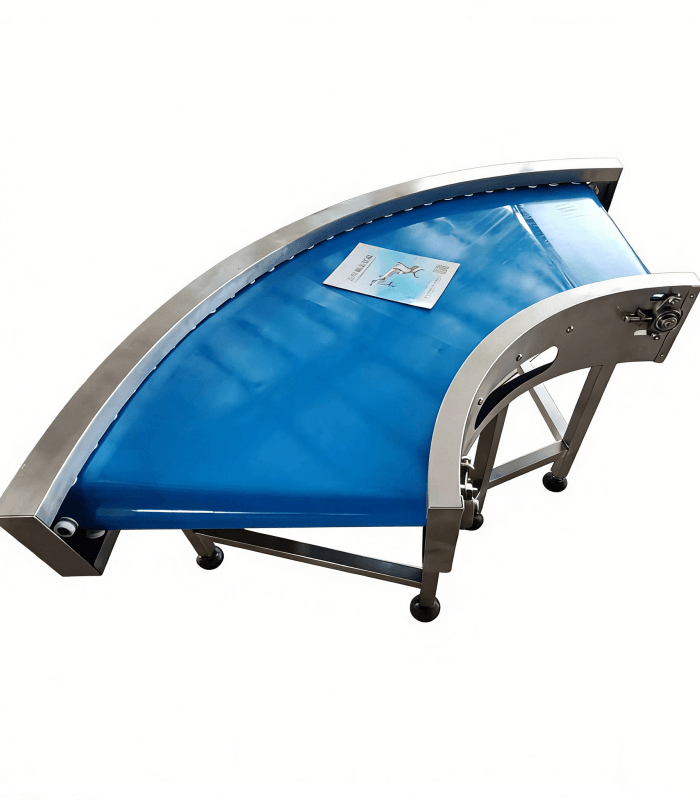
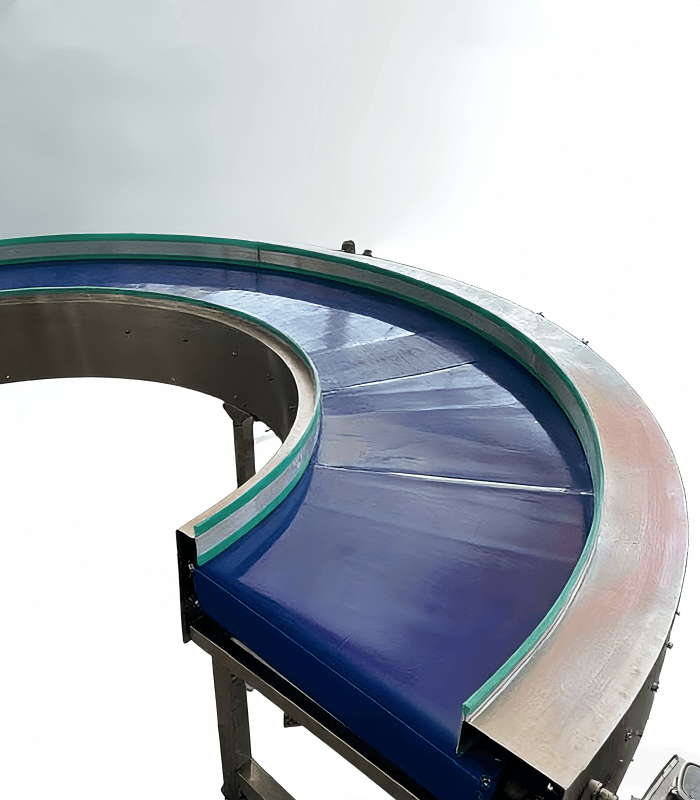
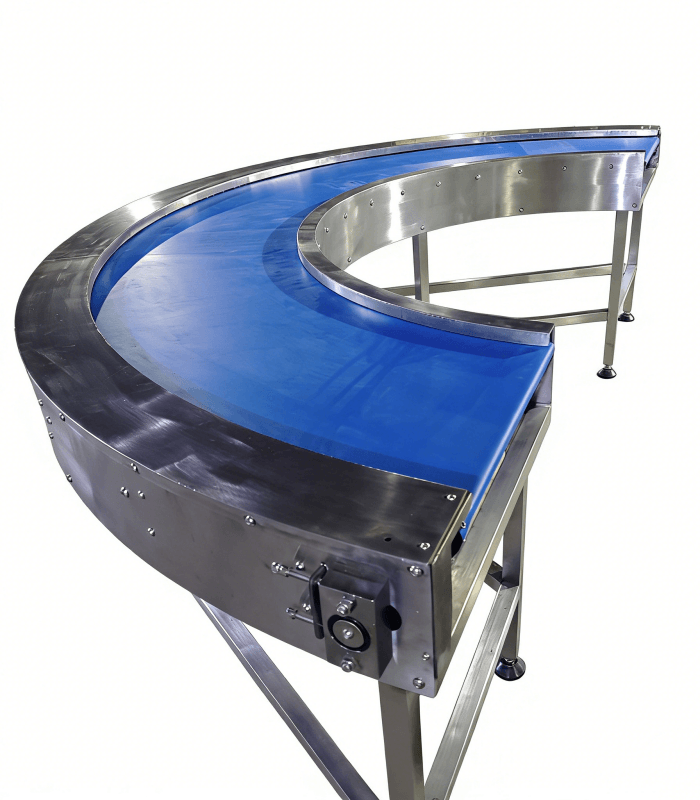
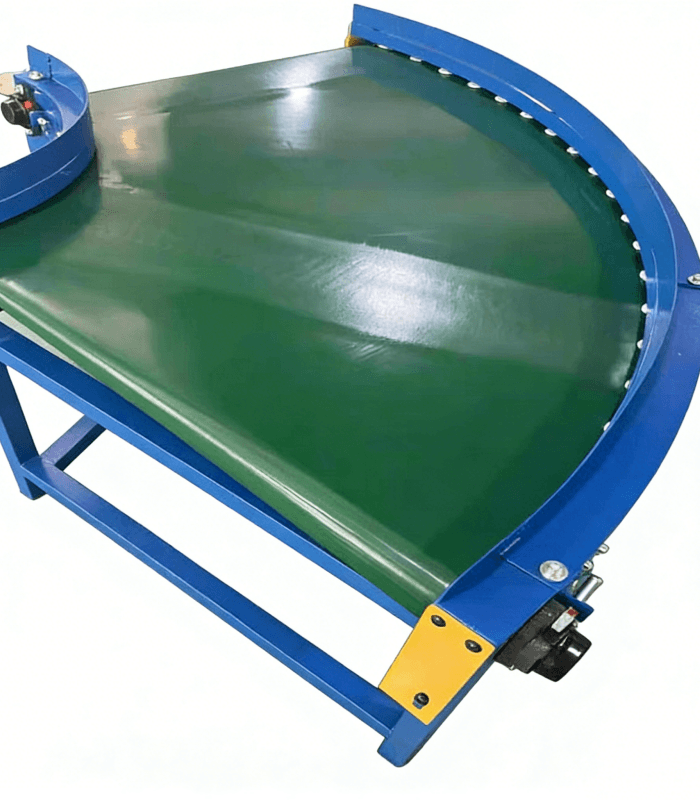
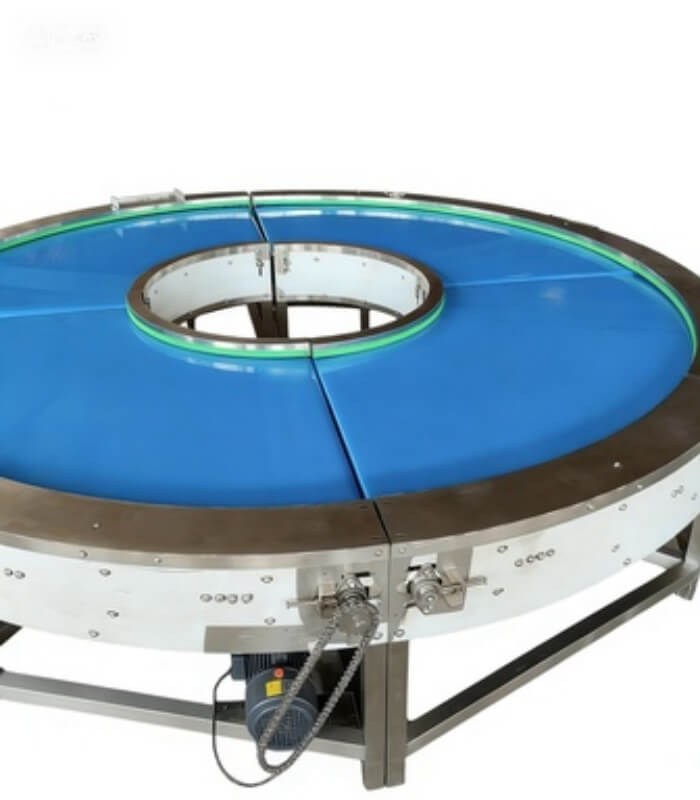
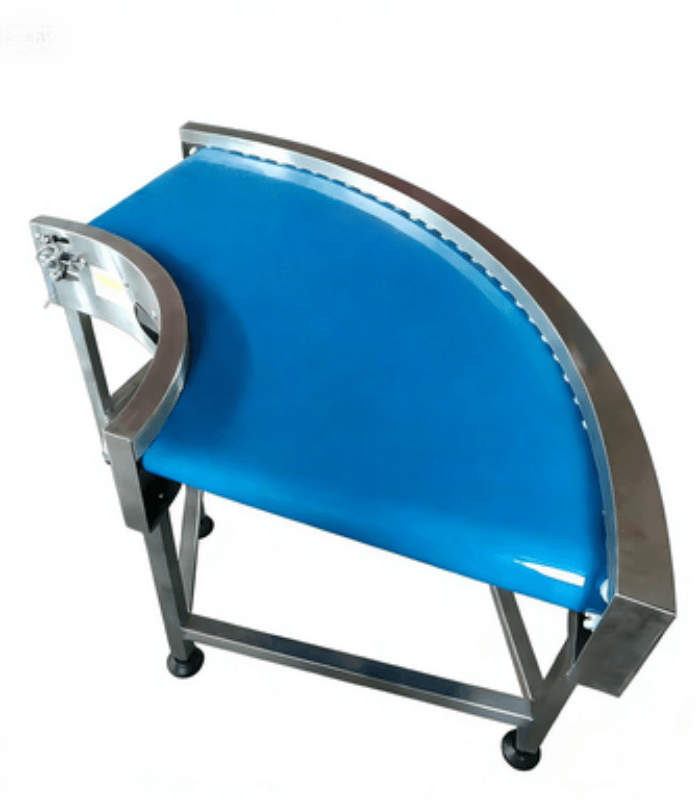
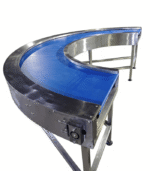
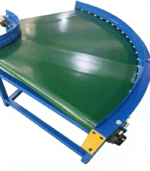
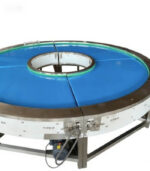
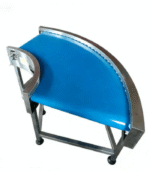
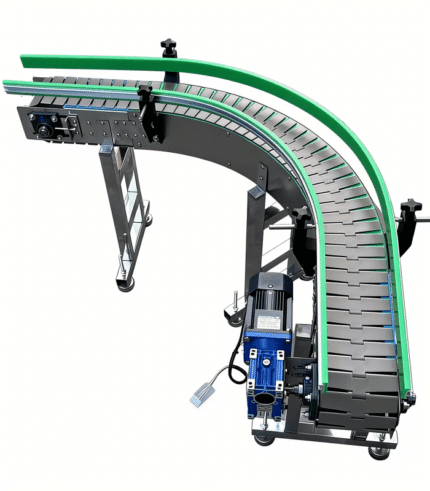
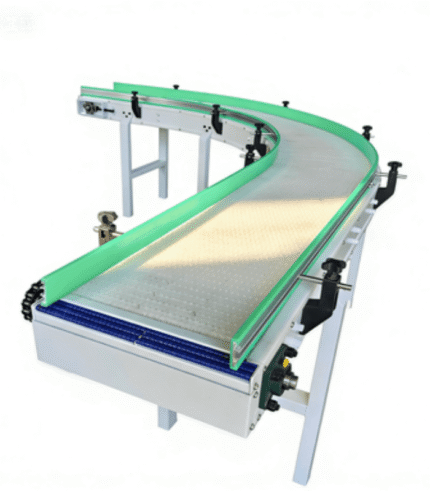
Belt turning machine, belt turning conveyor, belt turning conveyor
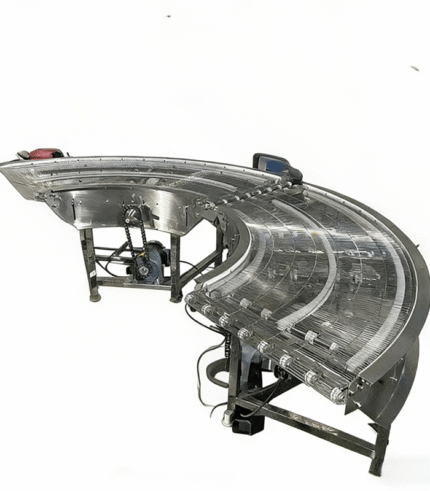
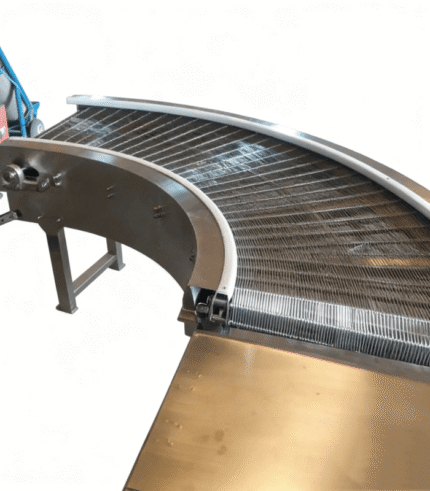
A belt turning machine is a continuous conveying device that uses a tapered drum and a segmented belt to achieve curved turns, combined with anti-drift rollers or guide ribs to ensure smooth operation.
A belt turning conveyor is a continuous conveying device that uses a V-belt, tapered rollers, and an anti-drift mechanism to ensure smooth material turning along a curved path.
—
I. Product Applications
Belt turning conveyors are widely used in applications requiring changes in conveying direction and optimized spatial layout:
1. Food and beverage industry: For conveying bottled, canned products, and food packaging; food-grade conveyor belts are available.
2. Electronics and Tobacco Industries: Used for assembly line operations involving small and medium-sized electronic products and tobacco products.
3. Pharmaceutical and Personal Care Industries: Meets cleanroom requirements for conveying pharmaceuticals, cosmetics, and similar products.
4. Logistics and Warehousing Systems: Facilitates the turning and transfer of parcels and boxes in sorting centers and warehouses.
5. Industrial Manufacturing Facilities: Used for equipment transitions and at workshop corners to save floor space.
II. Product Advantages
The core advantages of the belt turner lie in its smooth conveying and flexible layout:
1. Smooth conveying with no relative motion: There is no relative motion between the material and the conveyor belt, preventing damage to the conveyed items.
2. Low noise: Compared to equipment such as chain conveyors, it produces less noise, making it suitable for environments requiring quiet operation.
3. Simple structure and easy maintenance: It has low energy consumption, low operating costs, and is simple to maintain.
4. Flexible Layout and Space-Saving: Supports various turning angles including 30°, 45°, 60°, 90°, and 180°, enabling flow direction changes within limited spaces.
5. Diverse Materials and High Adaptability: Conveyor belts are available in PVC, PU, food-grade, and other materials to meet special requirements such as oil resistance, corrosion resistance, and anti-static properties.
6. Adjustable speed: The drive system employs a variable frequency speed control system, with a typical linear speed of approximately 30 m/min.
7. Significant energy savings: Reduces installed capacity and operational power consumption, resulting in low operating costs.
III. Product Manufacturing Process
The core of belt curve conveyor manufacturing lies in the machining of tapered drums, the design of anti-drift mechanisms, and the forming of segmented belts. The main process flow is as follows:
1. Design and Selection Phase
Key parameters are determined based on customer requirements:
· Turning angle (30°, 45°, 60°, 90°, 180°)
· Turning radius (inner radius R600, R800, R1000, R1200 mm, etc.)
· Conveyor belt width (400, 500, 600, 700, 800, 1000, 1200 mm, etc.)
· Conveying speed, load capacity, and environmental requirements
2. Machining of Key Components
(1) Sector Belts and Anti-Drift Mechanisms
Component Process/Requirements Description
Sector Belt Cut into sectors according to the turning angle, e.g., 90° sector, 180° sector Material options: PVC, PU, food-grade
Anti-Drift Roller Roller with polyoxymethylene (POM) material over the bearing Installed at the belt edge to prevent drifting
Guide ribs High-frequency welded guide ribs on the outer side of the conveyor belt to keep the belt running within dedicated guide rails
Belt tensioning device Adjustable structure to ensure proper belt tension and prevent slippage
Support rollers Positioned below the tapered drum with a narrow gap between them and the drum to apply even pressure to the belt and ensure surface flatness
(3) Frame Fabrication
Process Step Process Requirements Description
Frame Structure: Sector-shaped frame with angles matching the turning radius; modular sheet metal construction may be used
Frame Material: Carbon steel (powder-coated), stainless steel, aluminum alloy; food-grade stainless steel for versatile applications
Support Feet: Installed at all four corners with adjustable height to ensure equipment leveling
Workbench: Same height as the drum working surface to facilitate seamless transition
(4) Drive and Transmission System
Item: Specifications/Options: Description
Power Transmission Mechanism: Geared motor + gearbox + drive shaft; provides driving force
Transmission Method: Drive pulley + drive belt; transmits power to the conical drum
Drive Pulley: Located inside the first drum; drives the belt
Tension Pulley: Located inside the second drum; maintains belt tension
Speed Control Method: Variable frequency drive, stepless speed variation; speed is adjustable
Power Guard Covers the drive components; provides safety protection
3. Final Assembly and Commissioning
· Assembly: Install the frame, tapered drum, V-belt, and anti-drift mechanism in sequence
· Commissioning:
· No-load testing: Power on and run the system to check for belt misalignment and verify proper tension
· Load testing: Place standard cargo to test for smooth cornering and stable cargo movement
· Speed adjustment: Use the variable frequency drive to adjust the conveying speed to the target value (typically 30 m/min)
4. Coating and Corrosion Protection
Apply coating and corrosion protection to the frame (powder coating/baked paint). For food-grade applications, stainless steel is required and does not require coating.
IV. Summary of Key Parameters
Parameter Dimension Typical Value/Requirement
Curve Angle 30°, 45°, 60°, 90°, 180°
Curve Radius R600, R800, R1000, R1200 mm (standard)
Conveyor Belt Width 400, 500, 600, 700, 800, 1000, 1200 mm
Linear Speed Approx. 30 m/min (adjustable)
Conveyor Belt Material PVC, PU, food-grade, oil-resistant, anti-static
Frame Material Powder-coated carbon steel, stainless steel, aluminum alloy
Anti-drift mechanism: POM anti-drift rollers, high-frequency welded guide ribs
Roller type: Tapered rubber-coated rollers
Drive method: Geared motor + variable frequency speed control
Tensioning method: Belt tensioning device / tensioning roller
Applicable industries: Food, beverage, electronics, tobacco, pharmaceuticals, chemicals, logistics
V. List of Key Selection Parameters
The following information must be specified during procurement or design:
1. Curve Parameters: Curve angle (30°/45°/60°/90°/180°), curve radius (inner radius R value)
2. Conveyed Item Parameters: Item type (boxes/packages/bottles/cans), unit weight, external dimensions
3. Performance Requirements: Conveying speed (m/min), load capacity
4. Environmental Conditions: Indoor/outdoor, temperature, humidity, hygiene grade requirements
5. Material Requirements: Conveyor belt material (PVC/PU/food-grade), frame material (stainless steel/carbon steel/aluminum alloy)
6. Installation Conditions: Connection height with upstream and downstream conveyor lines, spatial dimensions
The key feature of a belt turning machine lies in the interaction between the tapered drum and the anti-drift mechanism—the tapered drum creates a speed difference between the inner and outer sides, which, combined with POM anti-drift rollers or high-frequency welded guide ribs, ensures that the belt runs smoothly and without drifting along the curved track. The following are detailed specifications and descriptions:
—
I. General Core Parameter Ranges
Parameter Item General Range Remarks
Curve Angle 30°, 45°, 60°, 90°, 180° 90° is most commonly used
Curve Radius (Inner Radius) R600mm, R800mm, R1000mm, R1200mm Customizable
Conveyor Belt Width 400mm ~ 1400mm Commonly 800/1000/1200mm
Conveyor Speed 30 ~ 150 m/min Low speed 30-72, high speed 72-150, variable frequency speed control
Operating Noise ≤72 dB (single unit)
Drive Type: Chain Drive (Motor + Gearbox + Drive Shaft)
Frame Material: Powder-coated carbon steel, stainless steel, aluminum alloy; food-grade stainless steel
Conveyor Belt Material: PVC, PU, food-grade, oil-resistant, anti-static
II. Key Component Details and Specifications
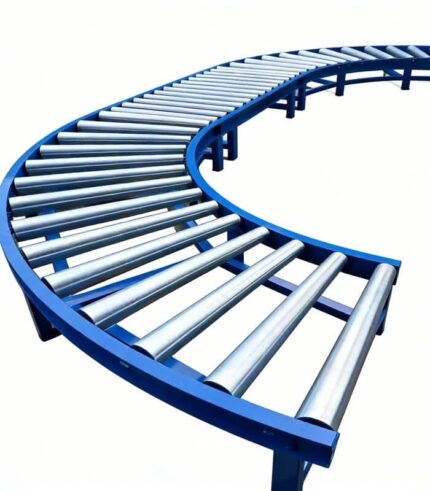
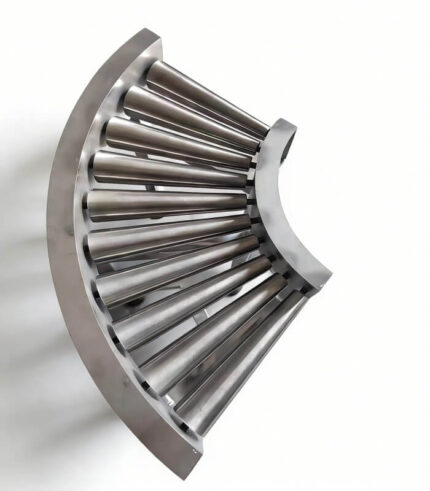
1. Tapered Roller (Core Component)
The tapered roller is the core technical component that enables belt turning; its taper design directly affects conveying stability:
Parameter Item Specifications/Requirements Description
Structural Features Tapered shape, smaller inside and larger outside Ensures the outer side of the belt has a higher linear velocity than the inner side
Surface Treatment Tapered rubber coating Increases friction to prevent slippage
Bearing Configuration Bearings installed at both ends Ensures smooth rotation
Speed Matching Principle: When cargo enters the turning section from the straight section, the outer side of the belt travels a longer distance. The tapered roller increases the rotational speed of the outer side, ensuring that the angular velocity of all points on the material relative to the center is equal, thereby guaranteeing a smooth turn without deviation.
2. Sector-Shaped Belts and Anti-Drift Mechanisms
Component Specifications/Requirements Description
Sector-Shaped Belt Cut into a sector shape according to the turning angle, e.g., 90° sector, 180° sector
Anti-Drift Rollers Bearings + polyoxymethylene (POM) rollers Installed along the belt edge to prevent drifting
Guide Ribs High-frequency welded to the outer side of the conveyor belt Keeps the belt running within dedicated guide rails
Belt Tensioning Device Adjustable structure Ensures proper belt tension and prevents slippage
3. Frame and Drive System
Component Material/Specifications Description
Frame Structure Sector-shaped frame, angle matched to the turning angle Modular sheet metal structure
Frame Machining: Brackets CNC-machined, 100% screw-assembled; surface treated with powder coating or baked paint
Drive Motor: Geared motor; can be mounted below or above the frame
Speed Control: Variable frequency drive (VFD), stepless speed control; adjustable speed
Drive Method: Chain drive; drive belts connect the shafts of each belt pulley
4. Auxiliary Function Configuration
Configuration | Function | Description
Cooling Fan | Motor cooling | Extends equipment service life
Adjustable Support Feet | Height adjustment | Installed at all four corners to ensure equipment levelness
Swivel Casters | Mobility | Equipped on some models for easy repositioning
III. Classification Parameters by Turning Angle
Turning Angle | Typical Turning Radius (mm) | Applicable Scenarios
30° R600–1200 Minor directional adjustments
45° R600–1200 Common angle for logistics diversion
60° R600–1200 Special layout requirements
90° R600–1200 L-shaped production line connection, most commonly used
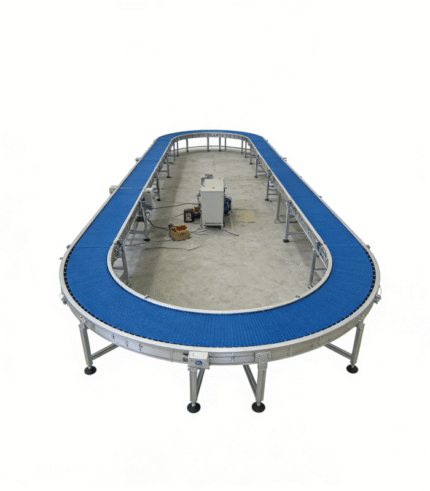
180° R600–1200 U-shaped production line or return line
IV. Conveyor Belt Material Selection
Material Features Applications
PVC (Polyvinyl Chloride) Economical and practical, good wear resistance General environments; most widely used
PU (Polyurethane) Superior wear resistance, good elasticity Light-load, high-speed applications
Food-grade conveyor belts Compliant with FDA standards, non-toxic and odorless Food, pharmaceutical, and daily chemical industries
Oil-Resistant Conveyor Belt Excellent oil resistance Oily materials, machining
Anti-Static Conveyor Belt Prevents static buildup Electronics, precision instrument industries
V. List of Key Selection Parameters
The following information must be specified during procurement or design:
1. Curve Parameters
· Curve angle (30°/45°/60°/90°/180°)
· Curve radius (inner radius R value, standard R600/800/1000/1200 mm)
· Inner and outer arc lengths
2. Conveyed Item Parameters
· Item type (boxes/bags/bottles/cans/bulk materials)
· Unit Weight (kg/unit)
· Dimensions (L × W × H)
3. Performance Requirements
· Conveyor speed (m/min); typically around 30 m/min
· Load capacity
4. Environment and Materials
· Indoor/outdoor, temperature, humidity
· Hygiene grade requirements (food/pharmaceutical applications require food-grade conveyor belts + stainless steel frames)
· Conveyor belt material (PVC/PU/food-grade/oil-resistant/anti-static)
· Frame material (powder-coated carbon steel/stainless steel/aluminum alloy)
5. Installation Conditions
· Conveyor surface height requirements
· Dimensions for interfacing with upstream and downstream conveyor lines
· Whether mobility is required (swivel casters)
VI. Summary
Parameter Dimension Typical Values/Requirements
Core Selection Criteria Turning angle, turning radius, cargo weight, hygiene requirements
Turning angle 30°/45°/60°/90°/180°
Curve Radius R600/800/1000/1200 mm
Conveyor Belt Width 400–1400 mm (Common: 800/1000/1200)
Conveyor Speed 30–150 m/min (Standard: 30)
Conveyor Belt Material: PVC, PU, food-grade, oil-resistant, anti-static
Frame Material: Powder-coated carbon steel, stainless steel, aluminum alloy
Anti-drift Mechanism: POM anti-drift rollers, high-frequency welded guide ribs
Roller Type: Tapered rubber-coated rollers
Drive System: Geared motor + chain drive, variable frequency speed control
Special Features: Height-adjustable, casters for mobility, motor cooling


评价
目前还没有评价