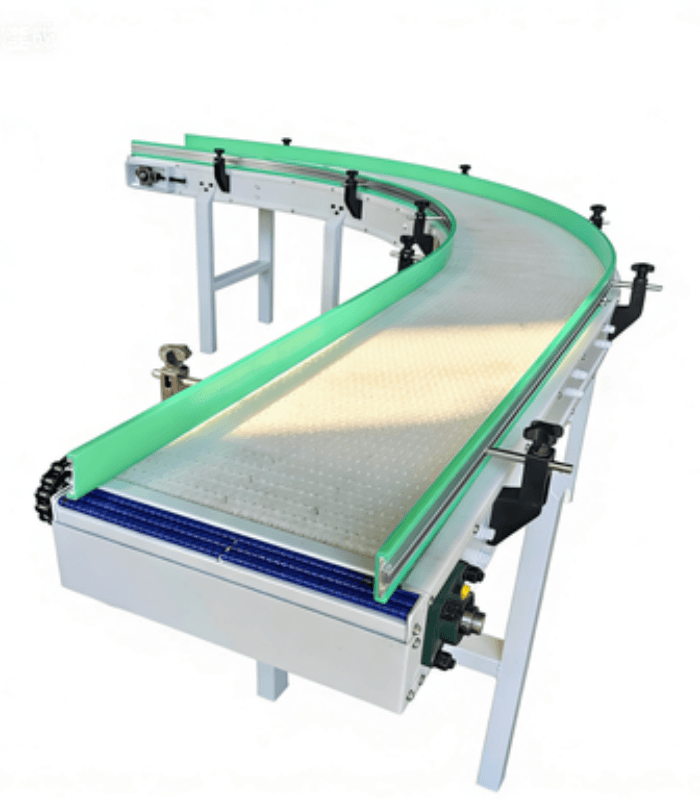
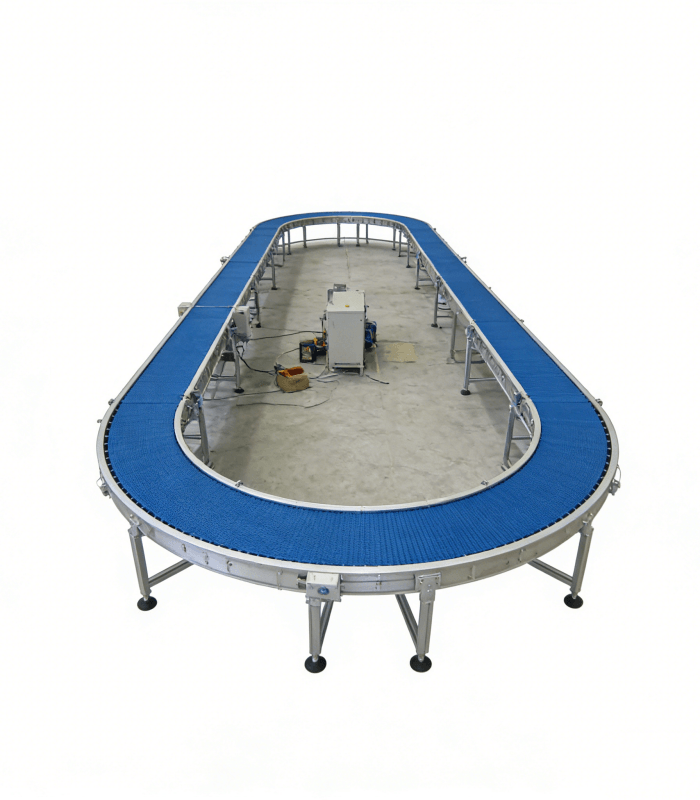
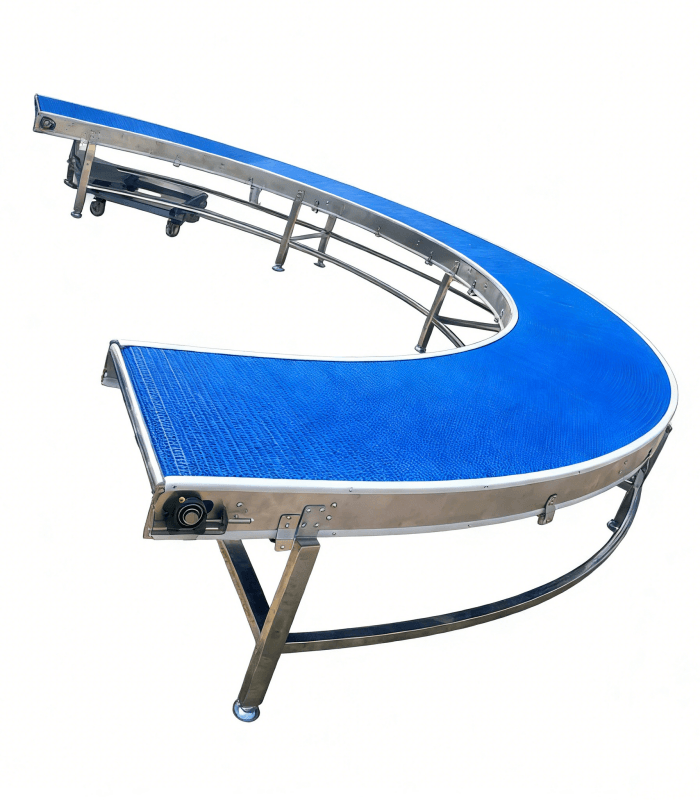
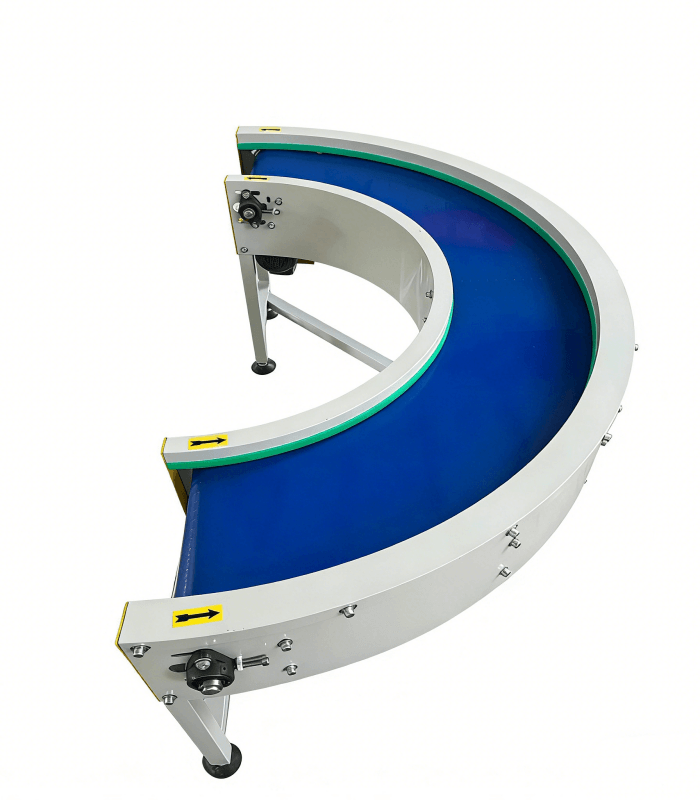
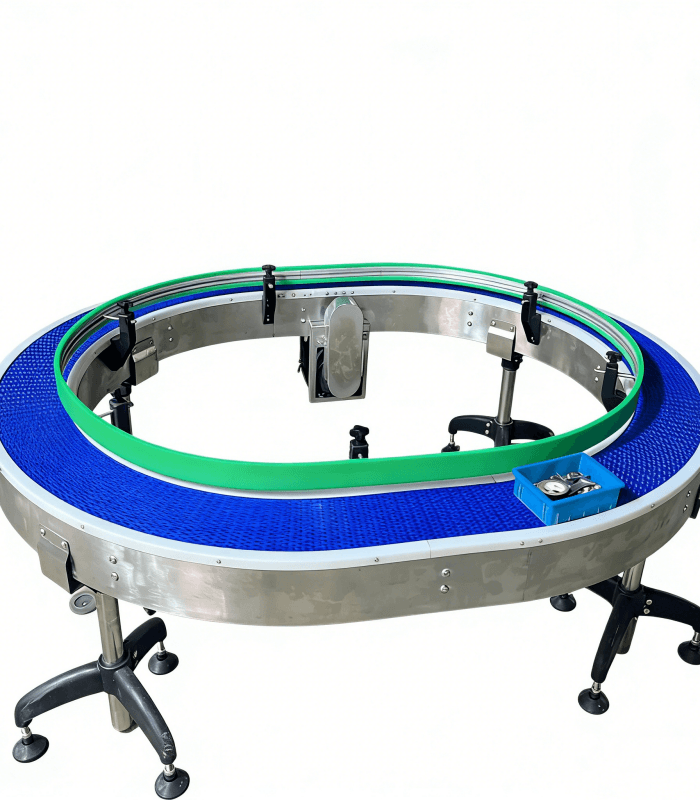
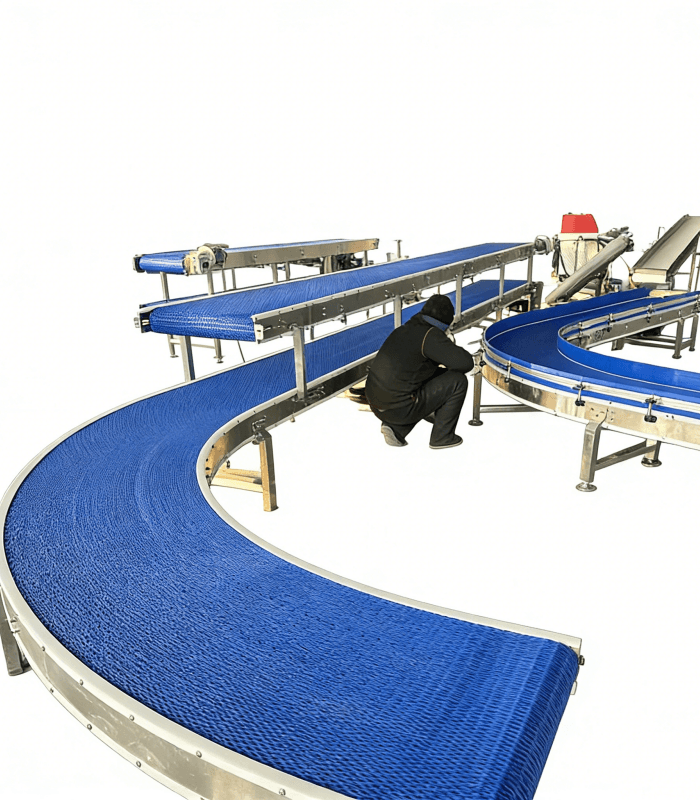
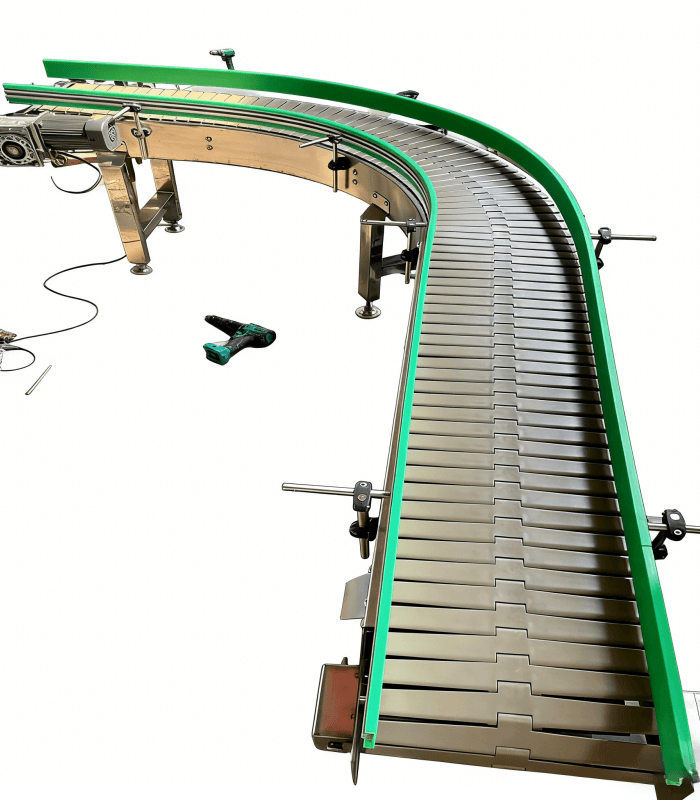
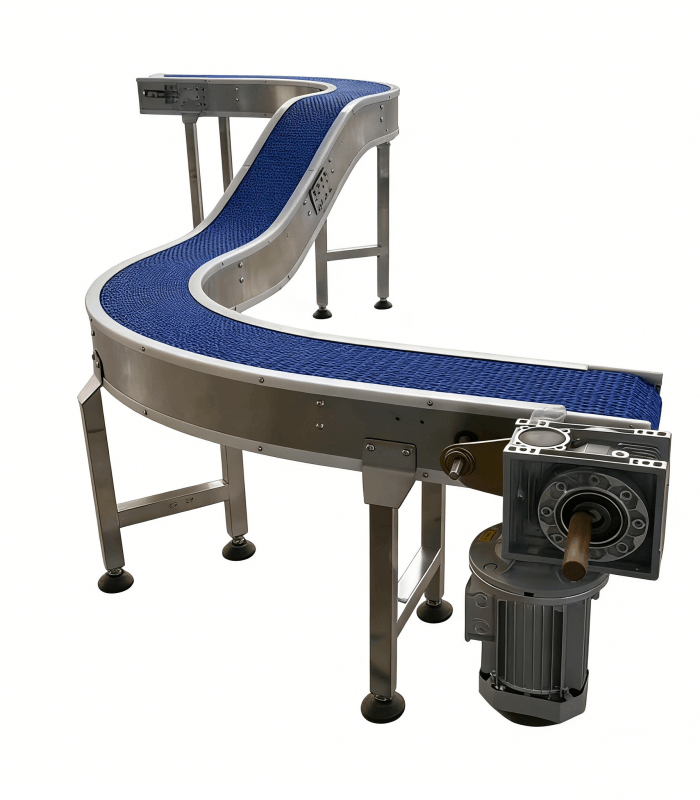
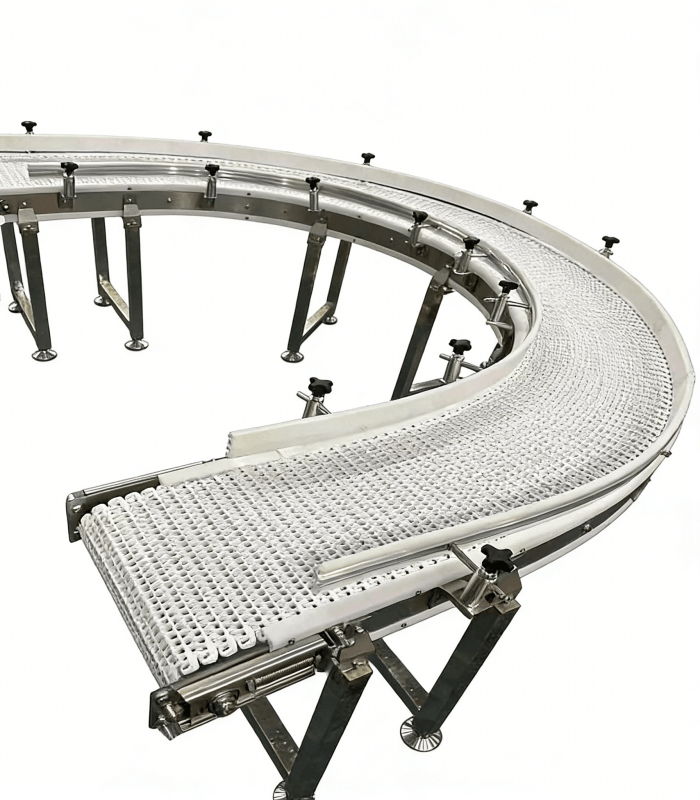
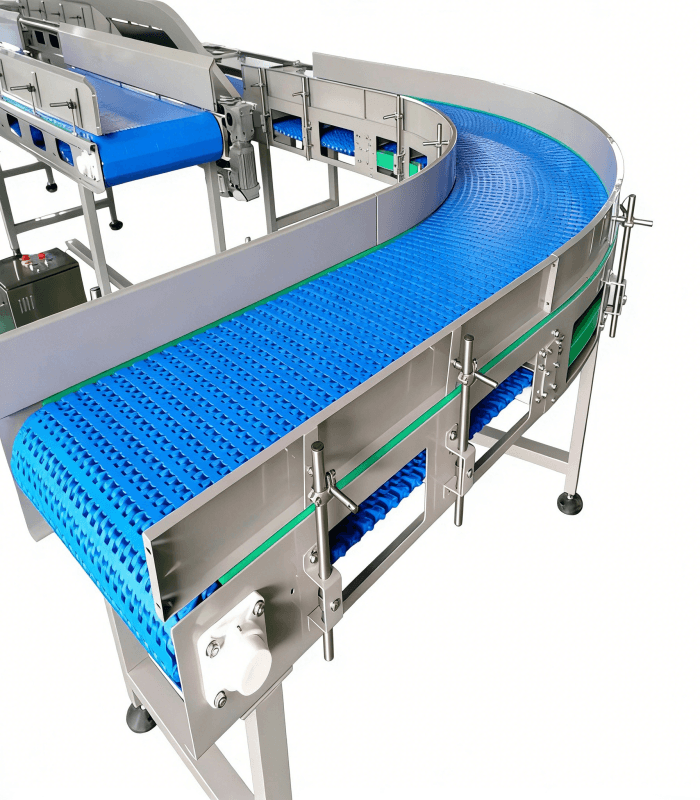
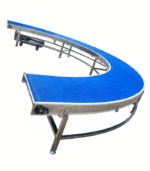
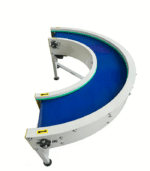
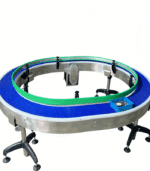
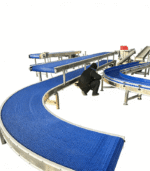
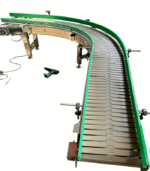
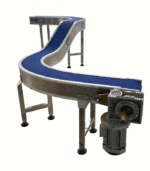
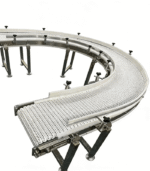
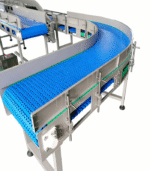
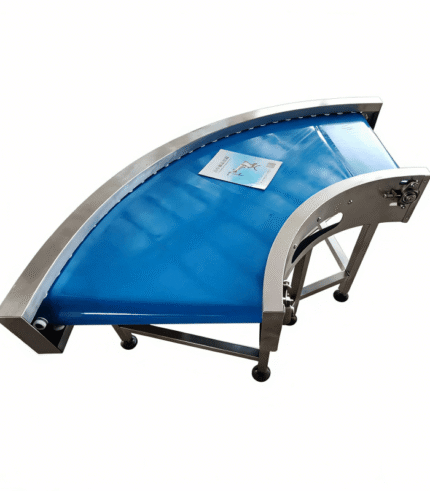
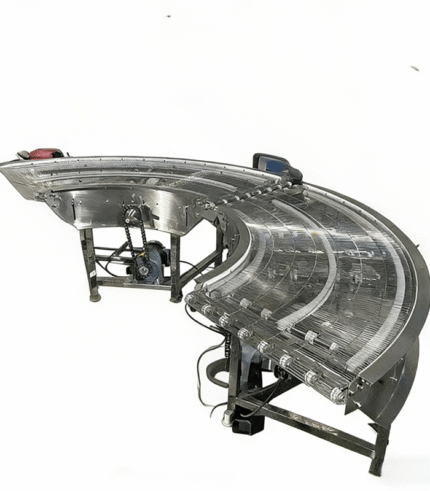
Plastic mesh belt curve conveyor, plastic chain plate curve conveyor, plastic module curve conveyor
The plastic mesh belt curve conveyor is a conveying system that utilizes modular injection-molded mesh belts and multi-pitch splicing technology to achieve corrosion resistance, easy cleaning, and smooth, low-noise curved turns.
A plastic mesh belt curve conveyor is a conveying system that utilizes modular plastic mesh belts and sprocket drives. It achieves smooth, curved turns by employing belts with different pitch lengths on the inner and outer sides or special tracks, and features corrosion resistance, ease of cleaning, and low noise.
—
I. Product Applications
Plastic mesh belt turners are widely used in industries with high requirements for hygiene, corrosion resistance, and smooth operation:
1. Food and Beverage Industry: Used for the curved conveyance of meat, seafood, vegetables, fruits, frozen foods, puffed snacks, beverage bottles, and canned goods. It can withstand high-temperature (cooking, sterilization) and low-temperature (quick-freezing) operating conditions.
2. Pharmaceutical and Personal Care Industries: Used for the automatic conveyance of pharmaceuticals, cosmetics, and cleaning products. Compliant with GMP hygiene standards, the conveyor belt’s structure is free of pores and gaps, making it resistant to contaminant adhesion.
3. Electronics and Light Industry: Used for assembly line operations involving electronic components, batteries, rubber and plastic products, paper products, and tobacco.
4. Complex Automation Systems: Can be integrated with in-line automatic inspection, rejection, lane merging and splitting, labeling, and automatic palletizing equipment to form complex automated conveying and packaging systems.
II. Product Advantages
The core advantages of plastic mesh belt turners lie in their material properties and structural reliability:
1. Corrosion resistance and high/low temperature tolerance: Mesh belt materials include PP (polypropylene), PE (polyethylene), POM (polyoxymethylene), and NYLON (nylon), offering excellent resistance to acids and alkalis with an operating temperature range of -50°C to 190°C.
2. Hygienic and Easy to Clean: The modular plastic mesh belts are integrally molded with a seamless, pore-free construction that prevents penetration by contaminants such as blood, water, or grease. They are easy to clean and comply with FDA/USDA food-grade standards.
3. Smooth Operation and No Drift: Utilizing sprocket drive and traction, the system effectively prevents slippage, stretching, and edge damage, ensuring the conveyor belt does not snake or deviate.
4. Impact-Resistant and Durable: The plastic mesh belt is thick and sturdy, withstanding cuts and impacts, and overcomes the drawbacks of traditional belts prone to tearing, puncturing, and corrosion.
5. Flexible Layout and Space-Saving: Supports various turning angles including 45°, 60°, 90°, and 180°, and can be integrally molded with straight sections, eliminating the need for additional transition segments.
6. Simple Maintenance and Low Replacement Costs: The modular structure allows for the replacement of individual sections when damaged, eliminating the need to dismantle the entire line and making maintenance convenient.
III. Product Manufacturing Process
The core of plastic mesh belt curve conveyor manufacturing lies in the injection molding of the mesh belt and the precision welding of the frame. The main process flow is as follows:
1. Design and Selection Phase
Key parameters are determined based on customer requirements:
· Turning angle (45°, 60°, 90°, 180°, etc.)
· Turning radius (inner radius R value)
· Mesh belt width, pitch, and open area ratio
· Conveyor speed, load capacity, and environmental requirements (temperature, corrosion resistance, hygiene grade)
Design principle for turning radius: The minimum radius for standard turns is approximately 2.3 to 2.5 times the belt width (R ≥ W × 2.3).
2. Key Component Manufacturing
(1) Plastic Mesh Belt Injection Molding (Core Technology)
Plastic mesh belts utilize a modular injection molding process, in which injection-molded belt modules are assembled into interlocking units via plastic hinge pins extending across the entire width.
Item Specifications/Parameters Description
Belt Pitch 12.7, 15.2, 19.05, 25.4, 27.2, 38.1, 46, 50.8, 52, 57.15 mm Multiple pitches available
Open Area Ratio 2% ~ 48% Select as needed
Material Options POM, PP, PE, Acetal, Nylon POM: wear-resistant; PP: acid and alkali resistant; Nylon: high strength
Belt Types Flat, Flat-Slot, Curved, Ribbed, Ball-Bearing Curved belts feature a specialized structure
Special Design for Curved Conveyor Belts (Multi-Pitch Technology): Modular belts with different pitches are joined together, with smaller pitches on the inner side (smaller turning radius) and larger pitches on the outer side (larger turning radius). The surface requires no perforations, making it suitable for conveying items such as pallets, crates, and film-wrapped bags.
(2) Frame Fabrication
Process Technical Requirements Notes
Frame Cutting Laser cutting of 3mm-thick metal plate High precision, accurate curves
Frame Welding TIG welding Strong, aesthetically pleasing welds
Uprights Stainless steel square tubing 40×60×1.5mm Food-grade requirements
Frame Material Stainless steel (304), aluminum profiles, powder-coated carbon steel Stainless steel suitable for food and pharmaceutical applications
Surface Treatment Powder coating/baking paint/polishing Corrosion and rust resistance
(3) Drive and Transmission System
Item Specifications/Options Notes
Drive Method Geared motor drive Sprocket-driven mesh belt
Speed Control Variable frequency drive, stepless speed variation Adjustable speed
Sprocket Machined one-piece gear Tooth count: 12/15/18/28; optional round or square holes
Drive Shaft: Unique square shaft design provides optimal torque and prevents slippage
3. Final Assembly and Commissioning
· Assembly: Install the frame, sprockets, mesh belt, and drive unit in sequence; interlock the mesh belt into a closed loop using hinge pins
· Commissioning:
· No-load testing: Power on and run the system to check for smooth operation and any belt misalignment
· Load Testing: Place standard cargo to test whether turns are smooth and cargo remains stable
· Speed Adjustment: Use a variable frequency drive to adjust the conveying speed to the target value
4. Special Feature Configurations
Configuration Function Description
Lifting Baffle Prevents material from sliding down Suitable for uphill sections
Side Baffles Prevents material from falling off the sides Essential on the outer side of turns
Easy-Clean System: Customized jet cleaning; can reduce cleaning time and water consumption by up to 65%
IV. Summary of Core Parameters
Parameter Dimension Typical Value/Requirement
Curve Angle 45°, 60°, 90°, 180° (Any angle can be customized)
Curve Radius R ≥ Belt Width × 2.3 ~ 2.5
Belt Pitch 12.7 ~ 57.15 mm (Multiple specifications available)
Belt Width 300–1000 mm (Customizable)
Open Area Ratio 2% ~ 48%
Conveyor Speed 5–15 m/min (Standard), adjustable
Operating Temperature -50°C ~ 190°C (Depends on material)
Conveyor Belt Material: POM, PP, PE, Acetal, Nylon
Frame Material: 304 Stainless Steel, Aluminum Profiles, Powder-Coated Carbon Steel
Drive Type: Geared Motor + Sprocket Drive
Speed Control: Variable Frequency Drive (VFD), Stepless Speed Variation
Applicable Industries: Food, Beverage, Pharmaceuticals, Cosmetics, Electronics, Tobacco, Chemicals
V. List of Key Selection Parameters
The following information must be specified during procurement or design:
1. Curve Parameters: Curve angle (45°/90°/180°, etc.), curve radius (inner radius R value)
2. Conveyed Item Parameters: Item type (boxes/bottles/cans/bulk materials/meat/poultry), unit weight, external dimensions
3. Performance Requirements: Conveying speed (m/min), load capacity, whether incline is required
4. Environmental conditions: Temperature range (ambient/high-temperature sterilization/low-temperature quick-freezing), humidity, acid/alkali corrosion resistance
5. Material requirements: Mesh belt material (POM/PP/PE/NYLON), frame material (stainless steel/aluminum profiles/carbon steel)
6. Special features: Whether lifting guards, side guards, or an easy-clean system are required
The key feature of the plastic mesh belt curver lies in the integration of modular injection-molded mesh belts with multi-pitch splicing technology. By splicing together mesh belt modules with different pitches (smaller pitches on the inner side and larger pitches on the outer side), the system enables smooth curved turns without any surface openings, while offering corrosion resistance, ease of cleaning, and low maintenance costs.
—
I. General Core Parameter Ranges
Parameter Item General Range Remarks
Curve Angle 30°, 45°, 60°, 90°, 180°, Customizable to any angle 90° is most commonly used
Curve Radius (Inner Radius) R ≥ Belt Width × 2.3 ~ 3.5 Varies by belt series
Belt Width 300 mm ~ 1000 mm (customizable) Carrier width: 152.4–800 mm
Belt Pitch 12.7, 19.05, 25.4, 27.2, 38.1, 46, 50.8, 52, 57.15 mm Multiple pitches available
Open Area Ratio: 2% to 55% (up to 55% for flat-mesh type)
Conveyor Speed: 1 to 35 m/min (fixed speed / stepless speed control / variable frequency speed control)
Conveyor Length: 1,500 mm to 20,000 mm (measured from centerline)
Conveyor Deck Height: 150 mm to unlimited (suitable for overhead installation)
Operating Temperature: -10°C to 120°C (standard), 4–105°C (PP material); POM low-temperature: 4–80°C, PP low-temperature: 5–105°C
Drive Power: 0.37 kW to 3.7 kW
Working Load: 15,000 to 30,000 N/m 7100 Series Specifications
II. Key Component Details and Specifications
1. Plastic Mesh Belt (Core Load-Bearing Component)
The plastic mesh belt utilizes a modular injection molding process, assembling injection-molded belt modules into interlocking units via plastic hinge pins extending across the entire width.
Belt Types and Specifications:
Belt Series Pitch (mm) Thickness (mm) Open Area Ratio Minimum Turning Radius Working Load (N/m) Operating Temperature (°C)
7100 Curved Flat Mesh Type 25.4 13 55% R = 2.3×W 30,000 (POM)/15,000 (PP) POM: 4–80 / PP: 5–105
6200 Series — — — R = 2.7×W — —
F-SNB Series — — — R = 3.3×W — —
2200 Series — — — R = 3.5×W — —
YS2000 Series Multi-pitch splicing — No openings Customizable — —
Conveyor Belt Material Selection:
Material Features Operating Temperature Applications
POM (Polyoxymethylene) Excellent wear resistance, high rigidity, self-lubricating 4°C ~ 80°C Beverage industry, general applications
PP (Polypropylene) Acid and alkali resistant, chemical corrosion resistant 5°C ~ 105°C Food contact applications, chemical environments
PE (Polyethylene) Low-temperature resistance, good flexibility -50°C ~ 80°C Frozen food conveying
ACETAL (Acetal) High strength, wear resistance — General-purpose applications
NYLON (Nylon) Extremely high strength, impact resistance — Heavy-duty or high-wear applications
2. Special Design of Curved Conveyor Belts
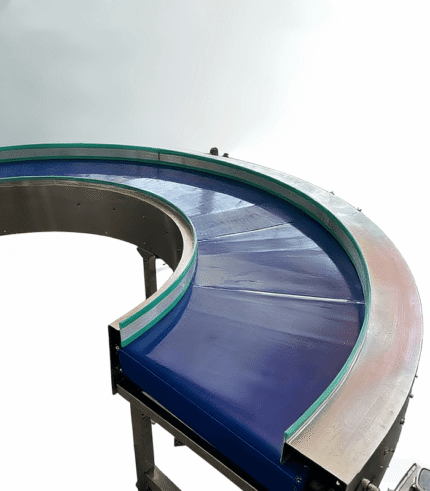
(1) Multi-pitch Splicing Technology (Curved Conveyor Belts Without Openings)
Conventional curved conveyor belts achieve curvature through large openings on their surface, whereas multi-pitch curved conveyor belts are created by splicing together modular belts of different pitches:
· Small-pitch section: Located on the inner side, with a small turning radius
· Large-pitch section: Located on the outer side, with a large turning radius
· No surface openings: Smooth and stable, suitable for conveying items such as pallets, crates, and film-wrapped bags
· Drive requirements: Different-pitch sections require belt sprockets of different sizes
(2) Flat-mesh Curved Conveyor Belt (7100 Series)
Flat-mesh belts feature a high open area ratio (55%), facilitating ventilation and drainage, and are widely used in the beverage and food industries.
3. Frame and Structure
Component Material/Specifications Description
Frame Thick metal plate, laser-cut and TIG-welded Precise curvature, strong welds
Uprights Stainless steel square tubing 40×60×1.5mm Food-grade requirements
Frame Material: 304 stainless steel, aluminum profiles, powder-coated carbon steel; stainless steel for food and pharmaceutical applications
Structure Type: Horizontal straight, lifting/incline, and integrated curved sections; curved and straight sections formed as a single unit
4. Drive and Transmission System
Item Specifications/Options Description
Drive Method Sprocket drive Prevents slippage, stretching, and edge damage
Speed Control Fixed speed, stepless speed adjustment, variable frequency speed control
Gear Motor Can be mounted under or on top of the equipment Customizable as needed
Power Supply 380V 50Hz Standard industrial power supply
III. Classification Parameters by Turning Angle
Curve Angle | Application | Description
30° | Minor directional adjustments | Customizable
45° | Logistics diversion | Standard specification
60° | Special layout requirements | Customizable
90° | L-shaped production line connection | Most commonly used specification
180° | U-shaped production line or return line | Customizable
360° | Circular conveying | Composed of two 180° units
IV. List of Key Selection Parameters
The following information must be clarified during procurement or design:
1. Curve Parameters
· Curve angle (30°/45°/60°/90°/180°/360°)
· Curve radius (inner radius R value; relationship between standard and belt width)
· Belt series selection (affects the curve radius coefficient)
2. Conveyed Item Parameters
· Item Type (Boxes/Bottles/Cans/Pallets/Bulk Materials)
· Unit Weight (kg/piece) or Load per Unit Length
· Dimensions (Length × Width × Height)
· Requirement for a Surface Without Openings (e.g., pallets, film-wrapped bags)
3. Performance Requirements
· Conveyor Speed (m/min)
· Speed Control Method (Constant Speed/Variable Frequency/Stepless)
· Load Capacity (N/m)
4. Environment and Materials
· Operating Temperature Range (Ambient Temperature/High-Temperature Sterilization/Low-Temperature Quick-Freezing)
· Corrosion Resistance Requirements (PP material required for acidic or alkaline environments)
· Hygiene Grade Requirements (FDA certification required for food and pharmaceutical applications)
· Conveyor belt material (POM/PP/PE/Acetal/Nylon)
· Frame material (Stainless steel/Powder-coated carbon steel/Aluminum profiles)
5. Installation Requirements
· Conveyor surface height requirements
· Dimensions for interfacing with upstream and downstream conveyor lines
· Need for guardrails and their type
V. Summary
Parameter Dimension Typical Values/Requirements
Core Selection Criteria Turning angle, turning radius (related to the mesh belt width coefficient), cargo type, hygiene requirements
Turning angle 30°/45°/60°/90°/180°/360°
Curve Radius Coefficient 2.3 ~ 3.5 (depending on belt series); 2.3×W for the 7100 series
Belt Width 300–1000 mm (customizable up to 800 mm)
Belt Pitch 12.7–57.15 mm (various specifications)
Open Area Ratio 2%–55% (up to 55% for flat-mesh type)
Conveyor Speed 1–35 m/min
Operating Temperature -10°C to 120°C (standard); 5–105°C for PP material; 4–80°C for POM material
Working Load 15,000–30,000 N/m (7100 series)
Drive Power 0.37–3.7 kW
Belt Material: POM, PP, PE, Acetal, Nylon
Frame Material: 304 Stainless Steel, Aluminum Extrusions, Powder-Coated Carbon Steel
Drive Type: Sprocket Drive (Anti-slip, Anti-drift)
Special Features: Multi-pitch splicing (perforation-free turns), integrated turn structure, modular and replaceable
Single-unit Length: 1,500–20,000 mm (measured along the centerline)


评价
目前还没有评价