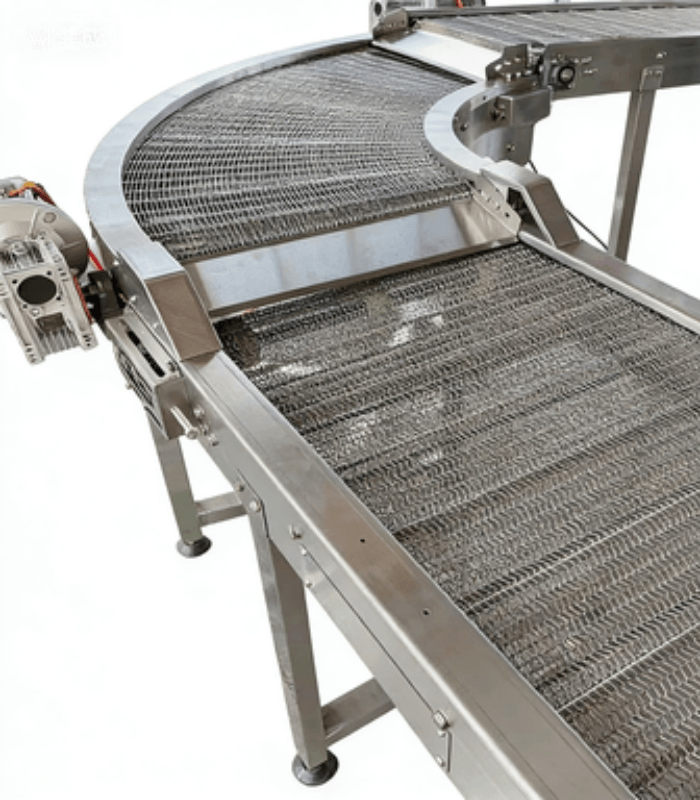
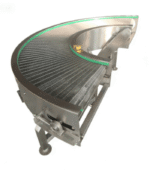
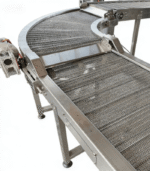
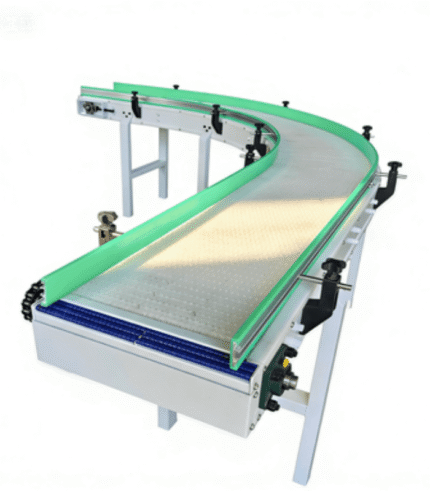
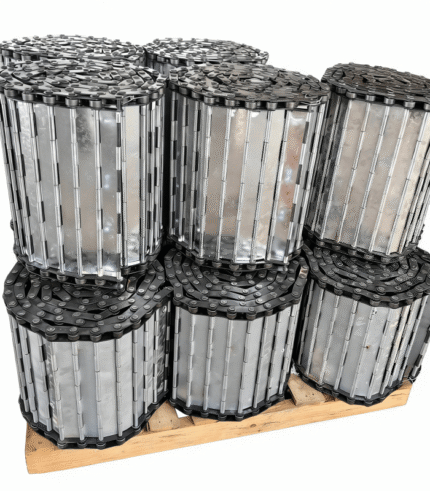
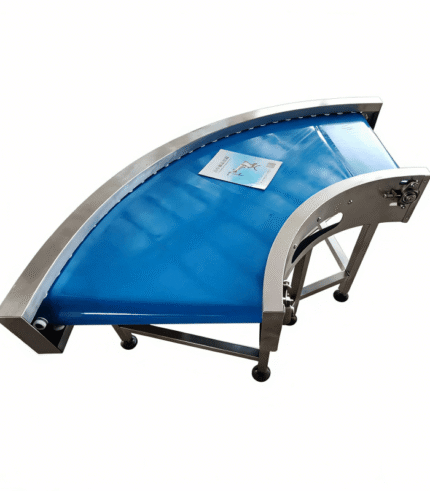
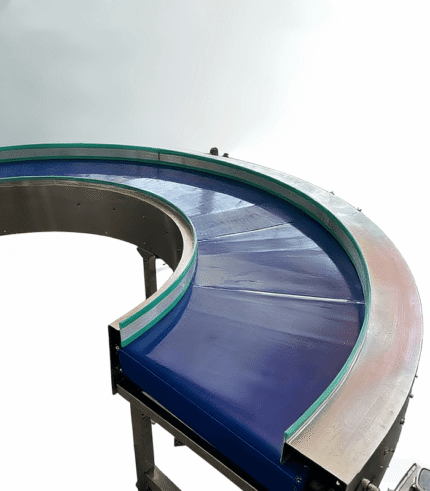
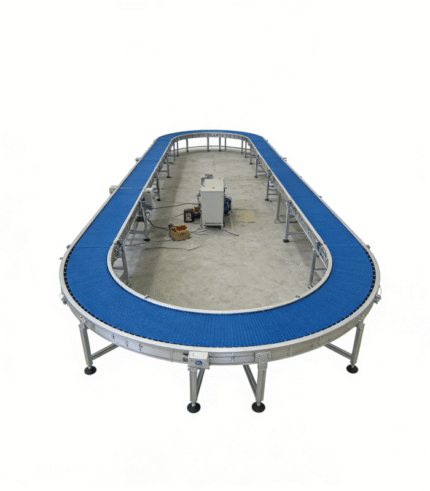
Metal Mesh Belt Curved Conveyor, Stainless Steel Mesh Belt Curved Conveyor, Mesh Chain Curved Conveyor
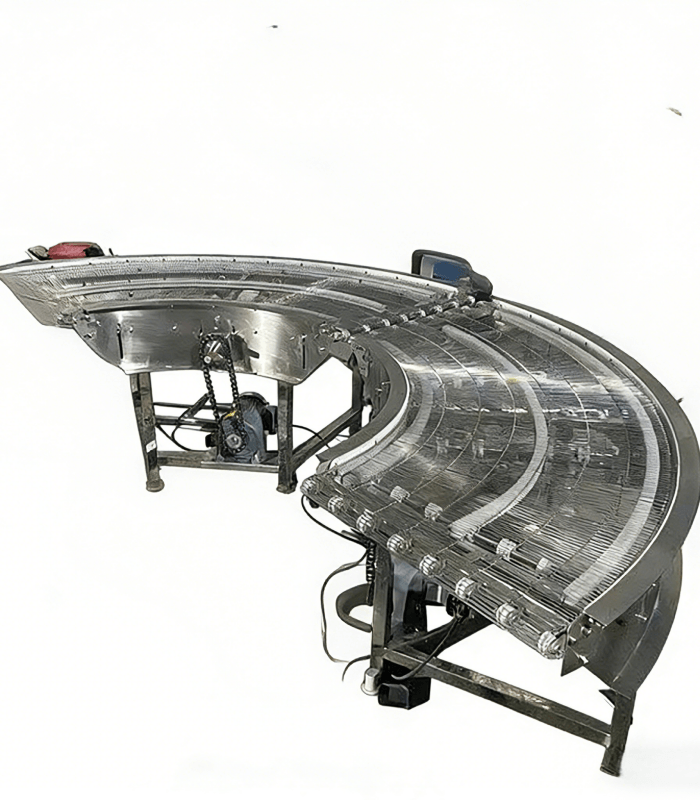
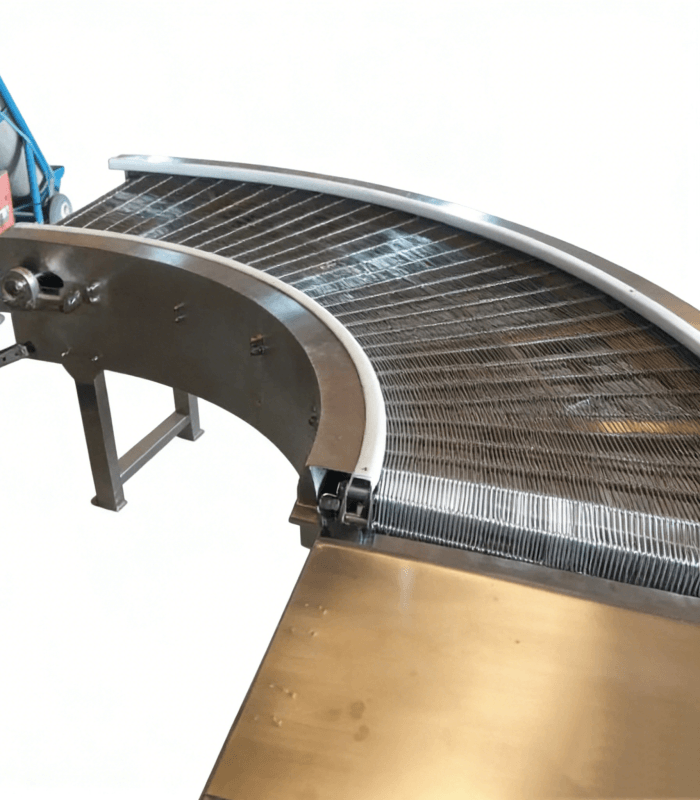
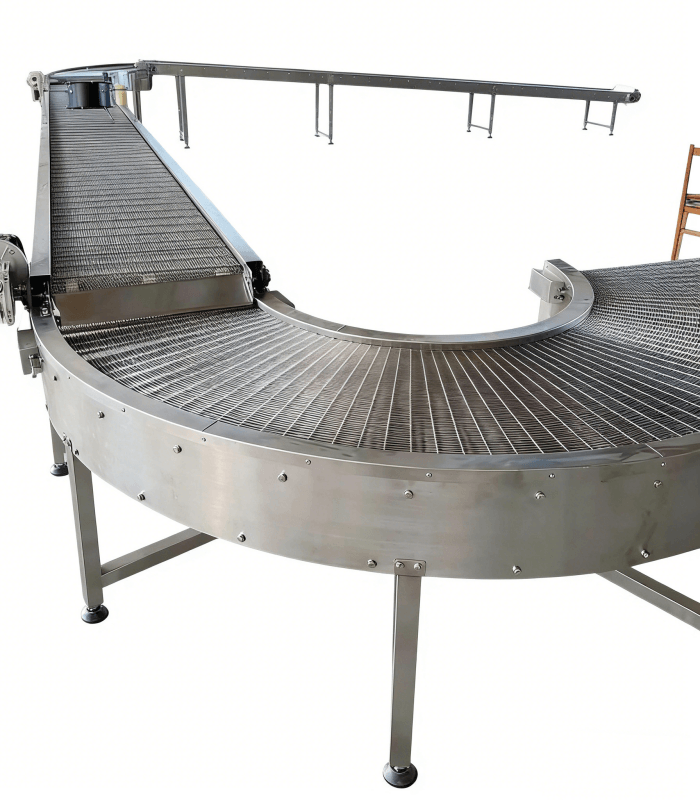
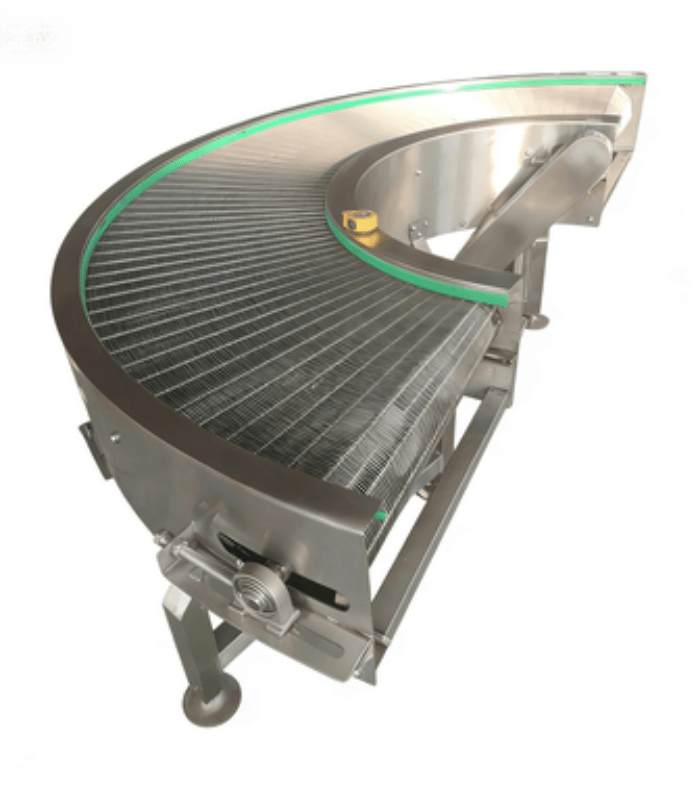
A metal mesh belt curving conveyor is a conveying system that utilizes chains with varying pitch to create a speed differential between the inner and outer sides. Combined with stainless steel mesh belts and guide rollers, it achieves high-temperature resistance, corrosion resistance, and precise, drift-free curved turning.
A metal mesh belt turner is a heavy-duty conveying system that uses a metal mesh belt (made of materials such as stainless steel) as the conveying medium. Driven by sprockets, it enables smooth, curved turns. It features high-temperature resistance (up to 600°C), high strength, corrosion resistance, and excellent air permeability.
—
I. Product Applications
Metal mesh belt turners are widely used in applications requiring high-temperature resistance, high strength, corrosion resistance, and air permeability:
1. Food Processing Industry: Used in drying, steaming, frying, washing, and quick-freezing processes for meat, seafood, vegetables, fruits, and frozen foods; capable of withstanding both high and low-temperature environments.
2. Heat Treatment and Baking Industry: Suitable for the heating and baking conveyance of electronic components and food products; the metal mesh belt withstands high temperatures, overcoming the disadvantages of conventional belts prone to tearing, puncturing, and corrosion.
3. Pharmaceutical and daily chemical industries: Used for conveying pharmaceuticals and cosmetics; the metal material is hygienic, easy to clean, and highly corrosion-resistant.
4. Logistics and packaging industries: Used for curved conveyance of cartons, packaging bags, and other unit loads, enabling changes in spatial flow direction and saving factory floor space.
5. Ultrasonic cleaning equipment: Metal mesh belts can be used in conjunction with cleaning equipment; they are water-resistant and corrosion-resistant.
II. Product Advantages
The core advantages of the metal mesh belt curve conveyor lie in its high-temperature resistance and high-strength structure:
1. Excellent high-temperature resistance: Capable of conveying materials at temperatures below 600°C, suitable for high-temperature applications such as clinker handling, baking, and heat treatment.
2. High conveying capacity: Maximum conveying capacity reaches 526 m³/h, with a maximum incline of 60 degrees, meeting high-volume conveying demands.
3. High Strength and Long Service Life: The conveyor belt is made of metal (stainless steel), offering high strength, minimal elasticity, and resistance to deformation. The drive chain is constructed from heat-treated alloy steel, ensuring wear resistance and durability.
4. Corrosion Resistance and Hygienic Design: The stainless steel material resists acids, alkalis, and corrosion. With no pores or gaps, it does not easily adsorb impurities and complies with food hygiene standards.
5. Flexible Layout and Space-Saving: Supports various turning angles including 45°, 90°, 180°, and 360°, enabling material diversion in confined spaces. Multiple horizontal and inclined sections can be combined in various configurations.
6. Low Energy Consumption: Load-bearing rollers use rolling bearings (replacing sliding friction with rolling friction), reducing operational resistance by 55%–65% and minimizing power consumption.
7. Minimal deviation: Utilizes sprocket drive transmission, preventing the conveyor belt from meandering or deviating, ensuring stable and reliable operation.
III. Product Manufacturing Process
The core of manufacturing metal mesh belt turners lies in the coordination of metal mesh belt forming, precision frame welding, and the sprocket drive system. The main process flow is as follows:
1. Design and Selection Phase
Determine key parameters based on customer requirements:
· Turning angle (45°/90°/180°/360°, etc.)
· Turning radius (inner radius R value; minimum turning radius ≈ belt width × 2.3)
· Belt width, pitch, and material
· Conveying speed, load capacity, and environmental requirements (temperature, corrosiveness)
2. Key Component Manufacturing
(1) Metal Mesh Belt Manufacturing (Core Component)
The metal mesh belt is the core load-bearing component of the turning conveyor. Its manufacturing process includes:
Item Specifications/Parameters Description
Mesh Belt Material Stainless Steel (304/316L), Carbon Steel Stainless steel is commonly used for food-grade and high-temperature applications
Mesh Belt Type Shaft-driven mesh belt, Sprocket-driven mesh belt Sprocket-driven systems offer greater stability
Conveyor Belt Structure Spiral, bar-chain, flat-plate Select based on airflow and load-bearing requirements
Minimum Turning Radius R ≥ Conveyor Belt Width × 2.3 Ensures smooth turning
(2) Frame Machining
Process Process Requirements Description
Frame Cutting Laser cutting of 3mm thick metal plate Precise curvature, high accuracy
Frame Welding TIG welding Strong, aesthetically pleasing welds
Uprights Stainless steel square tubing 40×60×1.5mm Food-grade requirements
Frame Material Stainless steel 304, carbon steel Stainless steel commonly used in food and pharmaceutical applications
Surface Treatment Powder coating/baking paint/polishing Corrosion and rust prevention
(3) Drive and Transmission System
Item Specifications/Options Description
Drive Method Geared motor drive; sprocket-driven mesh belt
Speed Control Variable frequency drive; stepless speed variation; adjustable speed
Sprockets Machined gears; mounted on the drive shaft
Bearings Rolling bearings; reduce operating resistance by 55%–65%
(4) Anti-Drift Mechanism
Component Function Description
Anti-drift rollers Prevent the mesh belt from drifting Installed along the edge of the mesh belt
Guide ribs High-frequency welded to the outer side of the mesh belt Keep the mesh belt running within dedicated guide rails
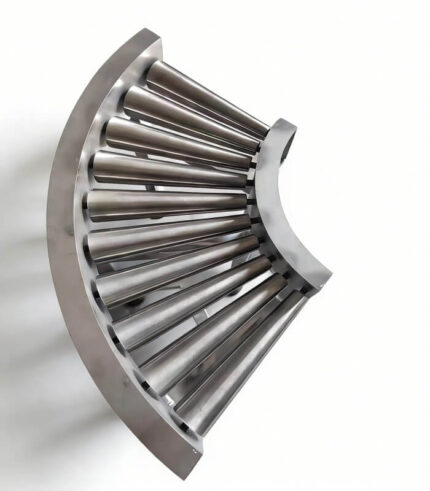
Tapered rubber-covered rollers Facilitate smooth turning during curves
3. Final Assembly and Commissioning
· Assembly: Install the frame, sprockets, mesh belt, and drive unit in sequence
· Commissioning:
· No-load testing: Power on and run the system to check for smooth operation and any deviation
· Load testing: Place standard cargo to test for smooth turning
· Speed adjustment: Use a variable frequency drive to adjust the conveying speed to the target value
4. Patented Technology
· Curving Conveyor Top Structure: Stainless steel mesh belt drive shafts are installed at both ends of the internal structure
· Sprocket Drive: Sprockets are fixed on both sides of the drive shaft, with the stainless steel mesh belt laid over the surface of the drive shaft
· Idler Sprocket: An idler sprocket is installed at one end of the drive shaft and rotated by the drive unit
· Drive Unit Mounting Bracket: Located at the lower ends of the curving conveyor’s top structure
IV. Summary of Core Parameters
Parameter Dimension Typical Value/Requirement
Turn Angle 45°, 90°, 180°, 360° (customizable)
Turn Radius R ≥ Conveyor Belt Width × 2.3 (minimum)
Conveyor Belt Width Customizable (typically 300–1200 mm)
Maximum Conveying Capacity 526 m³/h
Maximum Incline Angle 60°
Temperature Range ≤600°C (capable of conveying high-temperature materials)
Conveying Speed Adjustable (variable frequency drive/stepless speed variation)
Drive Method Geared motor + sprocket drive
Speed Control: Variable frequency drive, stepless speed variation
Frame Material: 304 stainless steel, powder-coated carbon steel
Belt Material: Stainless steel, carbon steel
Applicable Industries: Food processing, heat treatment, pharmaceuticals, daily chemical products, logistics and packaging
Special Features: High-temperature resistance, corrosion resistance, good air permeability, anti-drift rollers, guide ribs
V. List of Key Selection Parameters
The following information must be specified during procurement or design:
1. Curve Parameters: Curve angle (45°/90°/180°/360°), curve radius (inner radius R value)
2. Conveyed Material Parameters: Material type (bulk/boxes/food), unit weight, external dimensions
3. Performance Requirements: Conveying speed, conveying capacity (m³/h), maximum incline angle
4. Environmental Conditions: Operating temperature (high/low temperature), humidity, corrosiveness
5. Material Requirements: Mesh belt material (stainless steel/carbon steel), frame material (stainless steel/carbon steel)
The key feature of the metal mesh belt turner lies in the coordination between the stainless steel mesh belt and the sprocket drive system. By using chains with different pitch lengths on the inner and outer sides (27 mm on the inner side and 53 mm on the outer side), a speed differential is created, enabling the mesh belt to turn smoothly along the curved track. Additionally, the outer ring of the mesh belt is equipped with special guide rollers to prevent misalignment.
—
I. General Core Parameter Ranges
Parameter Item General Range Remarks
Curve Angle 30°, 45°, 60°, 90°, 180°, 360° 90° and 180° are most commonly used; 360° is achieved by combining two 180° units
Curve Radius (Inner Radius) R ≥ Conveyor Belt Width × 2.3; Minimum R ≥ 850 mm; standard R = 2000 mm
Effective belt width 200 mm ~ 1800 mm (customizable); standard 1100 mm
Conveyor deck height 250 mm ~ 5000 mm (crane-installable); standard 600 mm
Conveyor speed 1 ~ 40 m/min; standard 3–6 m/min, variable frequency speed control
Maximum conveying capacity: Up to 526 m³/h
Maximum incline angle: Up to 60°
Temperature range: ≤600°C; capable of conveying high-temperature materials
Drive power: 0.37 kW to 1.5 kW; standard 1.5 kW
Conveyor belt material: SUS304/SUS201 stainless steel, carbon steel; 304 for food/high-temperature applications
Frame Material: Stainless Steel 201/304, Powder-coated Carbon Steel
II. Key Component Details and Specifications
1. Metal Mesh Belt (Core Load-bearing Component)
The metal mesh belt is the core component of the turning conveyor, and its structural design directly affects the smoothness of the turn:
(1) Mesh Belt Specifications
Item | Specification/Parameter | Description
Belt Type: Spindle-driven belt, sprocket-driven belt (sprocket-driven is more stable)
Wire Diameter: 2 mm (Stainless steel)
Pins (Hinge Pins): 8 mm (Carbon steel) – Connect belt modules
Wire Hole Diameter: 10 mm
Minimum Turning Radius: R ≥ Belt Width × 2.3 (e.g., for a width of 400 mm, the minimum radius is 920 mm)
(2) Curve Chain System (Core Technology)
The key to achieving a speed difference between the inner and outer sides of a metal mesh belt curve conveyor lies in the design of chains with different pitch lengths:
Position Chain Pitch Description
Inner Chain 27mm Smaller curve radius, slower linear speed
Outer Chain 53mm Larger curve radius, faster linear speed (approximately twice that of the inner side)
(3) Selection of Mesh Belt Materials
Material Features Operating Temperature Applications
SUS304 Stainless Steel Corrosion-resistant, high-temperature resistant, hygienic and easy to clean ≤600°C Food, pharmaceuticals, high-temperature baking
SUS201 Stainless Steel Economical stainless steel, slightly lower corrosion resistance ≤600°C General industry, cost-sensitive applications
Carbon Steel High strength, low cost ≤200°C Heavy industry, general environments
(4) Anti-Drift Mechanism
Mechanism Function Description
Guide Rollers Prevents belt misalignment Installed on the outer ring of the belt
Sprocket Drive Prevents slippage and serpentine movement Minimizes belt misalignment
Specialized Guide Rails Guiding function T4 stainless steel stamped guide rails
2. Frame and Structure
Component Material/Specifications Description
Frame Fabrication 3mm thick metal plate, laser-cut and TIG-welded Precise curvature, strong welds
Uprights (Supports) 40×60×1.5mm or 40×40×1.2mm stainless steel square tubing; food-grade compliant
Frame Material Stainless steel 201/304, powder-coated carbon steel
Adjustable Feet Equipped with adjustable feet for leveling
Surface Finish Brushed stainless steel finish; aesthetically pleasing and corrosion-resistant
3. Drive and Transmission System
Item Specifications/Options Description
Drive Method Geared motor drive; sprocket-driven mesh belt
Motor Brand Taiwan Wanxin integrated motor with gearbox (optional)
Speed Control Method Variable frequency drive, stepless speed control (5x speed range); Aidel variable frequency drive
Sprockets Machined gears mounted on the stainless steel mesh belt drive shaft
Drive Shaft Stainless steel mesh belt drive shaft with sprockets mounted at both ends
Driven Sprocket: Mounted on one end of the drive shaft; rotated by the drive unit
Support Rollers: Mechanical bearings; support the mesh belt during operation
Power Supply: 380V 50Hz; standard industrial power supply
Drive Unit Installation Location: The drive unit mounting brackets are positioned at the lower ends of the top structure on both sides of the curve.
IV. Operating Direction Specifications
The operating direction must be specified at the time of ordering:
Operating Direction Description
Counterclockwise Standard option
Clockwise Optional
V. List of Key Selection Parameters
The following information must be specified during procurement or design:
1. Turning Parameters
· Turning angle (30°/45°/60°/90°/180°/360°)
· Turning Radius (Inner Radius R value, standard R2000mm)
· Direction of Operation (Counterclockwise/Clockwise)
2. Conveyed Material Parameters
· Material Type (Bulk Material/Boxes/Food/High-Temperature Materials)
· Unit Weight or Load per Unit Length
· Dimensions (Length × Width × Height)
3. Performance Requirements
· Conveyor Speed (m/min), typically 3–6 m/min
· Conveying Capacity (m³/h)
· Maximum Incline Angle (°)
4. Environment and Materials
· Operating Temperature Range (Ambient/High Temperature ≤ 600°C)
· Corrosion Resistance Requirements
· Hygiene Grade Requirements (Food/Pharmaceutical)
· Mesh Belt Material (SUS304/SUS201/Carbon Steel)
· Frame Material (Stainless Steel/Powder-Coated Carbon Steel)
5. Installation Conditions
· Conveyor Surface Height Requirement (Standard H=600 mm)
· Effective Mesh Belt Width (Standard W=1100 mm)
· Transition Connection Method
VI. Summary
Parameter Dimension Typical Values/Requirements
Key Selection Criteria: Turn Angle, Turn Radius, Cargo Type, Temperature Resistance Requirements
Turn Angle: 30°–360° (Common: 90°/180°)
Turn Radius: R ≥ Conveyor Belt Width × 2.3; Standard R2000mm, Minimum R ≥ 850mm
Conveyor Belt Width: 200–1800mm (Standard 1100mm)
Conveyor Speed: 1–40 m/min (typically 3–6 m/min, variable frequency speed control)
Maximum Conveying Capacity: 526 m³/h
Maximum Incline Angle: 60°
Temperature Resistance Range: ≤600°C
Drive Power: 0.37–1.5 kW
Conveyor Belt Material: SUS304, SUS201 stainless steel, carbon steel
Frame Material: Stainless steel, powder-coated carbon steel
Chain Pitch: 27 mm (inner side) / 53 mm (outer side) (for curved sections)
Anti-drift Mechanism: Guide rollers, sprocket drive, dedicated guide rails
Speed Control: Variable frequency drive, stepless speed variation (5x speed range)
Conveyor Height: 250–5000 mm (crane-installable)


评价
目前还没有评价