Spiral Tower Conveyor Guide: Working Principles & Design Benefits

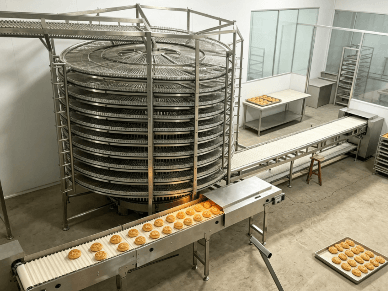
In modern industrial facilities, floor space is often the most expensive asset. Engineers and plant managers frequently face the challenge of transporting products vertically between different levels or providing sufficient dwell time for processes like cooling and proofing without expanding the factory’s footprint. This is where the spiral tower conveyor becomes an indispensable component of material handling.
A spiral tower conveyor is a vertical transport system designed to move products upward or downward in a continuous, helical path. Unlike traditional incline conveyors that require significant horizontal distance to achieve height, the spiral design utilizes verticality, making it the gold standard for high-density production environments.
The Mechanics: How a Spiral Tower Conveyor Works
The fundamental operation of a spiral tower revolves around a central rotating drum or a series of synchronized drive armatures that move a flexible modular belt along a circular path.
1. The Drive System
Most industrial spiral towers, such as those engineered by Leyu Conveyor, utilize a “Low Tension” drive system. Instead of pulling the belt from the end (which would create immense stress over long distances), the central drum provides frictional or positive engagement along the inner edge of the belt. This distributes the driving force evenly across all tiers, significantly reducing belt wear and allowing for much longer conveyor lengths than standard linear systems.
2. The Helical Path and Modular Belting
The belt travels on a precision-engineered track supported by low-friction wear strips. The modular belts used are specifically designed for side-flexing. These belts often feature a high open-area percentage, which is critical for applications requiring airflow, such as cooling or freezing.
3. Infeed and Outfeed Synchronization
Products enter the spiral at a specific height (the infeed) and exit at a different elevation (the outfeed). The speed of the spiral is typically controlled by Variable Frequency Drives (VFDs), allowing the tower to synchronize perfectly with upstream processing equipment and downstream packaging lines.
Critical Engineering Components
To understand the reliability of these systems, one must look at the structural elements that define their performance:
- The Framework: Usually constructed from Stainless Steel (SUS304 or SUS316) for food-grade environments or carbon steel for heavy industrial use.
- The Modular Belt: Made from Acetal (POM), Polyethylene (PE), or Polypropylene (PP). The material choice depends on the operating temperature—PE is favored for freezing applications, while POM offers higher strength for ambient transport.
- Automatic Lubrication: High-end towers include automated oiling systems for the drive chain and wear strips to prevent “stick-slip” motion and extend the lifespan of the plastic components.
- Tension Control: Sophisticated sensors monitor belt tension in real-time, triggering an automatic shutdown if a jam occurs to prevent structural damage.
Key Benefits of Spiral Tower Integration
Integrating a spiral tower into a production line offers more than just elevation changes. It provides a strategic advantage in process flow management.
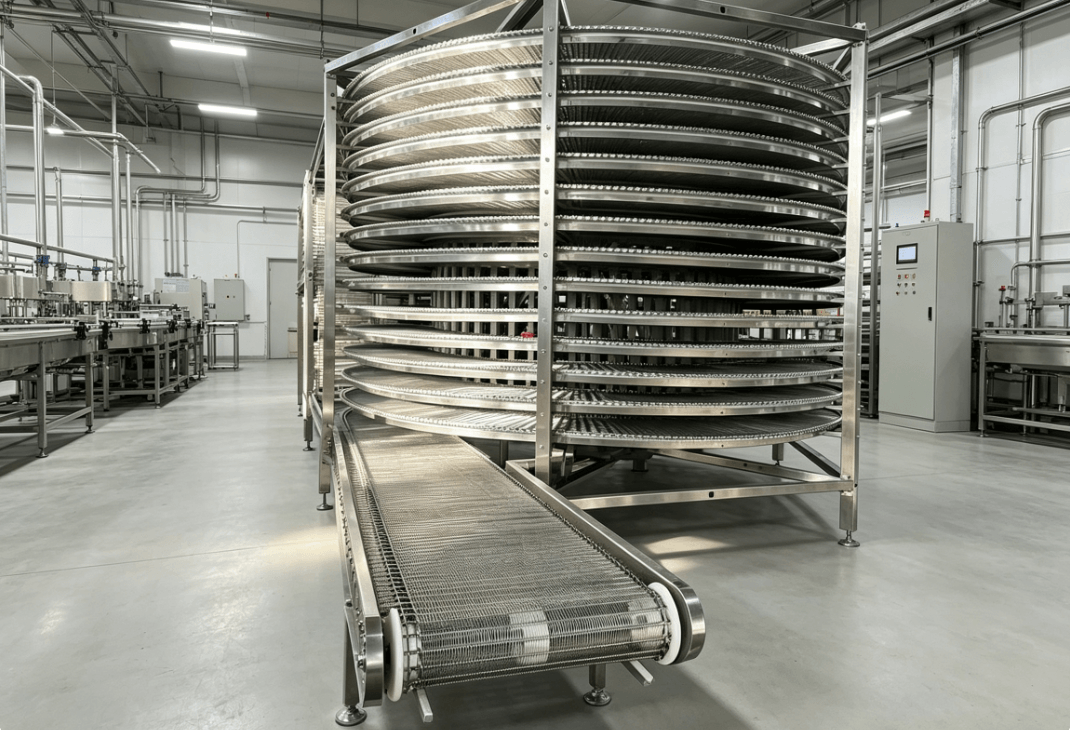
Extreme Space Efficiency
The primary driver for spiral adoption is the footprint-to-surface-area ratio. A spiral tower can provide 50 to 100 meters of conveying length within a 5-meter by 5-meter floor area. For facilities with high ceilings, this allows for massive “buffer” zones or long cooling durations without sacrificing floor space for other machinery.
Continuous Product Flow
Unlike vertical reciprocating conveyors (lifts/elevators) which operate in cycles, a spiral tower is a continuous motion machine. This eliminates the “stop-and-start” bottleneck, ensuring that the production line maintains a constant throughput rate, which is vital for high-speed bottling or baking operations.
Process Integration (Cooling and Proofing)
In the food industry, a spiral tower often doubles as a processing chamber. By circulating cold or ambient air through the open-mesh belt, the tower acts as a:
- Spiral Cooling Tower: Naturally reducing the temperature of baked goods before packaging.
- Spiral Proofer: Providing the controlled environment and time needed for dough to rise.
- Spiral Freezer: Using high-velocity airflow to flash-freeze seafood or prepared meals.
Technical Comparison: Spiral vs. Traditional Incline Conveyors
| Feature | Spiral Tower Conveyor | Traditional Incline Conveyor |
| Floor Space Requirement | Very Low (Vertical focus) | High (Requires long run for slope) |
| Product Stability | High (Flat, consistent centrifugal force) | Moderate (Risk of roll-back on steep inclines) |
| Continuous Flow | Yes | Yes |
| Max Elevation | Virtually unlimited (Multiple tiers) | Limited by floor length |
| Maintenance Complexity | Moderate (Drive drum/Wear strips) | Low (Simple belt/motor) |
Common Applications Across Industries
While most commonly associated with food processing, the spiral tower’s utility extends across several manufacturing sectors:
- Bakery and Pastry: Cooling bread, buns, and cookies directly out of the oven.
- Packaging and Bottling: Creating a “buffer” or “accumulator” zone between the filling machine and the palletizer to prevent line stoppages.
- E-commerce and Logistics: Moving parcels between different mezzanine levels in distribution centers.
- Pharmaceuticals: Providing dwell time for sterilized vials to cool before labeling.
Engineering Considerations for Selection
When evaluating a spiral tower for a specific project, engineers must account for several variables that impact long-term ROI:
- Pitch and Clearance: The vertical distance between tiers (the pitch) must allow for the tallest product plus a safety margin for airflow and maintenance access.
- Environmental Conditions: If the tower operates in a high-moisture or washdown environment, the bearings and drive components must be rated for IP66 or higher, and the frame should be designed to prevent “water pockets” where bacteria could grow.
- Product Orientation: For lightweight products, the centrifugal force at higher speeds must be calculated to ensure the product remains centered on the belt.
- Throughput Requirements: The total weight of the product on the belt at any given time (the “live load”) determines the torque requirements of the motor and the tensile strength required for the modular belt.
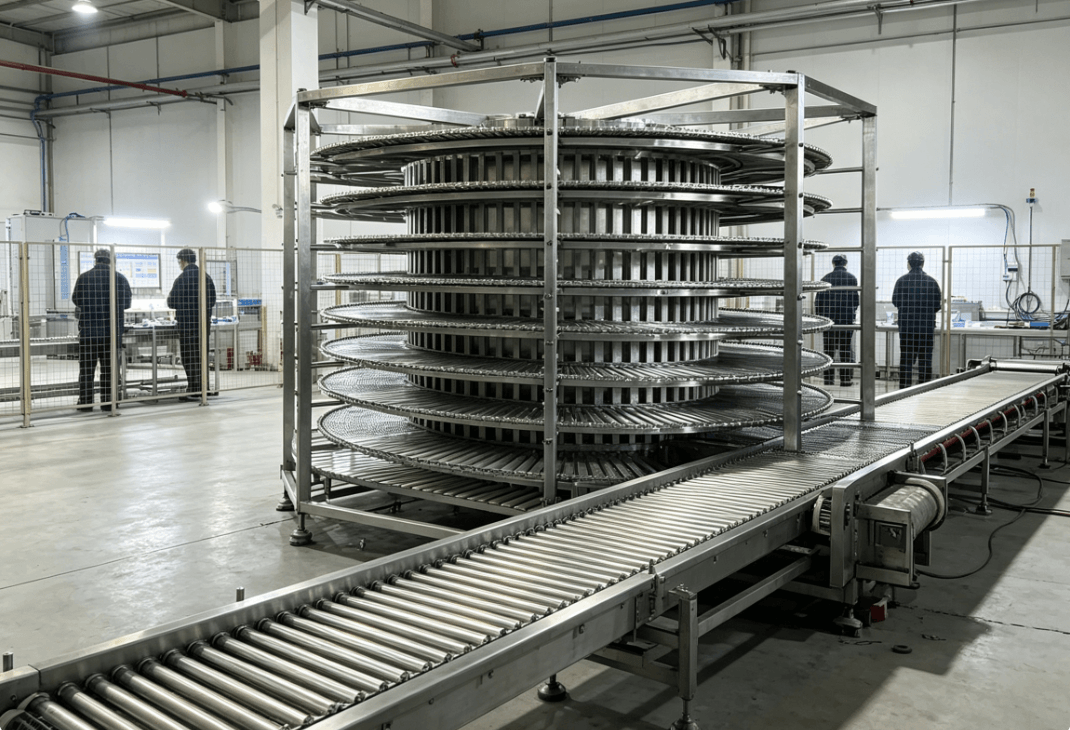
Conclusion
The spiral tower conveyor represents a pinnacle of efficient material handling. By moving away from horizontal expansion and embracing vertical engineering, manufacturers can achieve higher throughput, integrated processing, and superior floor space utilization. Whether used for cooling a thousand loaves of bread per hour or buffering pharmaceutical cartons, the spiral tower remains a cornerstone of high-efficiency industrial automation.
FAQ
What is the maximum height a spiral tower can reach?
Technically, the height is limited only by the structural integrity of the facility and the ceiling height. Most industrial spirals range from 2 meters to 10 meters, though multiple towers can be linked for even greater elevation.
Can spiral conveyors move products both up and down?
Yes. While most are built for one direction, they can be engineered as “Up-Spirals” or “Down-Spirals.” Some advanced modular systems even allow for reversible operation depending on the production shift’s needs.
How do you clean a spiral tower used for food?
Food-grade spirals are designed with “Clean-In-Place” (CIP) systems. These include spray bars that wash the belt and the internal structure with sanitizing solutions as the belt rotates, ensuring compliance with FDA and global food safety standards.
Is a spiral tower suitable for heavy items?
Yes, but the belt material and drive system must be specified for heavy-duty loads. For very heavy pallets or crates, manufacturers often use roller-based spirals rather than modular belt spirals.
Reference Sources
- ISO 2110: Conveyor belts — Characteristics of construction and belt types.
- CEMA (Conveyor Equipment Manufacturers Association): Standards for belt tension and vertical conveyor safety.
- HACCP Guidelines: For the design of sanitary food processing equipment (Relevant to spiral cooling and freezing).
- Leyu Conveyor Technical Specifications: Spiral Tower Product Category Data.