How Hoist Conveyors Optimize Vertical Material Handling Efficiency

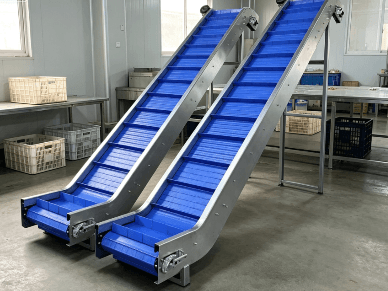
In the modern industrial landscape, floor space is often the most expensive asset in a facility. As manufacturing and distribution centers strive for higher throughput within existing footprints, the shift from horizontal to vertical material handling has become a necessity rather than an option. Hoist conveyors represent the critical link in this transition, providing a high-speed, automated solution for moving goods between different elevations.
Unlike traditional inclined belt conveyors that require a significant horizontal run to achieve height, a hoist conveyor operates on a vertical or near-vertical plane. This technical evolution allows engineers to utilize the “cubic volume” of a building, effectively stacking operations and reclaiming valuable floor real estate for production machinery or storage.
Understanding the Mechanics of a Hoist Conveyor
A hoist conveyor is an automated lifting system designed to transport products, pallets, or totes vertically between levels. While the term “hoist” often evokes images of manual cranes, in a conveyor context, it refers to a synchronized mechanical system integrated into a larger production line.
These systems typically utilize a robust structural mast, a lifting carriage (platform), and a drive mechanism—usually a high-torque motor coupled with heavy-duty chains or reinforced belts. The integration of sensors and Programmable Logic Controllers (PLCs) ensures that the vertical movement is perfectly timed with incoming horizontal conveyors. This synchronization prevents bottlenecks, ensuring a smooth transition of goods from a ground-level assembly line to a mezzanine or overhead storage area.
Key Efficiency Drivers in Vertical Transport
The implementation of a hoist conveyor directly addresses three primary operational challenges: throughput density, safety, and system footprint.
1. Footprint Optimization and the “Cube” Concept
The most immediate benefit of a hoist conveyor is the reduction of the system footprint. An inclined conveyor typically requires a 15° to 30° angle to prevent product slippage; to rise 5 meters, you might need 10 to 15 meters of floor space. A hoist conveyor accomplishes the same vertical rise in a footprint only slightly larger than the product itself. This allows facilities to implement multi-tier mezzanine systems, doubling or tripling usable space without expanding the building’s exterior walls.
2. Enhanced Throughput Consistency
Efficiency is often measured by cycle times. Reciprocating hoist conveyors move loads in discrete batches, while continuous vertical conveyors (CVCs) use a series of platforms to move goods in a non-stop flow. For high-volume environments, such as e-commerce fulfillment or automotive parts manufacturing, the ability to maintain a constant flow of materials between floors is vital. Modern hoist systems are engineered to minimize “dwell time”—the period a product spends waiting for the lift to arrive—thereby optimizing the overall Lead Time (LT) of the production cycle.
3. Reduced Manual Intervention and Improved Safety
Manual vertical handling, involving forklifts or freight elevators, introduces significant safety risks and labor costs. Hoist conveyors automate this process, removing the human element from high-risk lifting tasks. Advanced systems, such as those developed by specialized manufacturers like Leyu Conveyor, incorporate safety enclosures, interlocked gates, and emergency braking systems. These features comply with international safety standards (such as EN ISO 13849-1), ensuring that vertical transport does not become a liability in the workplace.
Comparing Reciprocating vs. Continuous Hoist Systems
When evaluating vertical material handling, engineers must choose between two primary hoist configurations based on their specific throughput requirements.
| Feature | Reciprocating Hoist Conveyor | Continuous Vertical Conveyor (CVC) |
| Movement Pattern | Up and down (Stop-and-start) | One-way loop (Continuous flow) |
| Throughput Level | Moderate (10–30 cycles/hour) | High (Up to 2,000 units/hour) |
| Load Capacity | Generally higher (Heavy pallets) | Optimized for totes and boxes |
| Complexity | Simpler drive mechanism | Complex chain/platform synchronization |
| Footprint | Extremely compact | Slightly larger due to return path |
Reciprocating hoists are ideal for heavy-duty applications where the volume is lower, but the weight per unit is high—such as moving full pallets of raw materials. Continuous conveyors, conversely, are the backbone of high-speed sorting and distribution centers where thousands of small parcels must move between levels every hour.
Technical Applications Across Industries
The versatility of hoist conveyors makes them indispensable in several high-growth sectors:
- Electronics Manufacturing: In cleanroom environments, vertical hoists transport sensitive PCB assemblies between stages of automated testing and assembly, minimizing the airborne dust generated by long horizontal belts.
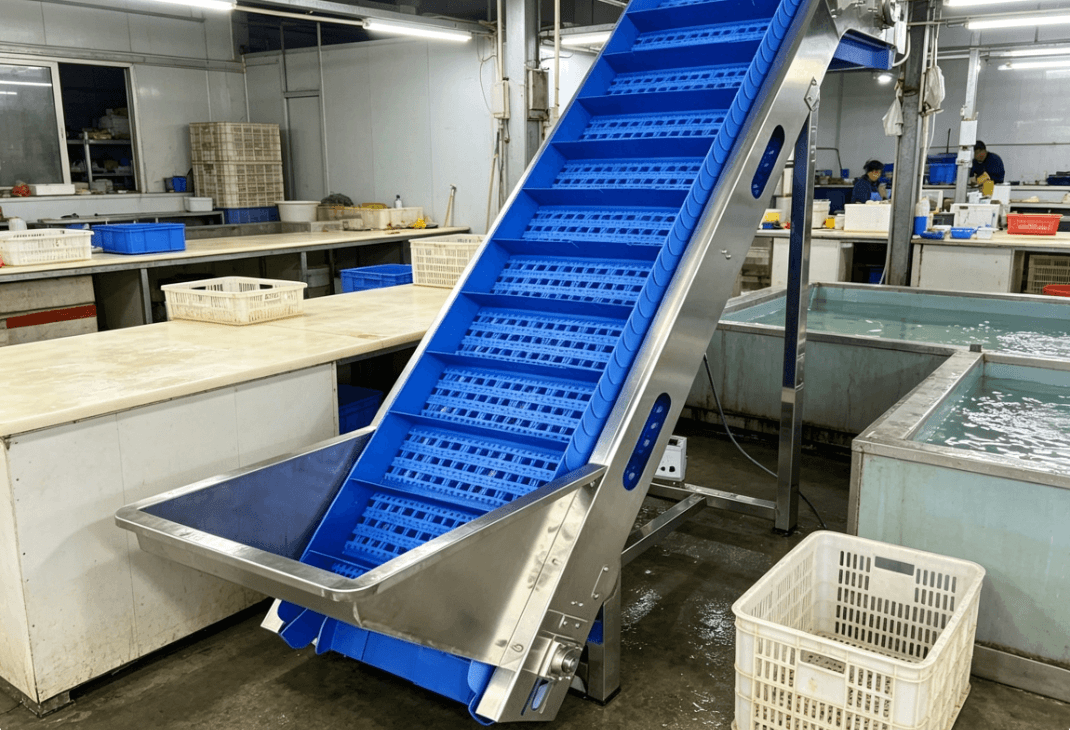
- Food and Beverage: Stainless steel hoist systems are used to move packaged goods from processing areas to elevated cooling or packaging decks. Here, the focus is on “washdown” capability and food-grade materials.
- Automotive Assembly: Hoist conveyors lift heavy components, like engines or chassis, to overhead power-and-free systems, allowing floor space to remain clear for robotic welding and human technicians.
- Cold Storage & Warehousing: Vertical lifts are crucial in temperature-controlled environments where every cubic foot of refrigerated space costs a premium.
Integration Considerations for System Designers
When integrating a hoist conveyor into an existing facility, several engineering constraints must be addressed to ensure long-term reliability:
- Infeed/Outfeed Heights: Precise alignment with existing conveyor heights is mandatory to avoid mechanical shocks to the product.
- Motor Torque and Braking: The drive system must be sized not just for the weight of the load, but for the dynamic forces of rapid acceleration and deceleration.
- Environmental Factors: High-humidity or high-temperature environments require specialized coatings and lubricants to prevent premature chain wear or motor failure.
- Control Logic (PLCs): The hoisting system must “talk” to the rest of the warehouse management system (WMS) to ensure it can clear the discharge zone before the next load arrives.
For manufacturers looking to upgrade their facilities, focusing on specialized solutions is key. Systems designed for high-cycle environments, such as the lifting and hoisting units from Leyu Conveyor, emphasize modularity. This allows a facility to scale its vertical capacity as production demands increase, without needing to replace the entire infrastructure.
The Role of Preventive Maintenance in Vertical Efficiency
Vertical systems are subject to gravity-induced stress that horizontal systems are not. Therefore, a strategic maintenance schedule is a pillar of efficiency. Engineers should focus on:
- Chain Tensioning: Excessive slack in a lift chain can cause vibration or misalignment, leading to emergency stops.
- Lubrication Systems: Automated lubrication ensures that the high-friction points in the mast and carriage remain fluid, reducing energy consumption and heat.
- Sensor Alignment: Photo-eyes and limit switches are the “eyes” of the hoist; if they are obscured by dust or knocked out of alignment, the entire line may grind to a halt.
FAQ
Q1: What is the maximum height a hoist conveyor can reach?
While theoretically limited only by structural engineering, most standard industrial hoist conveyors operate within a range of 2 to 20 meters. Beyond this, multiple stages or specialized high-rise elevators may be required to maintain structural stability.
Q2: Can hoist conveyors handle fragile items?
Yes. Modern vertical lifts use “soft-start” and “soft-stop” variable frequency drives (VFDs). This ensures that the acceleration and deceleration are gradual, preventing delicate items like glassware or electronics from shifting or sustaining impact damage.
Q3: How do hoist conveyors compare to freight elevators?
Freight elevators are typically designed for human operation and intermittent, high-capacity loads. Hoist conveyors are fully automated, integrated into the production flow, and designed for high-frequency, continuous use.
Q4: What safety certifications should a hoist conveyor have?
At a minimum, systems should comply with local occupational safety standards (such as OSHA in the US or CE in Europe). Specific standards for conveyors include ASME B20.1, which outlines safety requirements for the construction, installation, and operation of conveyors.
Q5: Is it possible to transport goods both up and down with the same hoist?
Yes, reciprocating hoist conveyors are naturally bi-directional. Some continuous systems can also be configured for “reversible” flow, though they are most efficient when dedicated to a single direction of travel.
Reference Sources
- MHI (Material Handling Institute): Industry standards and whitepapers on vertical lift safety and efficiency.
- ISO 12100: Safety of machinery — General principles for design — Risk assessment and risk reduction.
- CEMA (Conveyor Equipment Manufacturers Association): Technical guides on conveyor unit handling and bulk material handling.
- ASME B20.1: Safety Standard for Conveyors and Related Equipment.