What Is a Turning Machine Conveyor? Principles, Types, and Benefits

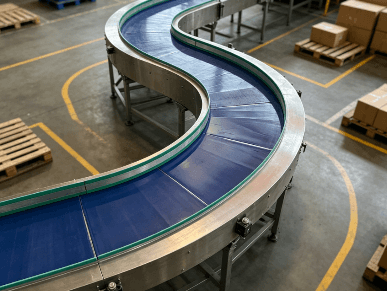
In modern industrial automation, the shortest distance between two points is rarely a straight line. As production facilities face increasing pressure to maximize floor space and integrate complex workflows, the ability to redirect product flow without compromising orientation or stability is critical. This is where the turning machine conveyor—often referred to as a curve conveyor or turn-belt—becomes an indispensable asset.
A turning machine conveyor is a specialized material handling system designed to transport goods through angular changes, typically 45°, 90°, or 180°. Unlike standard linear conveyors, these systems employ specific geometric engineering to ensure that items maintain their position and speed as they transition through a radius. Whether handling delicate electronic components or heavy packaged food items, the “turning” mechanism is the backbone of space-efficient facility layout design.
The Engineering Logic Behind Turning Machine Conveyors
The primary challenge in a curved conveyor system is maintaining consistent tangential velocity across the width of the belt. In a standard rectangular belt forced into a curve, the inner edge would bunch while the outer edge would stretch, leading to rapid wear and product misalignment.
To solve this, professional-grade turning machines, such as those developed by Leyu Conveyor, utilize one of three primary engineering approaches:
- Tapered Roller Design: Used primarily in roller-bed curves, the rollers are shaped like truncated cones. The larger diameter at the outer radius moves faster than the smaller diameter at the inner radius, matching the physical distance the product must travel and preventing skewed orientation.
- Conical Belt Geometry: Fabric belts (PU, PVC, or Silicone) are custom-cut into an arc. These belts are often guided by bearings or beads along the outer perimeter to resist the centripetal force that pulls the belt toward the center of the turn.
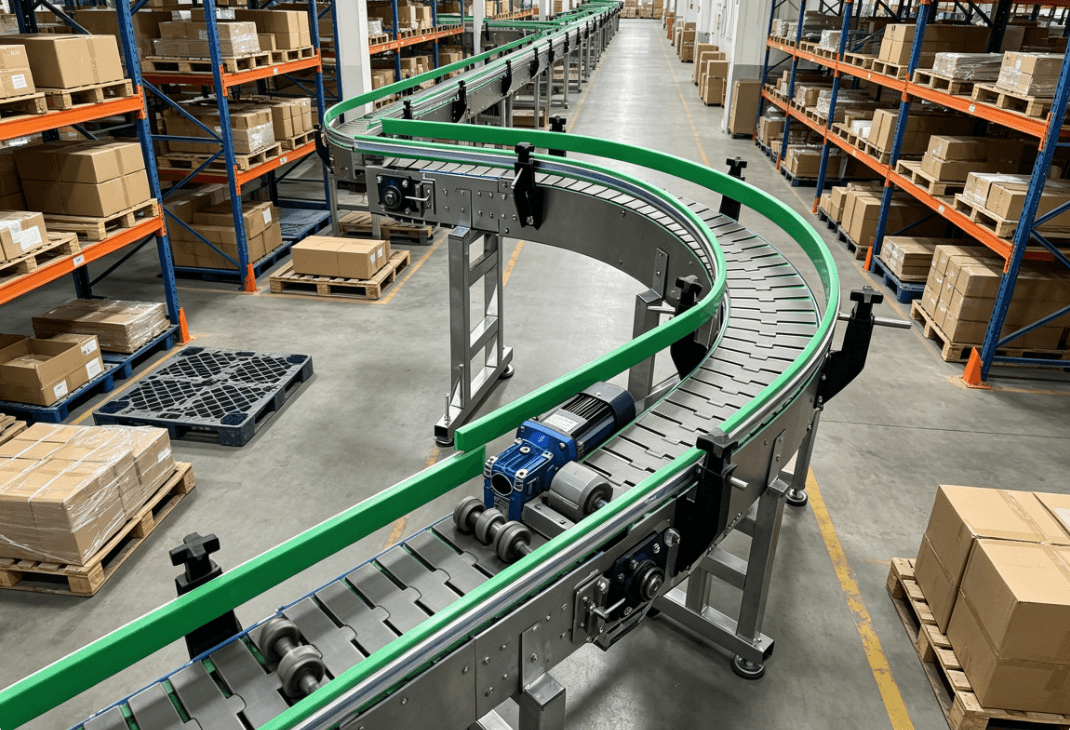
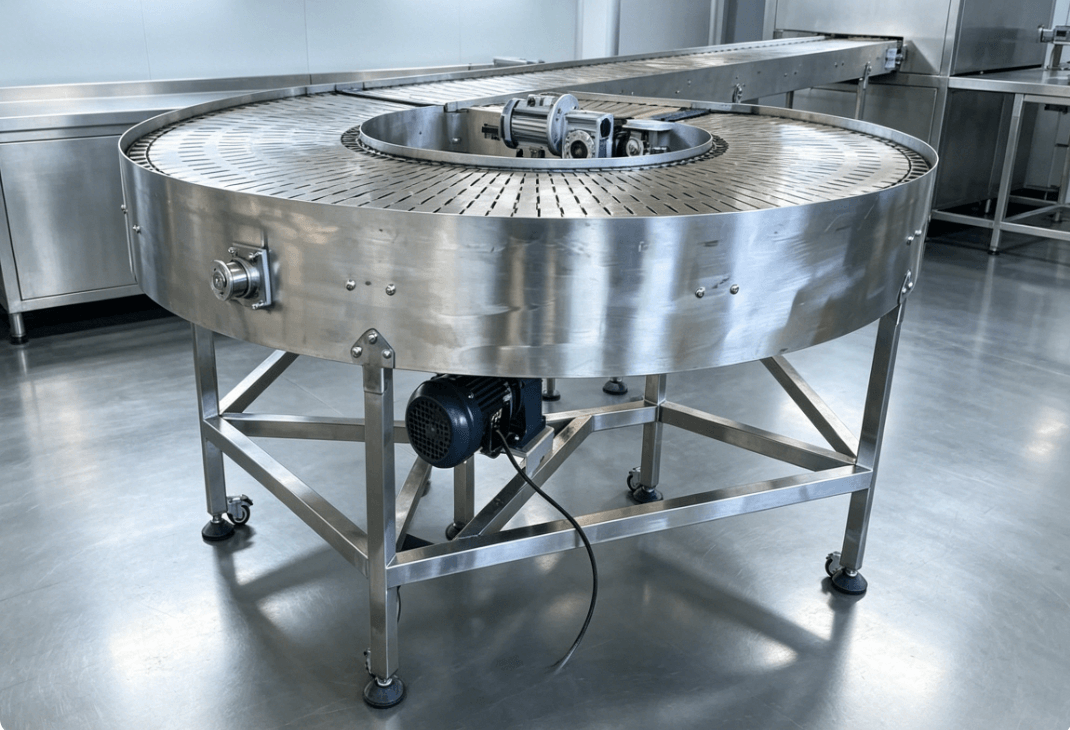
- Modular Plastic Chains: High-performance plastic segments are linked together, allowing for side-flexing capabilities. This design is highly favored in food and pharmaceutical industries due to its washdown compatibility and ease of repair.
Core Types of Turning Conveyors and Their Layout Roles
Selecting the right turning machine depends heavily on the facility’s “footprint” and the nature of the load. Engineers typically categorize these machines by their angle of deflection:
- 90-Degree Turning Conveyors: The most common configuration, used to create “L-shaped” production lines. These are vital when a product must move from a primary processing area to a secondary packaging or palletizing zone located in a perpendicular bay.
- 180-Degree (U-Turn) Conveyors: Ideal for “closed-loop” systems or facilities with extreme space constraints. A U-turn allows a product to return toward the operator or move to a parallel line, effectively doubling the usable length of a production area within the same square footage.
- S-Curve Configurations: Created by joining two turning machines with opposing radii, S-curves are used to bypass structural obstacles like building columns or other machinery without interrupting the product flow.
Industrial Applications: Where Precision Meets Movement
The application of a turning machine conveyor extends across nearly every sector of high-volume manufacturing. However, certain industries rely on the technical nuances of these systems more than others:
1. Food and Beverage Processing
In food production, maintaining product “pitch” (the distance between items) is essential for downstream processes like flash freezing or industrial baking. Turning conveyors in this sector often use FDA-approved antimicrobial belts. They prevent products from “piling up” at corners, which is critical for maintaining hygiene and preventing bruising in fresh produce.
2. Electronics and Semiconductor Assembly
For delicate PCBs (Printed Circuit Boards), vibration and centrifugal force are the enemies. Turning machines in electronics utilize anti-static (ESD) belts and precision-calibrated motors to ensure a smooth, jerk-free transition. The goal is to keep the component perfectly centered to facilitate robotic pick-and-place at the next station.
3. E-commerce and Logistics
Sorting centers utilize heavy-duty turning conveyors to manage high-speed throughput. Here, the focus is on the “transition zone”—the point where the turning machine meets a straight conveyor. Properly engineered turns prevent parcels from rotating, ensuring that barcodes remain visible to overhead scanners throughout the entire sorting journey.
Strategic Benefits of Integrating Turning Machines
Integrating a well-designed turning machine into a production line offers more than just a change in direction; it provides measurable operational advantages:
- Floor Space Optimization: Modern factory real estate is expensive. Turning conveyors allow for “nesting” machines closer together, turning dead corners into productive zones.
- Preservation of Product Orientation: For products that must enter a labeling machine or a shrink-wrapper in a specific direction, a turning machine ensures the leading edge remains the leading edge.
- Reduced Labor Costs: Without automated turns, facilities often rely on manual transfers or “dead plates” where products can stall. Turning machines automate these junctions, eliminating the need for manual intervention and reducing the risk of bottlenecks.
- Minimized Product Damage: Smooth transitions reduce the impact and friction that occur when products are forced around a corner, significantly lowering the “scrap rate” in fragile industries like glass or ceramics.
Technical Considerations for Specification
When consulting on the implementation of a turning machine, engineers must evaluate several “Performance Indicators” to ensure system longevity:
| Feature | Consideration |
| Inner Radius | A tighter radius saves space but increases belt tension and wear. |
| Load Capacity | Turning machines face lateral forces; the frame must be rigid (usually stainless steel or extruded aluminum). |
| Speed Synchronization | The turn must match the speed of the feeding and receiving conveyors to prevent “surging.” |
| Belt Friction | Low-friction surfaces are required for accumulation, while high-friction is needed for steep inclines within a turn. |
Conclusion: The Pivot Point of Automation
The turning machine conveyor is the unsung hero of the modern factory. It represents the transition from simple linear movement to sophisticated, integrated flow. By understanding the mechanical principles—from tapered rollers to modular chain dynamics—manufacturers can design layouts that are not only more efficient but also more resilient to the demands of high-speed production.
As industries move toward “Smart Factories,” the role of the turning conveyor will only grow. Its ability to act as a bridge between disparate processes makes it a foundational component of any scalable manufacturing strategy.
FAQ
Q: Can a turning machine conveyor handle different product sizes simultaneously?
A: Yes. However, the turning radius must be calculated based on the largest item to prevent the “overhang” effect, where a product might hit the side rails or lose stability during the turn.
Q: What is the maintenance requirement for a curve conveyor compared to a straight one?
A: Curve conveyors require slightly more attention, specifically regarding belt tension and the lubrication of the outer perimeter bearings. Because the belt is under asymmetrical tension, regular tracking inspections are recommended to prevent edge fraying.
Q: How do I choose between a 90-degree belt turn and a 90-degree roller turn?
A: Belt turns are superior for small, irregular, or lightweight items that might get stuck in roller gaps. Roller turns are generally better for heavy crates, pallets, or flat-bottomed containers where durability is the priority.
Q: Can turning machine conveyors operate on an incline?
A: Yes, spiral conveyors are essentially turning machines that incorporate a vertical pitch. However, for standard turning machines, the incline should be minimal unless a high-friction or “cleated” belt is used to prevent product slippage.
Reference Sources
- CEMA (Conveyor Equipment Manufacturers Association): Standards for belt tension and roller geometry.
- ISO 21183-1: Technical specifications for light conveyor belts.
- Leyu Conveyor Technical Specifications: Documentation on modular and belt-turning machine applications.