Hoist Conveyor Selection: How to Choose the Right System

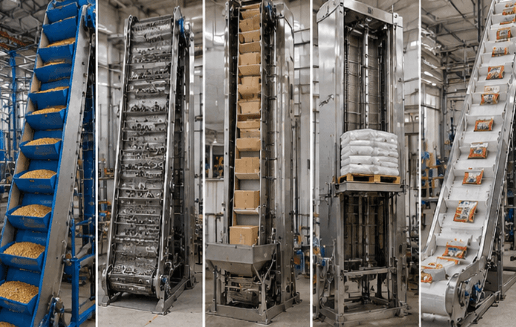
Effective hoist conveyor selection starts with matching the conveying mechanism to the material, required throughput, lifting height, and production layout. The right system must also provide stable material transfer, fit the available installation space, and operate reliably under actual process conditions. Comparing these factors together helps engineers avoid undersized equipment, unnecessary energy consumption, and transfer problems between production stages.
What Factors Determine the Right Hoist Conveyor?
A hoist conveyor is a material handling system that moves products or bulk materials between different elevations. Depending on the design, it may use a belt, buckets, metal mesh, chains, or carriers to transport material along a vertical or steeply inclined path.
The term covers different conveying arrangements, so the first decision is to identify what the system needs to move and how the production process operates.
Material Characteristics and Conveying Method
Material properties determine the suitable conveying surface, loading arrangement, and discharge mechanism.
- Powders and fine granules: Require suitable containment, controlled feeding, and a discharge design that limits material loss.
- Plastic pellets and grains: Often suit bucket elevators designed for relatively free-flowing bulk materials.
- Hot or abrasive components: May require metal conveying surfaces and wear-resistant components.
- Packaged products: Need stable support and controlled transfers to prevent tipping or damage.
For bulk materials, particle size and bulk density affect bucket loading and conveying capacity. For individual products, dimensions, orientation, center of gravity, and surface friction become more important.
For example, a feed-processing plant handling grain has different requirements from an assembly line transferring metal components. Choosing the same conveyor design for both applications without checking these differences can lead to premature wear or unreliable product transfer.

Load Capacity and Required Throughput
The rated load and hourly throughput must both match the operating requirement. A conveyor may carry an individual product safely but still fail to supply the downstream machine quickly enough.
For discrete products, estimate the required mass throughput using:
Q = N × W
Where Q is the required mass per hour, N is the number of items transported per hour, and W is the average item weight.
For example, 500 items per hour weighing 6 kg each represent a nominal throughput of 3,000 kg/h, or 3 tonnes per hour.
This calculation is only a starting point. The final design must also account for peak demand, carrier spacing, loading efficiency, maximum individual load, and the time required for transfers.
For bulk materials, conveying capacity must be evaluated alongside bulk density, bucket volume, filling efficiency, and discharge performance.
How Do Different Hoist Conveyor Designs Compare?
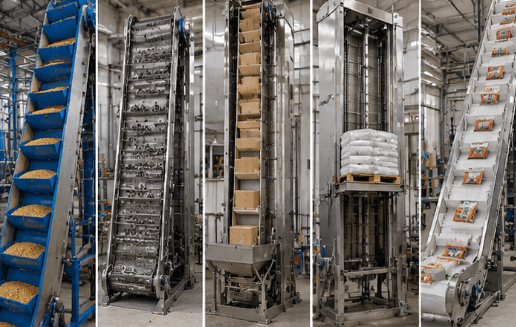
The main difference between vertical conveying systems lies in how they support and move the material. Selecting the right mechanism depends on whether the process handles loose bulk material, discrete products, or components exposed to demanding operating conditions.
| Conveyor design | Suitable applications | Main limitation to assess |
|---|---|---|
| Belt or bucket elevator | Grain, pellets, powders, and suitable small bulk materials | Heat resistance, abrasion, belt tracking, and particle characteristics |
| Metal mesh belt elevator | Hot components, products requiring airflow, and certain heavy-duty applications | Mesh opening, belt strength, inclination, and load retention |
| Continuous vertical conveyor | Repetitive product movement in automated production lines | Carrier spacing, transfer timing, and product stability |
| Reciprocating vertical lift | Pallets, containers, and discrete loads moving between fixed levels | Cycle time, platform loading, and stopping accuracy |
| Inclined or Z-type conveyor | Products requiring combined horizontal and vertical movement | Available footprint, incline angle, and side containment |
These systems should not be treated as direct substitutes. A bucket elevator is generally intended for bulk material, whereas a reciprocating lift transports discrete loads on a platform.
For suitable granular materials, Leyu Conveyor’s belt elevator and sidewall belt conveyor is one option to evaluate. The published product information describes applications involving grain, fertilizers, plastic pellets, and other suitable bulk materials.
For applications involving elevated temperatures, drainage, or airflow, the metal mesh belt elevator offers a different conveying surface. Its suitability still depends on the actual material temperature, load, mesh design, and equipment configuration.
Belt Elevator Versus Metal Mesh Belt Elevator
| Selection factor | Belt elevator | Metal mesh belt elevator |
|---|---|---|
| Conveying medium | Rubber belt, commonly fitted with buckets | Metal mesh belt |
| Typical material | Suitable powders, granules, and small bulk materials | Suitable components and materials requiring a metal conveying surface |
| Temperature considerations | Standard rubber belts have limited heat resistance | Metal selection must match the operating temperature |
| Key engineering concern | Belt tracking, bucket loading, and abrasion | Mesh strength, wear, corrosion, and product retention |
Neither design is universally better. The decision should follow the material properties and operating conditions rather than the perceived advantages of one construction material.
How Should Lift Height, Speed, and Installation Layout Be Matched?
Vertical conveying performance depends on the complete installation, not just the conveyor’s nominal speed or maximum lifting height.
Check the Actual Elevation and Footprint
Measure the vertical distance between the infeed and discharge points. Then account for the total equipment height, drive arrangement, discharge transition, and maintenance clearance.
The site review should establish:
- Infeed and discharge elevations.
- Available floor space and overhead clearance.
- The position of surrounding equipment and building structures.
- Access requirements for inspection and component replacement.
- The direction and height of upstream and downstream conveyors.
A conveyor may fit the nominal footprint but still be difficult to maintain if its drive assembly or inspection points are inaccessible.
Match Speed to the Production Cycle
For continuous systems, throughput depends on conveying speed, product spacing, loading efficiency, and the discharge arrangement. For reciprocating lifts, cycle time includes loading, upward travel, unloading, and the return movement.
A high travel speed does not necessarily produce higher usable throughput. If products accumulate at the discharge point, the vertical conveyor may simply transfer the bottleneck to another part of the line.
Variable-frequency drives and PLC controls can help coordinate conveying speed and transfer timing. Their value depends on the actual process requirements and the compatibility of connected equipment.
For integrated production lines, assess the complete material flow from the feeding conveyor through the vertical transfer to the receiving machine.
What Safety and Maintenance Requirements Should Be Checked?
A suitable hoist conveyor must be designed for its intended load, operating environment, and maintenance conditions. Safety provisions should be considered during equipment selection rather than added after the main design is complete.
Depending on the configuration and risk assessment, review:
- Guards around moving belts, chains, pulleys, and drive components.
- Emergency-stop arrangements and prevention of unexpected restart.
- Travel limits, position sensors, and suitable overload protection.
- Braking or load-holding provisions where required by the lifting mechanism.
- Safe access for inspection, cleaning, and maintenance.
- Replacement-part availability and the accessibility of wear components.
For installations in the United States, applicable OSHA requirements should be reviewed for the specific equipment and work environment. OSHA’s 29 CFR 1926.555 conveyor requirements address conveyor safety in construction settings, including stopping controls, warning signals, and lockout during hazardous maintenance. Other standards may apply to general-industry installations or specific lifting equipment.
Maintenance planning should reflect actual operating conditions. Abrasive materials may accelerate wear, while dust accumulation can affect sensors and moving components. Inspection intervals should therefore follow the manufacturer’s instructions and the severity of the application.
How Can You Evaluate a Hoist Conveyor Before Installation?
For a commercial project, a technically complete proposal makes it easier to compare equipment and identify design gaps before fabrication.
- Material type, dimensions, temperature, and weight are documented.
- Required throughput and peak operating conditions are specified.
- Lift height, infeed, discharge, and installation dimensions are confirmed.
- The conveying surface and drive system suit the material.
- Controls and transfer arrangements are compatible with adjacent equipment.
- Safety provisions and applicable standards are identified.
- Inspection access, wear parts, and maintenance requirements are documented.
- Testing, installation responsibilities, and technical support are clearly defined.
The supplier should be able to explain why the proposed configuration suits the application. Ask for layout drawings and a technical specification covering rated load, throughput assumptions, operating conditions, and relevant component details.
Total cost should also be assessed. Initial equipment price alone does not account for installation, energy use, replacement parts, downtime, or maintenance labor.
For a starting point, review Leyu Conveyor’s hoist conveyor product category. The listed range includes belt elevators and metal mesh belt elevators, which serve different conveying requirements. Confirm the specific model’s capabilities with the manufacturer before making a final selection.
A clear specification and a documented technical review provide a more reliable basis for choosing a system than comparing catalogue descriptions alone.
Frequently Asked Questions
What is the most important factor in hoist conveyor selection?
The most important factor is the match between material characteristics and the conveying mechanism. Load capacity, throughput, lifting height, and installation layout must then be checked to confirm that the selected system can meet the production requirement.
Can a belt elevator handle hot materials?
Standard rubber belt elevators have temperature limitations and may not suit hot materials. The allowable temperature depends on the belt compound, bucket construction, and overall design. A metal conveying surface or a specifically engineered heat-resistant system may be more appropriate.
How do you calculate hoist conveyor capacity?
For discrete products, multiply the number of items transported per hour by the average weight per item. For bulk materials, account for bulk density, bucket volume, filling efficiency, conveying speed, and discharge performance. Confirm the final capacity under the expected operating conditions.
Should a hoist conveyor be integrated with existing conveyors?
Yes, when the process requires automated transfer between production stages. The infeed and discharge heights, product spacing, transfer timing, and control signals should be checked together to avoid product damage, accumulation, or interruptions.
What information is needed to select a suitable vertical conveyor?
Provide the material type, weight, dimensions, required throughput, lifting height, site layout, operating temperature, and environmental conditions. Details of connected equipment and the required control interface will help the manufacturer evaluate the proposed configuration.