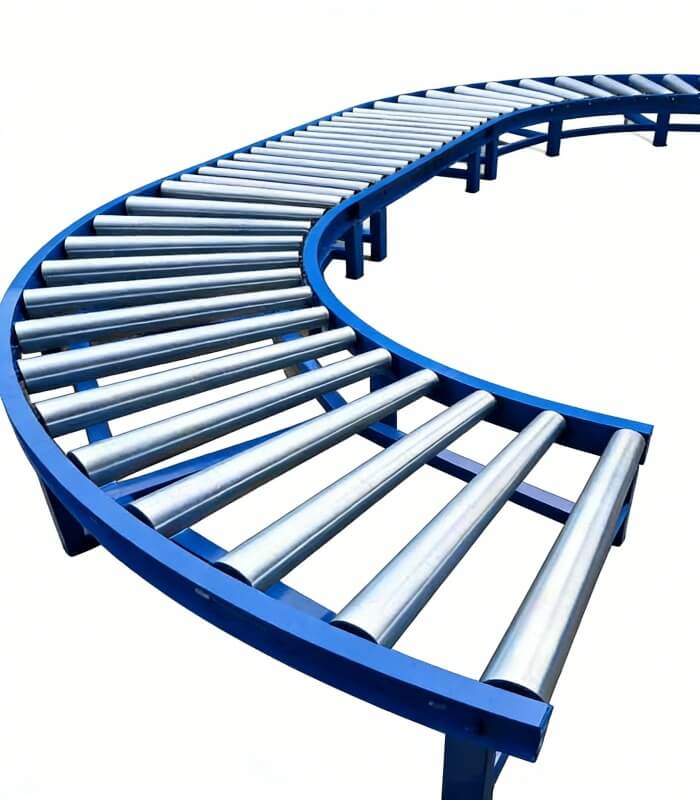
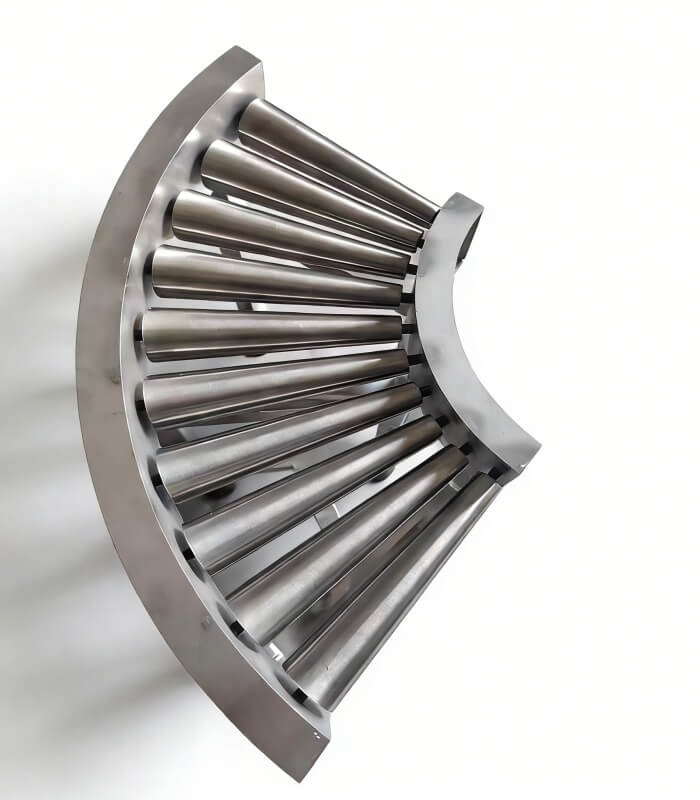
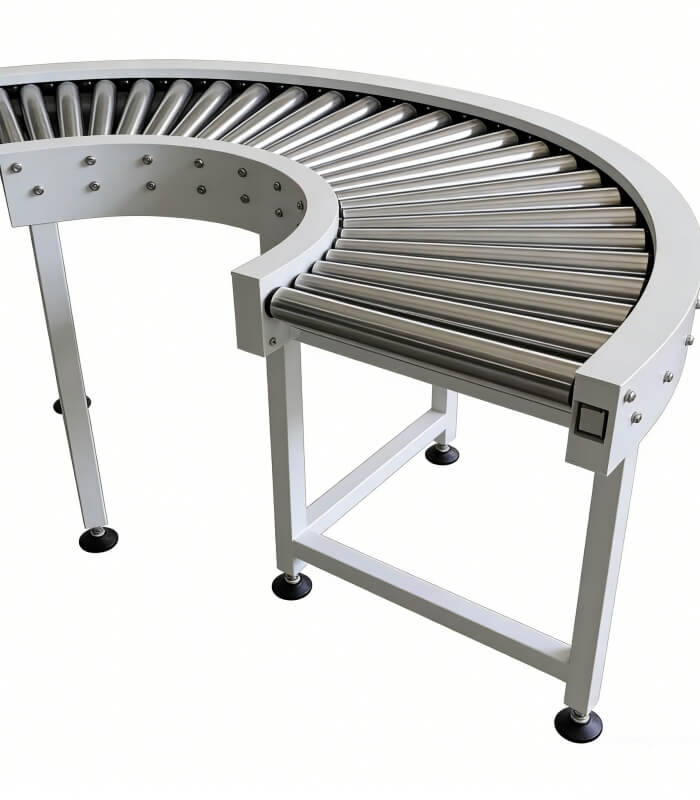
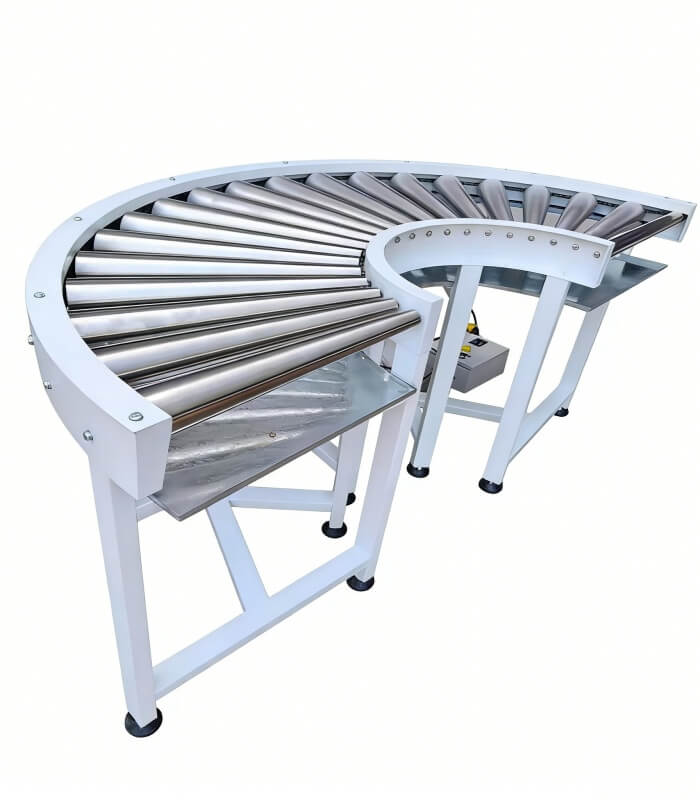

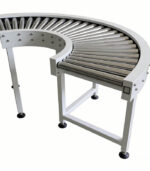
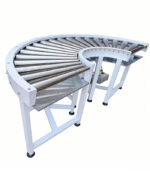
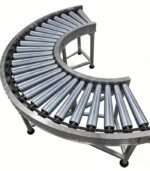
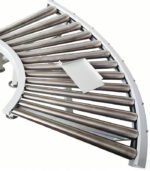
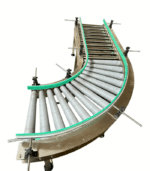
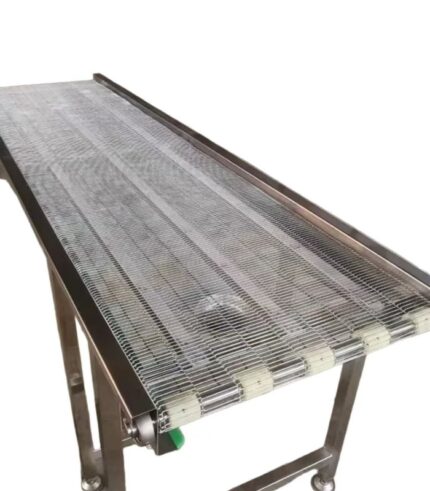
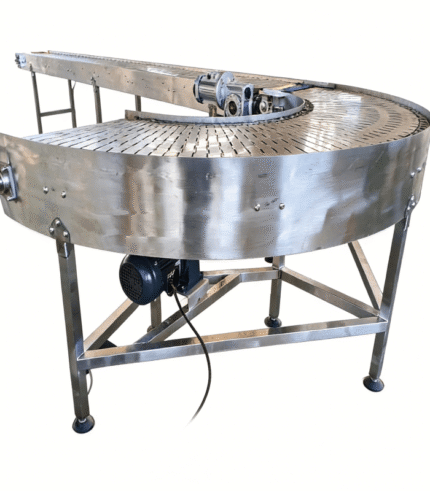
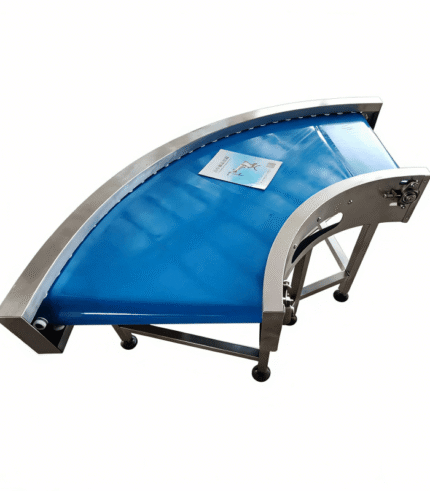
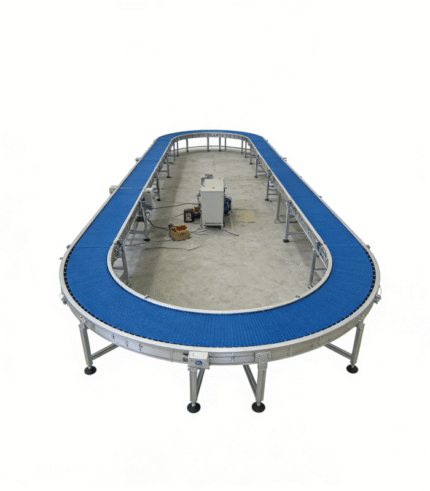
Curved roller conveyor, curved roller conveyor system, floor roller conveyor
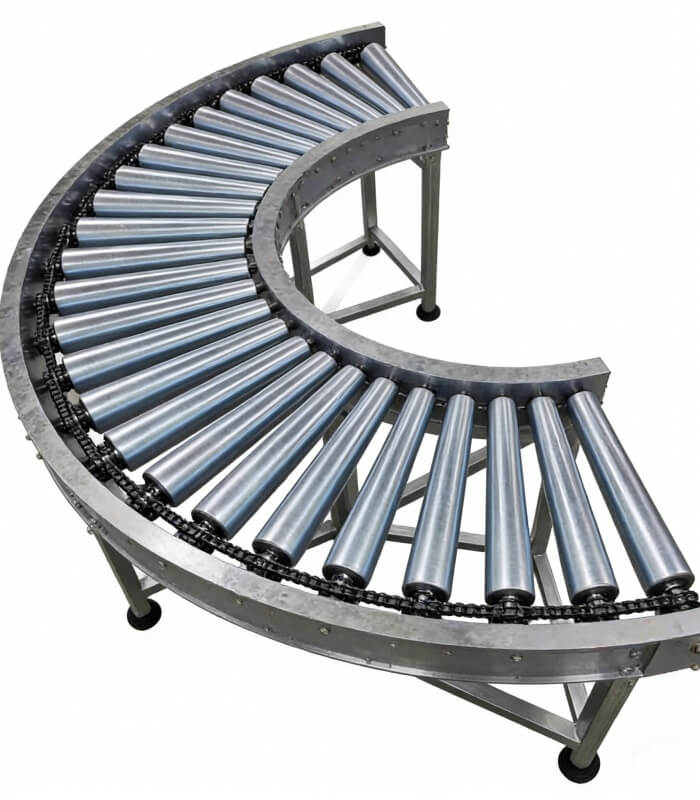
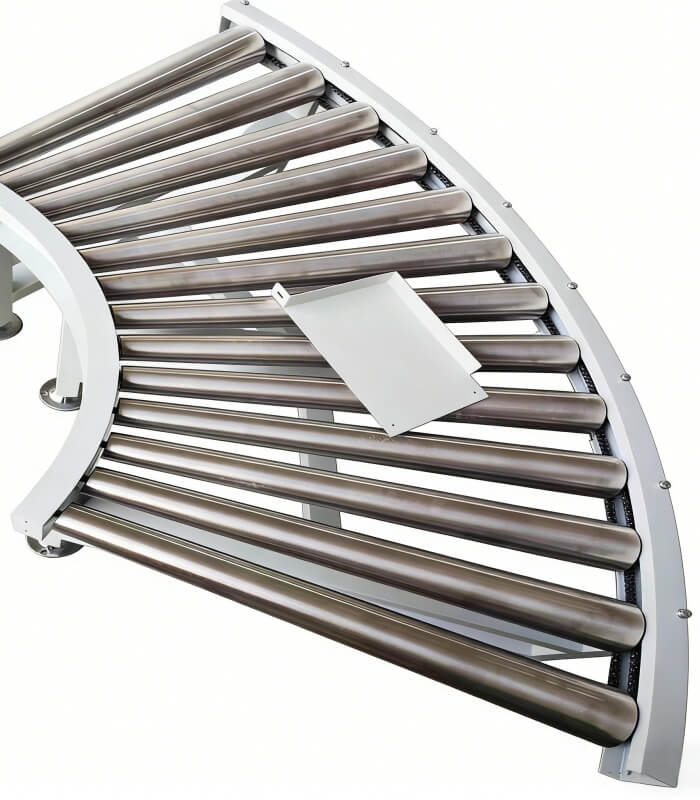
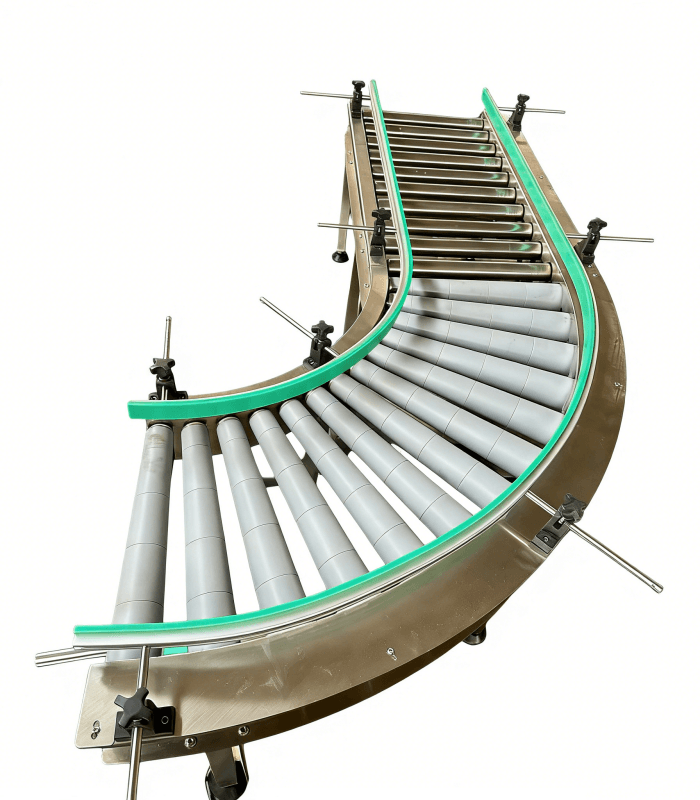
A curved roller conveyor is a modular conveying system that uses tapered rollers to redirect materials along a curved path; it is suitable for connecting sections at angles such as 90° and 180°.
A roller curve conveyor is a conveying device that utilizes the principle of differential speed in conical rollers to smoothly redirect materials along a curved path. It is widely used for spatial integration in logistics sorting, packaging lines, and automated production lines. Below are its detailed applications, advantages, and manufacturing processes:
I. Applications
Roller curve conveyors are primarily used in scenarios requiring a change in conveying direction or optimization of spatial layout:
1. Logistics Sorting Centers: Connects with straight roller conveyors to achieve 90° and 180° turning, diverging, and converging of parcels and cartons, forming circular or serpentine sorting systems.
2. Production Assembly Lines: In industries such as electronics, home appliances, and automotive/motorcycle manufacturing, it connects conveyor lines between different processes to create L-shaped or U-shaped layouts, saving factory floor space.
3. Warehouse Inbound/Outbound Systems: Serves as supporting equipment for automated high-rack warehouses to facilitate the turning and conveying of pallets and bins.
4. Post-Packaging Processes: Works in conjunction with case openers, case sealers, and palletizers to handle product turning and diversion.
II. Product Advantages
The core advantages of roller turning conveyors lie in their high space utilization and smooth conveying:
1. Space-saving and flexible layout: Capable of operating within a small turning radius (as small as R300mm), adapting to complex factory layouts and narrow spaces to facilitate material flow across multiple floors or in compact areas.
2. Modular Customization and Multi-Directional Conveying: Supports customization for various turning angles, including 30°, 45°, 60°, 90°, and 180°, allowing for personalized designs based on production needs and facilitating system expansion and upgrades.
3. Stable Structure and Efficient Transport: Equipped with precision high-performance bearings, it operates smoothly and reliably, with a maximum conveying speed of 80 m/min, significantly improving material turnover efficiency. Roller conveyors are easily interconnected, allowing multiple lines to be combined into complex logistics systems.
4. Low-Noise Operation: Incorporates noise-reduction features such as polyamide drive heads and sound-dampening V-belts, keeping operational noise below 72 dB(A), making it suitable for quiet workshop environments.
5. High load capacity: Capable of conveying heavy individual items (such as pallets and heavy containers) or withstanding significant impact loads.
III. Product Manufacturing Process
The core of manufacturing the roller curve conveyor lies in the precision machining of conical rollers and the high-precision welding of curved frames. The main process flow is as follows:
1. Design and Selection Phase
Key parameters are determined based on customer requirements, including: dimensions and weight of the conveyed items, turning angle (45°, 90°, 180°, etc.), turning radius (R600, R900, R1200 mm, etc.), conveying speed, and environmental requirements. The core design principle is that the taper of the conical drum must ensure equal angular velocity at every point of the cargo relative to the center. Otherwise, the cargo will deviate from the centerline and fail to turn accurately.
2. Machining of Key Components
(1) Conical Drum Machining (Core Technology)
The tapered roller is the core component of a curved conveyor, and its taper design directly affects conveying accuracy:
· Structural Configuration: There are two types: “fixed taper-shaft” (where the shaft and taper rotate together) and “separate shaft-taper” (where the taper rotates while the shaft remains stationary). The separate type offers easier installation, better sealing, and longer service life, but is more difficult to manufacture.
· Taper Design: The taper angle is typically approximately 2.2°, requiring precise calculations based on cargo dimensions, turning radius, and conveying speed.
· Materials and Processes: Rollers can be made of galvanized carbon steel, stainless steel, aluminum alloy, or engineering plastics (such as polypropylene). Tapered components are produced via injection molding, featuring wear resistance, noise reduction, impact resistance, and excellent weather resistance.
· Drive Accessories: Drive heads are machined at the drum ends according to the drive method (sprocket, V-belt, multi-ribbed belt).
(2) Arc-Shaped Frame Fabrication
· Inner and Outer Arc Guards: Fabricated from steel plate via welding or bending, these must ensure precise curvature to support the tapered drums and prevent cargo from slipping out.
· Frame Welding: Since the surface of the tapered drum must remain level, the frame must be angled to match the drum’s taper. After welding, the frame undergoes stress-relief annealing to prevent deformation.
· Legs: Made of lightweight channel steel, they are connected to the base via an adjustable mechanism to facilitate leveling of the frame.
(3) Machining of Drive Components
· Drive Method: Chain drive is generally used, with power transmitted sequentially between each pair of adjacent rollers. The tight side of the chain should be on top, and the angle between adjacent rollers should not exceed 5°, otherwise the chain is prone to derailment. V-belts, multi-v-belts, or flat friction belts may also be used.
· Drive System: The system can be driven by a gearmotor or an electric drum. A sprocket is mounted on the motor’s output shaft, which drives the drums via a chain.
· Buffering and Protection: Buffering plates equipped with buffer wheels and springs are installed on the inner side of the outer arc guard plates in the turning sections. These absorb the impact force of the cargo, protect the goods, and reduce noise.
4. Final Assembly and Commissioning
· Assembly: Install the tapered rollers in sequence at the designed angles into the mounting holes of the inner and outer arc guards (using spring-loaded press-fit or internal threaded shaft fasteners). Install the drive chain/V-belt and connect the drive motor.
· Commissioning:
· No-Load Commissioning: Power on and run the system to check whether the rollers rotate smoothly and whether the chain/V-belt is misaligned.
· Load Testing: Place standard cargo (cartons/pallets) to test whether the turn is smooth, whether the cargo deviates from the centerline, and whether there is any slippage or impact against the outer arc guard plates.
· Speed Adjustment: Use the variable frequency drive to adjust the conveying speed to the target value within the range of 15–80 m/min.
IV. Summary of Key Parameters
Parameter Dimension Typical Values/Requirements
Curve Angle 30°, 45°, 60°, 90°, 180°
Curve Radius ≥300 mm (Standard: 600, 900, 1200 mm)
Frame Width: Cargo width + 50–100 mm; standard widths: 200, 300, 400, 500, 1200 mm
Conveyor Speed: 15–80 m/min
Load Capacity: Standard type ≤50 kg/piece; heavy-duty up to 2000 kg (requires pallets)
Roller Type: Tapered rollers (taper angle approx. 2.2°)
Drive Method: Chain drive (heavy-duty), V-belt/multi-v belt (light-duty)
Drive System: Geared motor drive, electric roller drive
Frame Material: Powder-coated carbon steel, stainless steel, aluminum profiles
Control Method: Electric roller type / variable frequency speed control
V. List of Key Selection Parameters
The following information must be specified during procurement or design:
1. Curve Parameters: Curve angle (90°/180°, etc.), curve radius (R in mm), inner and outer arc lengths
2. Conveyed Item Parameters: Item type (cartons/pallets/soft packages), unit weight, external dimensions (L×W×H)
3. Performance Requirements: Conveyor speed (m/min), load capacity (kg/item), noise requirements
4. Environmental Conditions: Indoor/outdoor, humidity, temperature, cleanliness requirements (stainless steel material required for food/pharmaceutical industries)
5. Interconnection Requirements: Height, width, and speed matching for integration with upstream and downstream straight roller conveyors
The key feature of the curved roller conveyor lies in its use of a tapered roller structure. The difference in linear velocity created by the rollers’ inner diameter being smaller than their outer diameter allows goods to turn smoothly along the curved track. Below are the detailed specifications and descriptions:
—
I. General Core Parameter Ranges
Parameter Item General Range Remarks
Curve Angle 30°, 45°, 60°, 90°, 180° 90° is the most common specification
Curve Radius ≥300mm (Standard: 600, 900, 1200mm) Light-load plastic tapered drums can achieve R357mm
Effective Width (BW) ≤1700mm = Conveyed Item Width + 50mm
Roller Diameter Small-end diameter 38/50/60mm (Tapered rollers)
Roller Spacing ≥50mm To ensure the cargo contacts at least 3 rollers
Conveyor Speed 15–80 m/min (Typically 15–30 m/min)
Load Capacity: ≤50 kg/item (Standard Light Duty) ~ 1000 kg/m (Heavy Duty); Heavy Duty requires customization
Noise Level: <72 dB(A); Noise-reduction design available
Equipment Height (H): ≥200 mm; Customizable upon request
II. Key Component Details and Specifications
1. Tapered Rollers (Core Technology)
The tapered roller is the most critical component of a curved conveyor; its taper design directly affects conveying stability:
Parameter Specification/Requirement Description
Taper Angle Approx. 1.8°–2.2° Calculated based on turning radius and cargo dimensions
Structure Type Separate shaft and cone design Easy installation, good sealing, long service life
Material Options Galvanized steel, stainless steel, aluminum alloy, PVC, rubber-coated Galvanized steel is recommended for general environments
Surface Treatment Galvanized/Blackened/Rubber-coated Select based on the environment
Roller Length Width of conveyed goods + 50 mm Ensures goods are fully within the roller surface
Roller Selection Principles: Distribute the weight of the conveyed items across the contact rollers, calculate the required load capacity for each roller, and determine the wall thickness and shaft diameter.
2. Frame and Structure
Component | Material Options | Description
Frame Side Panels | Powder-coated carbon steel, stainless steel, aluminum alloy | Requires high precision in curved processing
Legs | Light-duty channel steel + adjustable feet | Facilitates leveling
Guardrails Carbon steel/stainless steel round tubing or sheet metal Prevents goods from being thrown out
Inner Circle Design: The junction box and motor are installed within the inner circle of the main body, resulting in a compact structure.
3. Drive and Transmission System
Item Specifications/Options Description
Drive Method Geared motor drive, electric roller drive Electric roller drive offers a more compact structure
Transmission Method: Single sprocket, double sprocket, O-ring belt, multi-v belt; sprockets for heavy loads, belts for light loads
Motor Power: 0.2–3.7 kW; selected based on load and conveyor length
Power Supply: AC 220 V / AC 380 V
Speed Control: Variable frequency drive, stepless speed variation
Noise Reduction Design: Polyamide (nylon) drive heads replace metal sprockets, and noise-reducing V-belts are installed on the drive wheels, significantly reducing operational noise.
4. Control and Detection (Smart Type)
Modern logistics curved roller conveyors can be equipped with detection mechanisms:
Configuration Function
Speed Sensor Detects incoming material speed, automatically adjusts roller speed to prevent goods from tipping over
Infrared Sensor: Detects cargo passage; enters low-power mode when no cargo is present
Control Panel: Sets operating parameters and displays operational data
III. Classification Parameters by Curve Angle
Curve Angle Typical Curve Radius (mm) Applicable Scenarios
30° ≥800 Fine-tuning direction; space-constrained environments
45° ≥800 Common angle for logistics diversion
60° ≥800 For special layout requirements
90° 600/900/1200 Most commonly used; for connecting L-shaped production lines
180° Customizable; for U-shaped production lines or return lines
Small-radius turning technology: Brands such as Interroll use polypropylene conical components to achieve a curve radius as small as 357 mm, suitable for the light-load packaging industry.
IV. List of Key Selection Parameters
The following information must be clarified during procurement or design:
1. Curve Parameters
· Curve angle (30°/45°/60°/90°/180°)
· Curve radius (R in mm)
· Inner and outer arc lengths
2. Conveyed Item Parameters
· Item type (cartons/pallets/flexible packaging), unit weight
· Dimensions (L × W × H)
· Base condition: flat/evenly distributed load
3. Performance Requirements
· Conveyor speed (m/min)
· Load capacity (kg/item or kg/m)
· Noise requirements (typically ≤72 dB)
4. Environment and Configuration
· Indoor/outdoor, humidity, temperature, and cleanliness requirements (stainless steel required for food/pharmaceutical applications)
· Frame material (powder-coated carbon steel/stainless steel/aluminum profiles)
· Drive Type (Geared Motor/Electric Drum)
· Need for Intelligent Detection (Speed Sensor/Infrared Sensor)
V. Summary
Parameter Dimension Typical Values/Requirements
Core Selection Criteria Turning Angle, Turning Radius, Cargo Dimensions and Weight
Turning Angle 30°/45°/60°/90°/180°
Curve Radius ≥300 mm (Standard: 600/900/1200 mm)
Effective Width Cargo width + 50 mm
Roller Type Tapered rollers (taper angle approx. 1.8°–2.2°)
Roller Material Galvanized steel/Stainless steel/Aluminum alloy/PVC/Rubber-coated
Drive Type: Geared motor / Electric drum
Drive Method: Sprocket (heavy-duty) / V-belt (light-duty)
Conveyor Speed: 15–80 m/min
Load Capacity: ≤50 kg (standard) / 1000 kg/m (heavy-duty)
Frame Material: Powder-coated carbon steel / Stainless steel / Aluminum extrusions


评价
目前还没有评价