What is a Flexible Chain Conveyor? Design, Logic & Applications

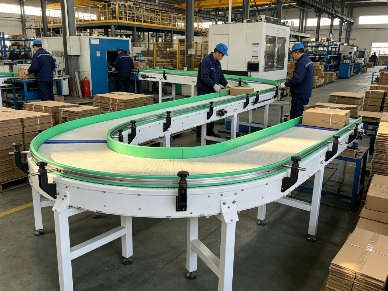
In the landscape of modern industrial automation, factory floor space is often the most expensive asset. Traditional linear conveyor belts, while effective for straight-line transport, frequently fail when faced with complex facility layouts, multi-level elevation changes, or tight cornering requirements. This is where the flexible chain conveyor system becomes indispensable.
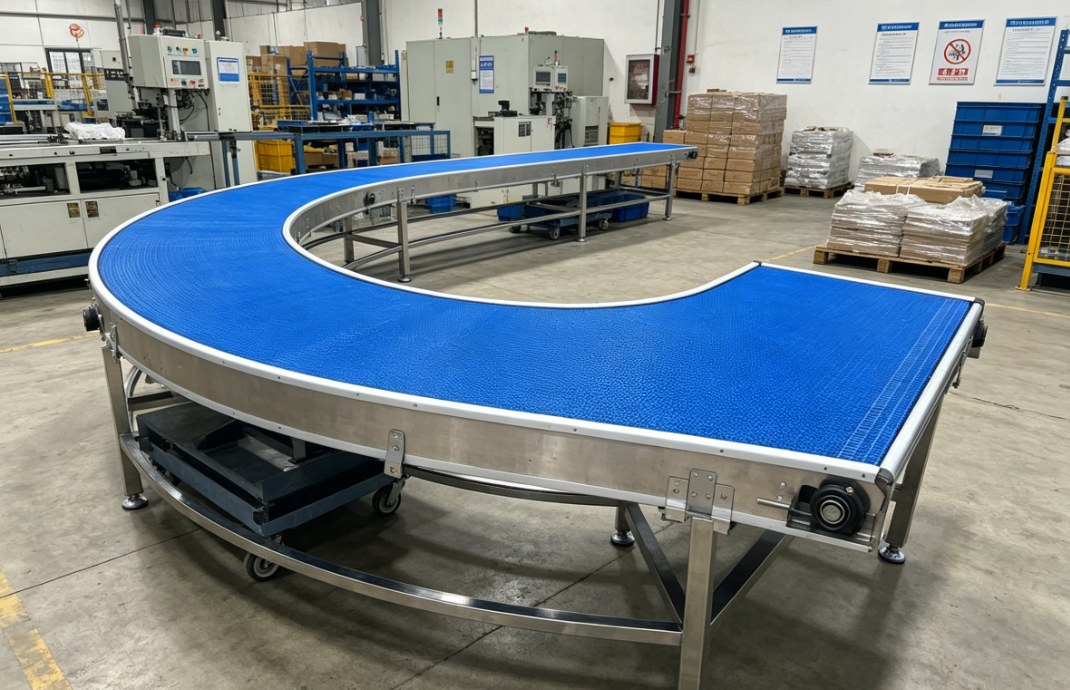
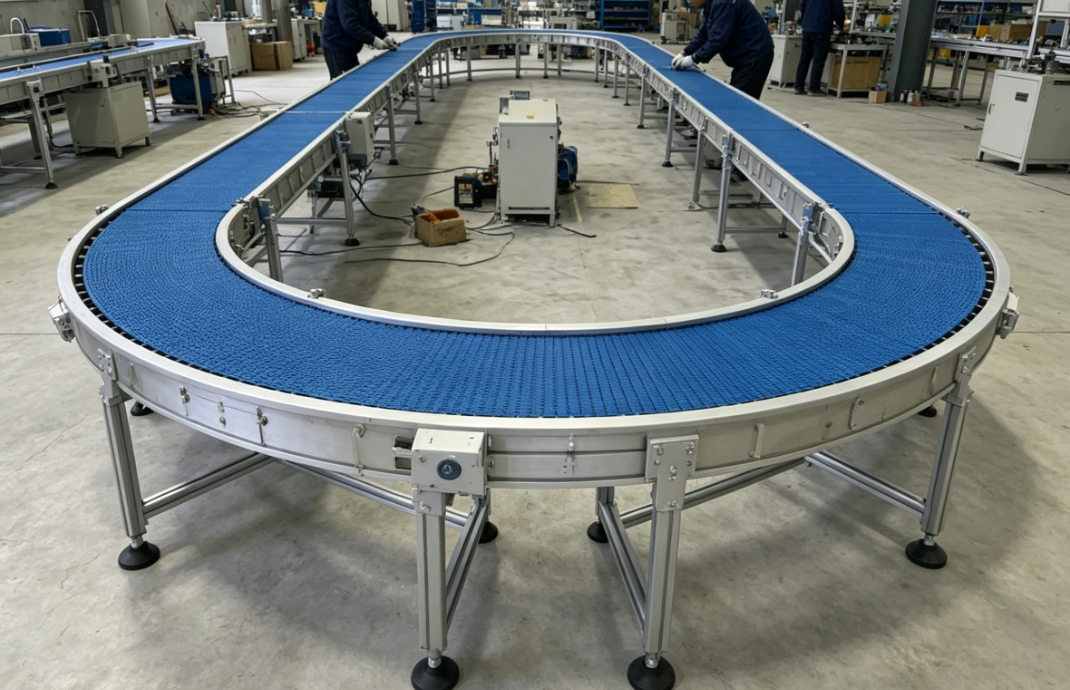
A flexible chain conveyor is a modular material handling solution utilizing a plastic or stainless steel chain that articulates in three dimensions. Unlike standard belt conveyors that are limited to two-dimensional movement, these systems can navigate horizontal curves, vertical inclines, and declines within a single continuous loop. For engineers and facility managers, this means the ability to route products around obstacles, through tight spaces, and across different floor levels with a single drive motor.
The Mechanics of Multi-Flexing Movement
The “flexibility” of these systems is derived from the geometry of the chain links. Each link is designed to pivot both horizontally and vertically. This allows the conveyor to achieve a remarkably small turning radius compared to its width.
For instance, a standard flexible chain system can often navigate a 90-degree turn with a radius as small as 150mm to 500mm, depending on the chain width (common widths include 63mm, 83mm, and 103mm). This mechanical capability is critical in high-density production environments, such as pharmaceutical packaging or beverage bottling, where every square meter of the facility must be utilized.
Anatomical Components of the System
To understand how a flexible chain conveyor operates, one must look at its modular architecture. These systems are typically constructed from standardized aluminum or stainless steel beams that serve as the “spine” of the conveyor.
The Conveyor Beam: A lightweight but rigid profile that houses the chain. It provides the track for the chain and the mounting points for accessories like side guides.
The Flexible Chain: Usually molded from high-performance Acetal (POM) or similar low-friction polymers. These materials offer high tensile strength and a low coefficient of friction against the slide rails.
Slide Rails: These are wear-resistant plastic strips (often UHMW-PE) snapped into the beam. They support the chain and ensure smooth, quiet operation while minimizing energy consumption.
Drive and Idler Units: The drive unit houses the motor and sprocket that pulls the chain, while the idler unit provides the necessary tensioning and return path.
Technical Comparison: Flexible Chain vs. Traditional Belt Conveyors
When evaluating material handling options, engineers must weigh the trade-offs between different conveyor technologies.
| Feature | Flexible Chain Conveyor | Traditional Belt Conveyor |
| Movement Logic | 3D (Horizontal, Vertical, Slopes) | 2D (Primarily Linear) |
| Turn Radius | Extremely Tight (Modular curves) | Wide (Requires large pulleys) |
| Space Efficiency | High (Vertical accumulation) | Moderate (Requires long footprints) |
| Maintenance | Easy (Replace individual links) | Difficult (Requires belt splicing/tensioning) |
| Energy Usage | Low (Low friction materials) | Moderate to High |
Engineering Logic: Why Use Plastic Chains?
Most modern flexible systems utilize plastic chains rather than metal. The choice of engineering-grade polymers like POM is deliberate. These materials are self-lubricating, which reduces the need for external oils that could contaminate sensitive products in food or medical industries.
Furthermore, plastic links are lightweight. This reduces the total mass the motor needs to move, leading to lower energy costs and less wear on the drive components. In the event of damage, a single link can be popped out and replaced in minutes, whereas a torn belt often requires hours of downtime for vulcanization or replacement.
Key Application Scenarios
The adoption of flexible chain conveyors is most prevalent in industries where product geometry is varied and throughput speed is high.
Pharmaceutical & Lab Automation: Navigating small vials or blister packs through cleanroom environments where vertical space is used for accumulation.
Food & Beverage: Handling cans, bottles, or pouches. The modular nature allows for “wash-down” configurations where hygiene is paramount.
Electronics Manufacturing: Transporting delicate components between robotic assembly stations with precision and minimal vibration.
E-commerce & Packaging: Sorting small parcels or boxes through complex “snake” layouts to maximize floor throughput.
Design Considerations for Layout Optimization
When integrating a flexible chain system, the design phase must account for the “pitch” of the chain and the load-bearing capacity of the beam. Since the chain pulls from a single point, the total length of a single conveyor run is limited by the tensile strength of the chain.
Longer runs or high-load applications may require multiple drive units or specific chain reinforcements. Modern configurations, such as those found in the Leyu Conveyor chain series, offer various chain types—including friction-top chains for inclines and cleated chains for vertical lifts—to meet these specific engineering constraints.
Maintenance and Longevity in Industrial Environments
A common misconception is that flexible systems are more fragile due to their plastic components. In reality, when properly specified, these systems offer a longer service life than belts.
Maintenance primarily involves monitoring the wear of the slide rails and the tension of the chain. Because the system is modular, it is “future-proof.” If a production line needs to be rerouted next year, the aluminum beams can be disassembled and reconfigured into a new shape with minimal additional investment in hardware.
The Strategic Value of Modularity
For an OEM project manager or a manufacturing consultant, the flexible chain conveyor represents more than just a means of moving parts from point A to point B. It represents flexibility in the truest sense—the ability to adapt a production line to changing market demands without scrapping the existing infrastructure.
By utilizing standardized components and 3D routing logic, factories can reduce their footprint, lower their energy consumption, and increase the MTBF (Mean Time Between Failures) of their material handling systems.
FAQ
Q: Can flexible chain conveyors handle heavy loads?
A: While they excel at small-to-medium parts, high-strength POM chains can handle significant loads. However, they are generally not used for heavy pallets or large automotive frames; those typically require roller or heavy-duty slat conveyors.
Q: Are these systems noisy?
A: No. Due to the use of low-friction plastic slide rails and precise sprocket engagement, flexible chain conveyors are significantly quieter than traditional metal chain or roller systems.
Q: How do I choose the right chain width?
A: Chain width is determined by the maximum width of your product. Standard widths like 83mm are common for bottling, while wider chains are used for larger boxed goods. Always ensure the product base is stable on the chain surface.
Q: Is it possible to go 90 degrees straight up?
A: Yes, using “wedge” conveyors or “gripper” chains, products can be gripped by their sides and transported vertically at a 90-degree angle to save floor space.
Reference Sources
- CEMA (Conveyor Equipment Manufacturers Association): Standards for unit handling and conveyor safety.
- ISO 2110:2020: Guidelines for the design and safety of continuous handling equipment.
- Hytrol Material Handling Systems: Technical whitepapers on modular chain dynamics.
- Leyu Conveyor Technical Documentation: Product specifications for 83mm and 103mm flexible chain series.