Selecting the Best High Temperature Metal Mesh Belt for Efficiency

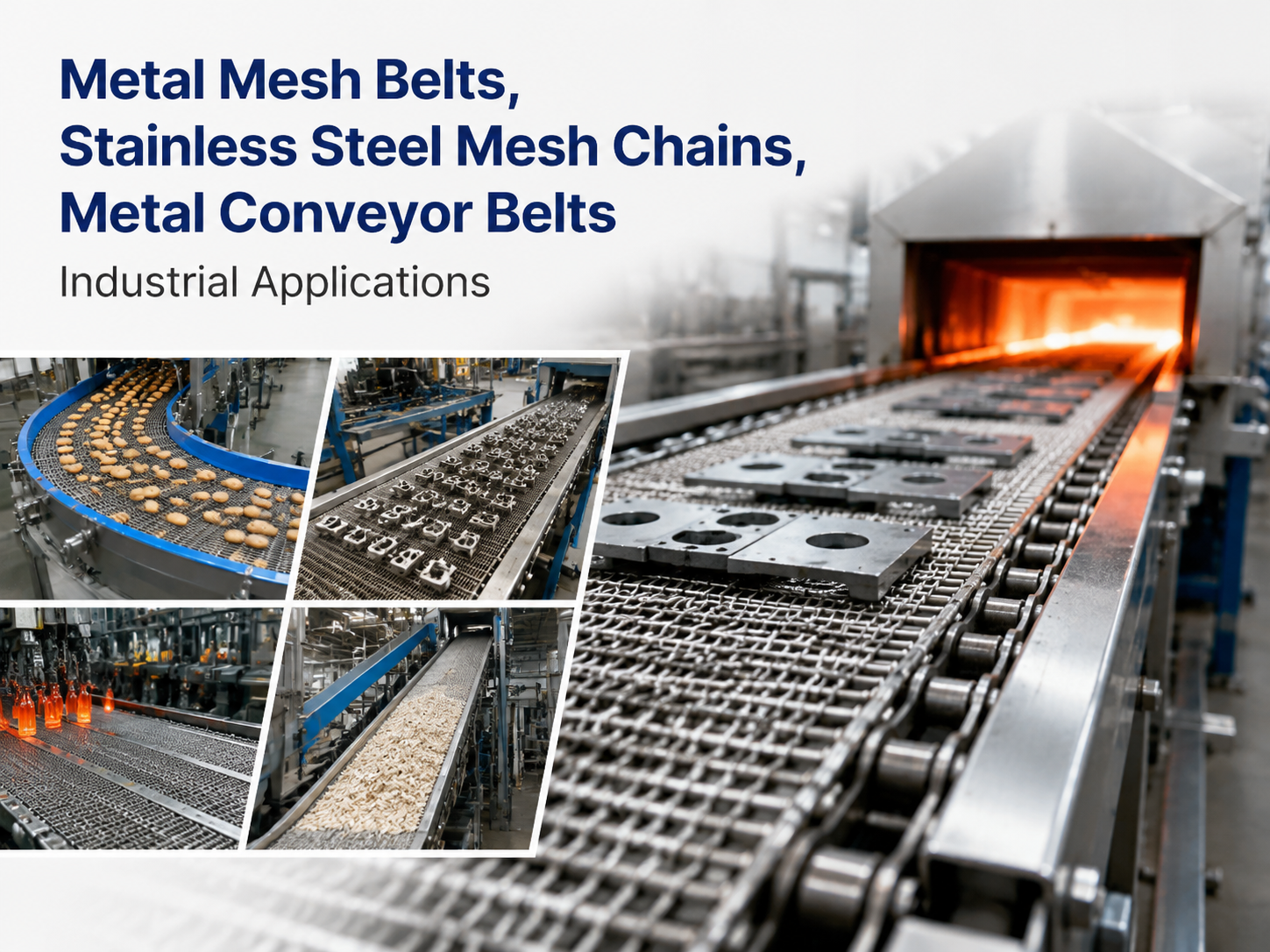
Thermal processing environments—ranging from industrial baking and glass annealing to powder metallurgy and sintering—place extraordinary demands on conveyor systems. Selecting the wrong high temperature metal mesh belt doesn’t just lead to premature belt failure; it results in catastrophic downtime, compromised product quality, and significant revenue loss. In high-heat applications where temperatures often exceed 1,000°C (1,832°F), the belt is not merely a transport mechanism but a critical thermal component that must withstand oxidation, creep, and mechanical stress simultaneously.
When engineers and procurement managers evaluate mesh belts, the focus must shift from “price per meter” to “total cost of ownership.” This involves a deep dive into metallurgy, weave architecture, and the specific atmospheric chemistry of the production line.
Understanding the Metallurgy of Heat Resistance
The most fundamental decision in the selection process is the alloy. In high-temperature zones, standard stainless steels lose their structural integrity. You must match the alloy’s chemistry to your specific operating temperature and atmosphere.
| Alloy Grade | Max Operating Temp | Primary Characteristics | Common Applications |
| AISI 304 | 400°C – 500°C | Basic corrosion resistance; loses strength at high heat. | Food processing, light cooling. |
| AISI 316 | 500°C – 600°C | Better chemical resistance than 304. | Chemical processing, salt environments. |
| AISI 314 | 1,000°C – 1,150°C | High Silicon content for superior oxidation resistance. | Heat treatment, glass lehrs. |
| AISI 310S | 1,050°C – 1,100°C | High Chromium and Nickel; excellent for intermittent heating. | Sintering, brazing furnaces. |
| Inconel 601 | 1,200°C+ | Exceptional resistance to oxidation and carburization. | High-end metallurgy, aerospace. |
For most industrial furnace applications, AISI 314 and 310S are the industry workhorses. The high chromium content allows the belt to form a protective oxide “scale” that prevents deeper corrosion. However, if your process involves rapid cooling cycles, you must account for “thermal shock,” which can cause this scale to flake off, exposing the core metal to accelerated degradation.
Weave Architecture: Balancing Load and Airflow
The geometry of the belt determines how it handles mechanical tension under heat. In high-temperature environments, metal becomes “plastic,” meaning it stretches more easily (a phenomenon known as creep).
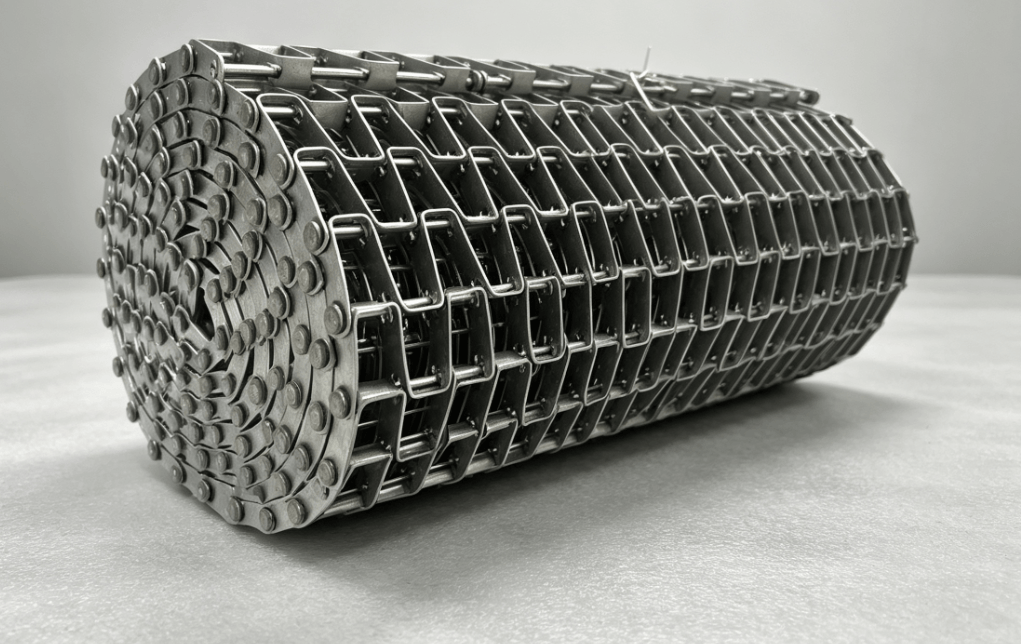
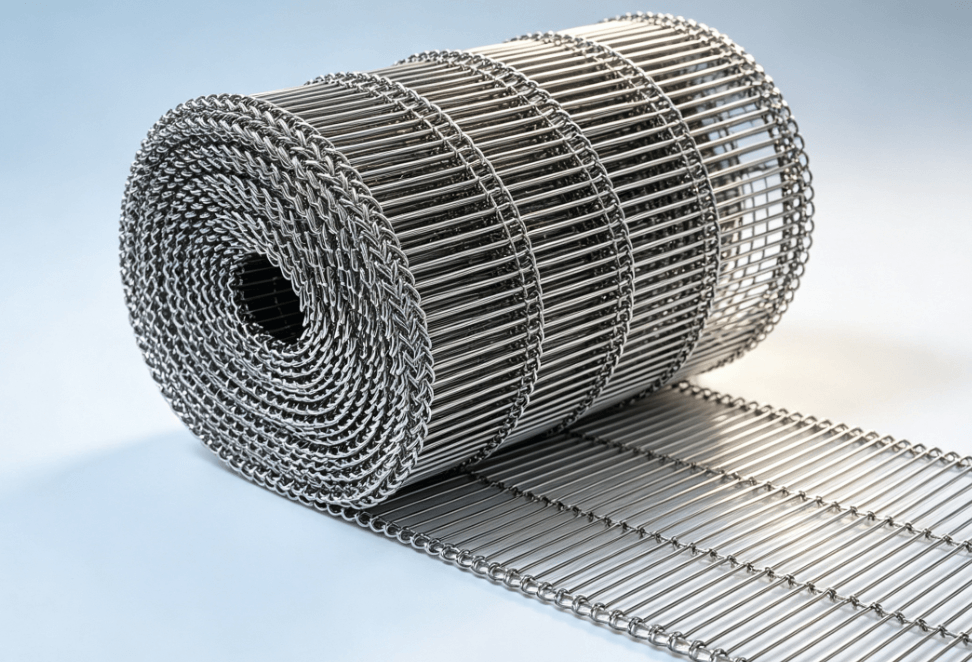
- Balanced Weave Belts: This is the most popular choice for general high-temperature use. It features alternating left and right-hand spirals joined by a crimped connector. The “balanced” nature prevents the belt from tracking to one side, which is critical when heat causes the conveyor frame to expand unevenly.
- Compound Balanced Weave (CB Series): By using multiple spirals and cross-rods per pitch, this weave creates a very dense, flat surface. This is ideal for small parts or unstable products that require a continuous support base. However, the reduced open area means less airflow, which may increase heating times in convection-based ovens.
- Rod Reinforced Weave: For heavy-load applications like foundry work or heavy forging, rod-reinforced belts offer the highest tensile strength. The reinforcement allows the belt to carry more weight without the spirals “stretching out” over time.
When consulting with a manufacturer like LeYu Conveyor, it is essential to provide the exact weight-per-square-foot of your product. This allows engineers to calculate the “Allowable Working Tension” (AWT), ensuring the belt won’t snap under the combined stress of the load and thermal expansion.
The Critical Role of Furnace Atmosphere
A common mistake in procurement is ignoring the chemical makeup of the furnace atmosphere. A belt that thrives in an oxidizing atmosphere (rich in oxygen) may fail rapidly in a reducing atmosphere (hydrogen or nitrogen-rich).
- Oxidizing Atmospheres: Generally favorable for stainless alloys as they help maintain the protective chromium oxide layer.
- Carburizing Atmospheres: Common in heat-treating steels. Carbon can penetrate the belt alloy, making it brittle and prone to “green rot” or internal oxidation. In these cases, alloys with higher nickel content (like Inconel) are required to prevent carbon absorption.
- Sulphidation: If your process involves sulfur-bearing fuels or materials, nickel-based alloys can fail prematurely. In such specific niches, specialized high-chromium, low-nickel alloys are the safer bet.
Technical Edge Details and Drive Systems
The “business end” of the belt—the edges—is where many failures begin. In high-temperature production, the edges are subject to different cooling rates than the center of the belt, creating thermal gradients.
- Welded Edges: The most common for high-heat belts. Automated plasma welding ensures each spiral is fused to the cross-rod. This provides a smooth edge that resists snagging.
- Ladder/Knuckled Edges: These are preferred when the belt must navigate small-diameter pulleys or when the application requires mechanical flexibility over pure lateral strength.
- Side Plates and Flights: For inclined high-temperature conveyors, integrated side plates prevent product loss. These must be engineered with “expansion gaps” to allow the metal to grow and shrink without warping the base mesh.
The drive system is equally vital. For high-temperature belts, friction drives are common, but they require precise tensioning. If the belt is too tight, creep acceleration occurs; too loose, and the belt slips, leading to heat spots and uneven wear.
Optimizing Procurement: Total Life Cycle Cost
When evaluating a supplier, especially for OEM or large-scale replacements, technical support outweighs the initial quote. A high-quality high temperature metal mesh belt should be viewed as an engineering asset.
Key questions for your supplier should include:
- Material Certification: Can they provide MTRs (Material Test Reports) to verify the alloy chemistry?
- Pre-stressing: Does the factory pre-stress the belt before shipping to minimize “initial stretch” during the first few furnace cycles?
- Customization: Can they adjust the wire gauge or pitch to optimize the “Open Area vs. Strength” ratio for your specific throughput?
By focusing on these technical parameters—alloy chemistry, weave geometry, and atmospheric compatibility—production managers can significantly extend the service life of their conveyor systems. Investing in a belt engineered for the specific rigors of your thermal process reduces the frequency of replacements and ensures a more stable, predictable production environment.
FAQ
Q: How often should I inspect my high temperature metal mesh belt?
A: In 24/7 high-heat operations, a weekly visual inspection for “necking” (narrowing of the belt), localized oxidation, or tracking issues is recommended. Monthly measurements of the belt’s total length can help track the rate of creep.
Q: Can I use a standard 304 stainless belt for a 900°C furnace?
A: No. While 304 is stainless, it will oxidize rapidly and lose almost all structural strength above 600°C. For 900°C, you should use at least AISI 310S or 314 to ensure safety and longevity.
Q: What causes a belt to “wave” or become distorted at high temperatures?
A: This is usually caused by “thermal gradient stress.” If one side of the belt is hotter than the other, or if the belt is heated/cooled too rapidly, the uneven expansion causes the mesh to warp. Ensuring even heat distribution across the furnace width is the best fix.
Q: Does LeYu Conveyor provide custom edge treatments for sintering belts?
A: Yes, custom edge reinforcements and specialized welding techniques are available to handle the specific stresses of sintering and brazing cycles.
Q: What is the lead time for specialty alloy belts like Inconel?
A: Because specialty alloys are not always stocked in all wire gauges, lead times can range from 4 to 8 weeks. It is advisable to maintain a “spare belt” on-site for critical production lines.
Reference Sources
- ASTM A240/A240M: Standard Specification for Chromium and Chromium-Nickel Stainless Steel Plate, Sheet, and Strip for Pressure Vessels and for General Applications. astm.org
- ISO 15156: Materials for use in H2S-containing environments in oil and gas production (relevant for high-temp chemical resistance). iso.org
- Nickel Institute: High-Temperature Characteristics of Stainless Steels. nickelinstitute.org
- ASM International: Specialty Handbook: Stainless Steels (Technical data on creep and oxidation). asminternational.org