How to Choose a Spiral Tower Conveyor for Limited Factory Space

Choosing a spiral tower conveyor for limited factory space requires balancing vertical lift, available floor area, conveying capacity, product stability, and the process conditions along the production line. A spiral system can move products continuously between elevations while using a compact footprint, but it is not suitable for every load or layout. The right selection starts with the product, the required material flow, and the available building height—not simply the desire to save floor space.
Why Use a Spiral Tower Conveyor in a Space-Constrained Factory?
A spiral tower conveyor moves products along a continuous helical path around a vertical structure. It can connect different production elevations or provide additional conveying time within a relatively compact floor area.
Unlike a long inclined conveyor, a spiral tower uses vertical space to accommodate the conveying path. This can be useful when equipment, walls, columns, or existing production lines limit the room available for horizontal transport.
Typical applications include:
- Cooling baked products after an oven.
- Moving packaged foods through a cooling or freezing process.
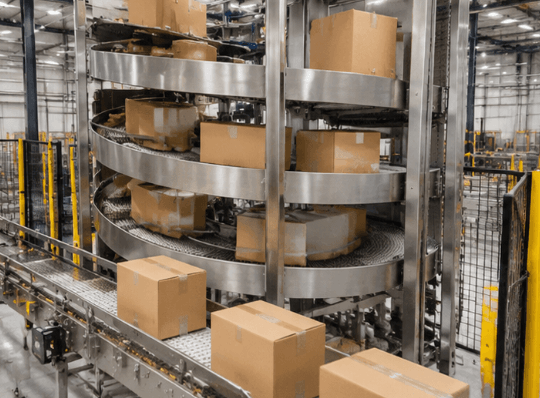
- Elevating cartons, containers, or other suitable unit loads.
- Providing accumulation between production stages.
- Connecting equipment positioned at different elevations.
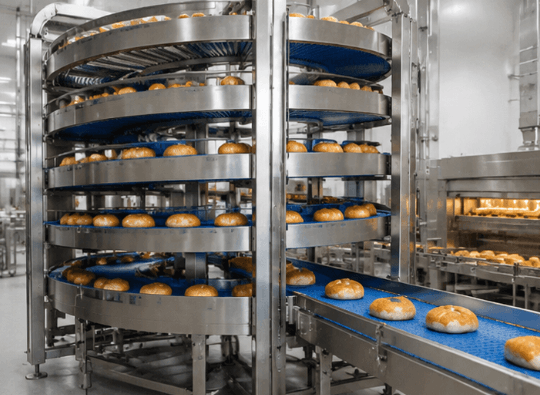
For example, a bakery may need to allow products to cool before packaging. A spiral conveyor can provide a longer travel path without requiring an equally long straight conveyor route across the factory floor. The required residence time, belt arrangement, and environmental conditions must still be evaluated for the actual product.
LEYU’s spiral conveyor and food cooling tower is designed for vertical conveying and applications that include cooling and freezing. The appropriate configuration depends on the process requirements and the selected equipment specifications.
Spiral Tower Conveyor vs. Other Vertical Conveying Options
A spiral tower is most useful when continuous product movement and a compact vertical layout are important. Other conveying systems may be more suitable when the load, transfer method, or operating cycle differs.
| Conveying option | Where it may fit | Main consideration |
|---|---|---|
| Spiral tower conveyor | Continuous elevation changes, cooling, freezing, or accumulation | Vertical clearance, spiral footprint, product stability, and process time |
| Inclined conveyor | Products moving between nearby elevations with sufficient horizontal space | Incline angle, product retention, and available conveyor length |
| Hoist or vertical lift conveyor | Discrete loads transferred between fixed levels | Cycle time, loading method, positioning, and transfer sequence |
| Straight conveyor on multiple levels | Facilities with sufficient room for separate horizontal conveying sections | Building layout, transfer points, and coordination between sections |
A spiral tower is not automatically the most economical option. If products only need to move between two nearby levels in intermittent batches, a vertical lift may be simpler. If the process needs cooling time or continuous flow, a spiral arrangement may offer a better fit.
For applications involving discrete loads and fixed-level transfers, compare the requirements with a suitable hoist conveyor system. The choice should be based on the operating cycle and material flow rather than equipment names alone.
Five Factors That Determine Spiral Tower Conveyor Selection
1. Available Floor Space and Building Height
Measure the available footprint and the usable height before selecting a tower. The overall installation requires more than the conveying structure itself: infeed and discharge conveyors, drive components, guarding, access routes, and maintenance clearances also occupy space.
Confirm the following dimensions:
- Available floor area and permitted tower diameter.
- Required infeed and discharge elevations.
- Total usable building height and overhead obstructions.
- Positions of columns, walls, doors, and existing equipment.
- Access space for inspection, cleaning, and repairs.
A layout that fits on paper may still be impractical if operators cannot access critical components or if product transfers require awkward conveyor transitions. Request a general arrangement drawing before approving the installation footprint.
2. Product Dimensions, Weight, and Stability
The product determines the suitable conveying surface and the conditions under which it can travel safely around the spiral. Record the minimum and maximum product dimensions, unit weight, base shape, center of gravity, and orientation.
Flat-bottomed packages may behave differently from tall bottles, flexible bags, or irregular containers. Products with a high center of gravity can become unstable during acceleration or when gaps occur at transfer points.
Also consider whether products touch one another, require individual spacing, or must maintain a fixed orientation. Side guides and transfer arrangements should be evaluated where necessary, without creating additional friction or product damage.
3. Required Throughput and Residence Time
Throughput describes how much material must pass through the system over a given period. Residence time describes how long a product remains on the conveyor, which is particularly important for cooling, freezing, or other process applications.
For a cooling application, the required conveying path depends on the incoming product condition, target exit condition, airflow, product spacing, and process environment. A longer spiral path alone does not guarantee adequate cooling.
For general conveying, calculate the required product flow and compare it with the proposed belt speed and loading arrangement. Confirm performance under normal operation and anticipated peak demand.
For process applications, provide the supplier with the product temperature at entry, required exit condition, product dimensions, and available process time. Thermal performance should be evaluated separately from mechanical conveying capacity.
4. Belt Material and Operating Environment
The conveying surface must suit the product, operating temperature, cleaning method, moisture level, and any chemical exposure. A material suitable for ambient carton handling may not be appropriate for hot bakery products or low-temperature freezing applications.
LEYU’s published spiral tower information describes configurations using stainless steel components, including 304 or 316L stainless steel, and carbon steel for selected non-corrosive environments. Actual material suitability depends on the specific component, grade, process conditions, and cleaning requirements.
For food processing, ask for documentation supporting any required food-contact or hygiene claims. Stainless steel construction alone does not establish compliance for every component or application.
For freezing applications, confirm the operating temperature range of the complete system, including the belt, drive, bearings, lubrication, seals, and electrical components. Low-temperature performance should not be inferred from the belt material alone.
5. Integration With Upstream and Downstream Equipment
A spiral conveyor operates as part of a larger material handling system. The infeed and discharge points must align with the production process, and the transfer arrangement must accommodate the dimensions and stability of the products.
Check conveyor elevations, travel direction, product spacing, speed matching, accumulation requirements, and control signals. If an upstream machine produces continuously but the downstream machine stops periodically, the line may require accumulation capacity or coordinated controls.
LEYU’s spiral tower product information describes optional control features such as PLC integration and speed monitoring. Confirm the available configuration and interface requirements for the specific project rather than assuming these features are included in every standard model.
How to Check Whether a Spiral Tower Fits Your Production Line
Before requesting a quotation, prepare a short engineering brief that defines the actual operating conditions. This helps the supplier assess the proposed configuration and identify missing information.
| Requirement | Information to provide | Why it matters |
|---|---|---|
| Product | Dimensions, weight, shape, and orientation | Determines conveying surface and product stability |
| Layout | Available footprint, building height, and transfer elevations | Establishes physical installation constraints |
| Production rate | Units per minute or hour and peak demand | Supports capacity and speed evaluation |
| Process conditions | Entry and exit temperatures, cooling or freezing needs, humidity | Determines environmental and process requirements |
| Integration | Upstream and downstream equipment, interfaces, and controls | Reduces transfer and synchronization problems |
| Maintenance | Cleaning access, inspection requirements, and spare parts | Supports practical long-term operation |
When reviewing a proposal, check the scope of supply, drive and control arrangements, guarding, installation requirements, and documentation. Ask which performance values are confirmed and which require testing or further engineering review.
Total ownership cost also matters. Installation work, cleaning time, energy consumption, maintenance access, and replacement components can affect the long-term economics of the system.
For an initial product review, visit LEYU’s spiral tower conveyor category. Compare the listed product configuration with the intended application, then confirm the technical details with the supplier.
Common Selection Mistakes to Avoid
- Choosing by footprint alone: A compact structure is not useful if the system cannot meet throughput or process-time requirements.
- Ignoring building height: Infeed, discharge, drive assemblies, and service access all affect the required clearance.
- Assuming all products can travel on the same belt: Dimensions, center of gravity, friction, and temperature can change the suitability of the conveying surface.
- Confusing conveying capacity with cooling capacity: Mechanical throughput does not establish that a product will reach its target temperature.
- Leaving transfer interfaces until installation: Unconfirmed heights, gaps, and control signals can create bottlenecks or product instability.
- Comparing quotations with different assumptions: Verify that each supplier is quoting against the same load, layout, operating conditions, and scope.
Conclusion
Spiral tower conveyor selection for limited factory space requires a combined assessment of floor footprint, available height, product stability, throughput, process time, operating environment, and line integration. The most suitable design is the one that satisfies the actual production requirement while remaining accessible for cleaning and maintenance.
Before choosing a model, prepare the product and layout data, define the required operating conditions, and request a technical proposal that identifies confirmed performance values and unresolved assumptions. This approach gives engineering and procurement teams a more reliable basis for comparing spiral tower conveyors and reducing installation risks.
Frequently Asked Questions
When should a factory choose a spiral tower conveyor?
A spiral tower is worth evaluating when products need continuous vertical transport, cooling, freezing, or accumulation and floor space is limited. Suitability depends on product characteristics, throughput, available building height, and the process requirements.
Does a spiral tower conveyor always save more space than an inclined conveyor?
Not in every layout. A spiral tower uses a compact vertical path, while an inclined conveyor requires a longer horizontal run. The actual footprint comparison must include infeed and discharge sections, access space, guarding, and maintenance clearances.
Can a spiral tower conveyor be used for cooling or freezing?
Yes, spiral conveyors can be used in cooling and freezing applications when the equipment, belt, drive, and operating environment are suitable. The required residence time and thermal performance must be confirmed for the specific product and process conditions.
What information should be included in a spiral conveyor quotation request?
Provide product dimensions and weight, required throughput, infeed and discharge heights, available footprint, operating temperature, cleaning requirements, and details of connected equipment. Include a layout drawing where possible so the proposed configuration can be evaluated against the actual installation.