Straight Conveyor Types: How to Choose the Right Configuration

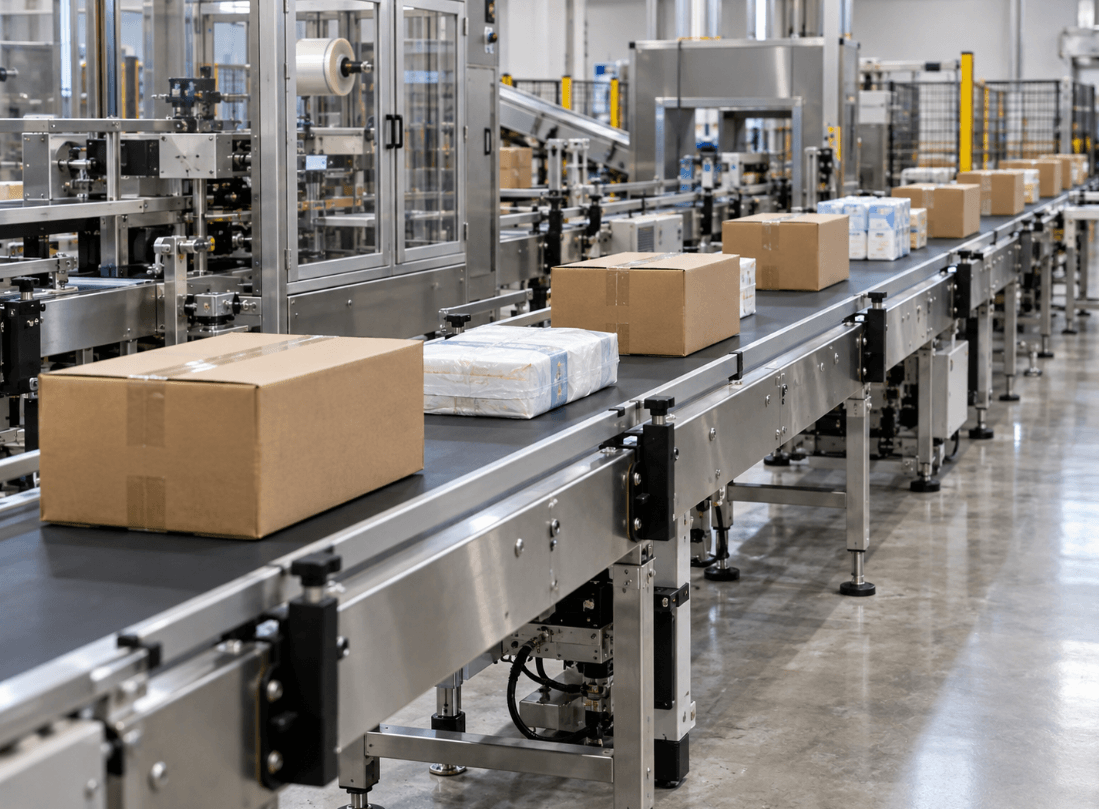
Choosing the right straight conveyor depends on the products being transported, required throughput, load characteristics, operating environment, and how the conveyor connects to other production equipment. Common straight conveyor types include belt conveyors, roller conveyors, chain conveyors, plastic modular belt conveyors, and metal mesh belt conveyors. Each uses a different conveying surface or drive mechanism, so the correct configuration should match the application rather than simply the available space or purchase price.
What Are the Main Types of Straight Conveyors?
A straight conveyor transports products along a predominantly linear path between workstations, processing equipment, storage areas, or packaging operations. Although the route is straightforward, conveyor designs differ significantly in how they support loads, transfer motion, manage friction, and handle operating conditions.
The main configurations include continuous belt systems, gravity or powered roller conveyors, chain-driven systems, modular plastic belt conveyors, and metal mesh belt conveyors. Some are designed for individual packages, while others are better suited to production processes involving moisture, heat, drainage, or specific hygiene requirements.
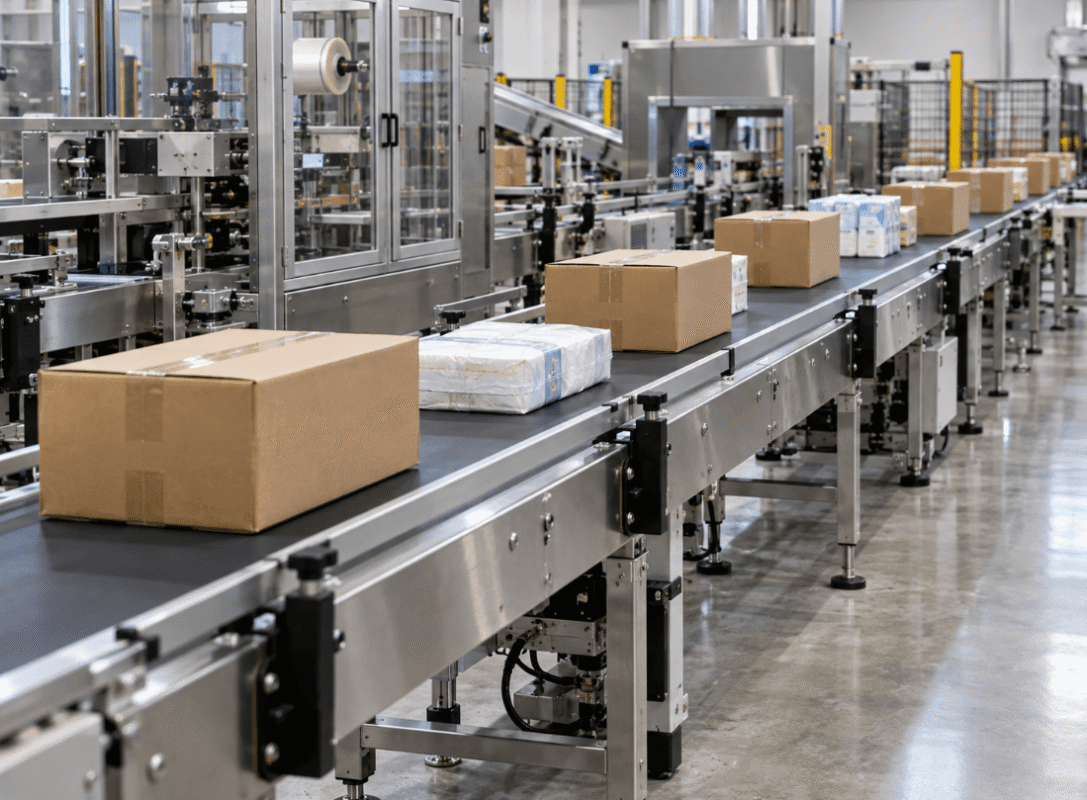
1. Flat Belt Conveyors
A flat belt conveyor uses a continuous belt supported by rollers or a sliding bed. A drive pulley moves the belt, carrying products along its surface.
This configuration is commonly considered for cartons, packaged goods, components, and products that need a continuous supporting surface. The belt material and surface texture should be selected according to the product, friction requirements, and operating environment.
Flat belt conveyors may be unsuitable when products require substantial drainage, the material is too hot for the belt compound, or the load exceeds the design limits of the belt and support structure. The correct belt construction, pulley arrangement, tensioning method, and drive capacity must be verified for the intended duty.
2. Roller Conveyors
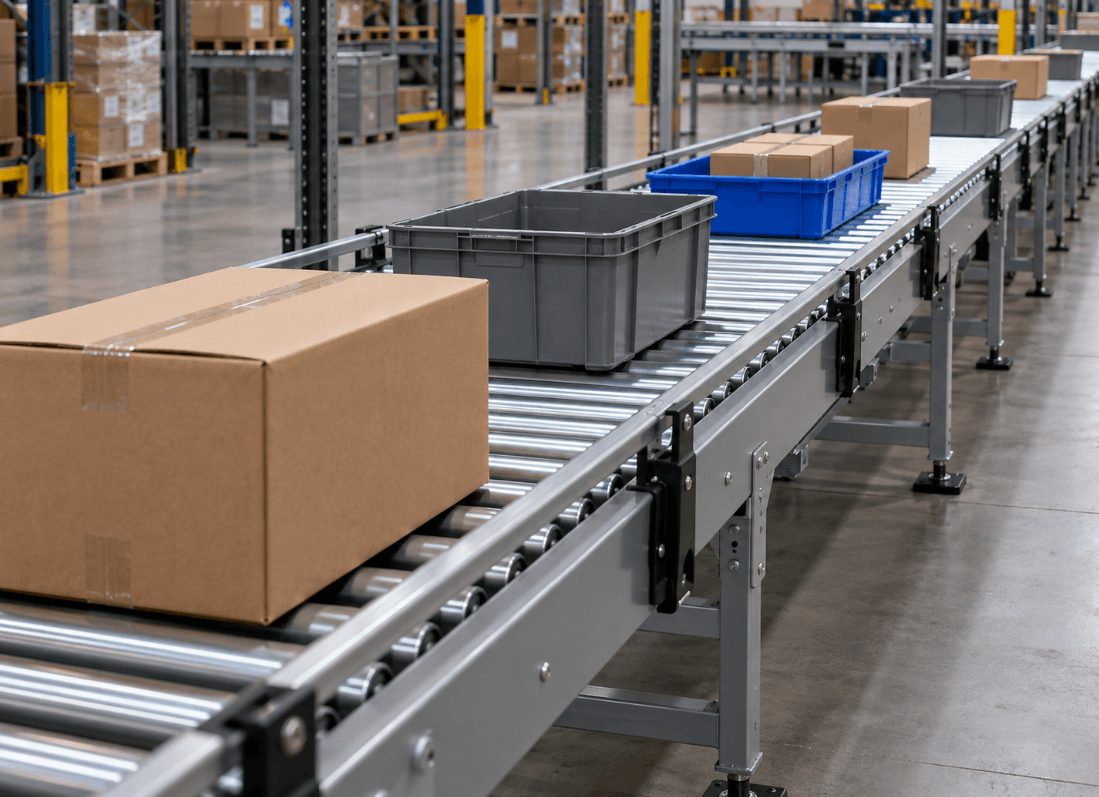
Roller conveyors transport products on a series of rollers. Gravity roller systems rely on an appropriate incline or manual movement, while powered roller systems use motors, belts, chains, or other drive arrangements.
They can be suitable for cartons, totes, trays, and products with a sufficiently stable base. Roller spacing must support the product throughout its travel; small packages or irregular bases may require a different arrangement.
Roller conveyors are not automatically suitable for every product. Flexible packages may sag between rollers, while unstable items may need guides or a continuous supporting surface.
3. Chain Conveyors
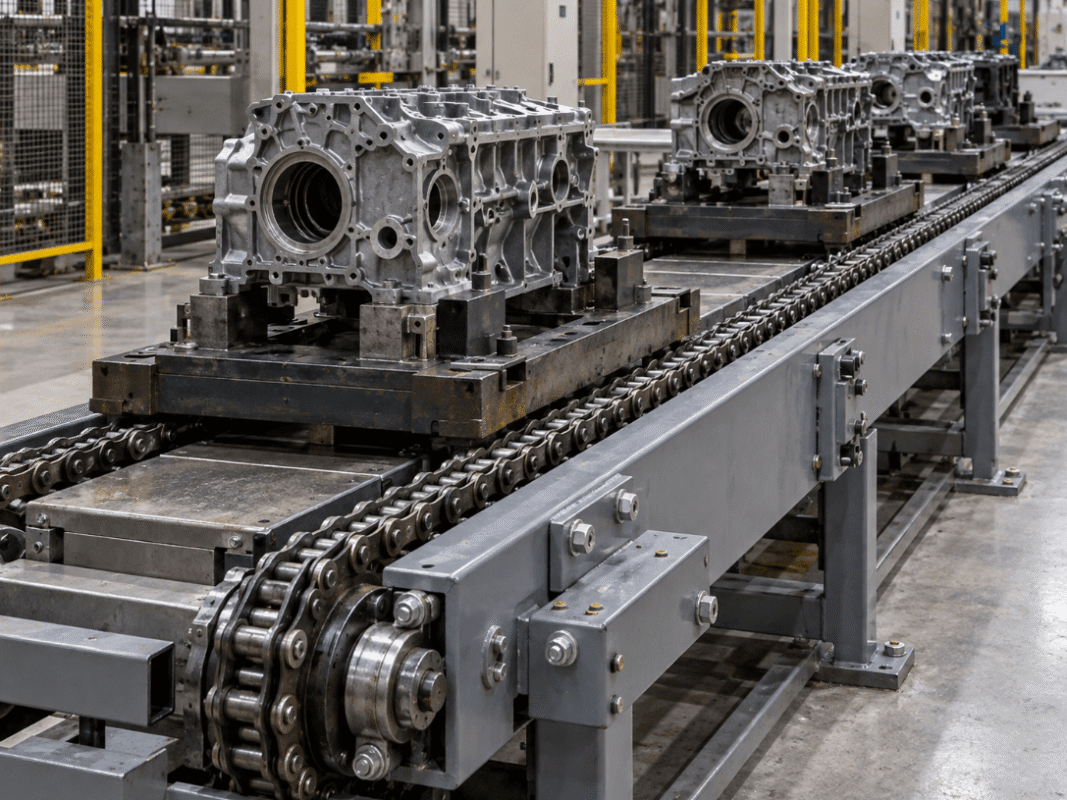
Chain conveyors use one or more driven chains to move products directly or support pallets, fixtures, or carriers. Their suitability depends on the chain design, load distribution, required positioning, and transfer method.
They are worth evaluating when the application requires a chain-driven conveying surface or a defined load-carrying arrangement. However, chain type, sprocket compatibility, lubrication requirements, and maintenance access must be considered together.
For a closer comparison of transmission methods and applications, read LEYU’s chain conveyor vs. belt conveyor guide.
4. Plastic Modular Belt Conveyors
Plastic modular belt conveyors use interlocking plastic modules connected by pins. Their modular construction can make it practical to replace individual sections, while the belt design can be selected for specific conveying and cleaning requirements.
These systems are commonly considered for food processing, packaging, and industrial handling where the required belt surface, drainage, corrosion resistance, or maintenance arrangement favors modular construction.
Material selection still matters. Polypropylene (PP), acetal (POM), polyethylene (PE), and other engineering plastics have different mechanical and environmental properties. The appropriate material depends on temperature, chemical exposure, load, wear, and product-contact requirements.
Review LEYU’s plastic modular conveyor belt range when evaluating this configuration.
5. Metal Mesh Belt Conveyors
Metal mesh belt conveyors use a woven or linked metal conveying surface. Depending on the belt construction, openings can allow airflow, drainage, or passage of small process residues.
They may suit applications where an open metal surface is useful, including certain food-processing, drying, cooling, and industrial conveying operations. The correct design depends on mesh opening, wire or link construction, load distribution, corrosion exposure, and temperature.
An open mesh belt is not necessarily appropriate for small products that can fall through its openings. The belt and support arrangement must be matched to the smallest product dimension and the actual process conditions.
How Do Straight Conveyor Types Compare?
| Conveyor type | Typical applications | Main selection considerations |
|---|---|---|
| Flat belt conveyor | Cartons, packaged goods, components | Belt material, friction, tension, pulley design, and load |
| Roller conveyor | Boxes, totes, trays, and suitable unit loads | Product base, roller spacing, accumulation, and drive method |
| Chain conveyor | Pallets, fixtures, carriers, and selected industrial loads | Chain type, sprocket matching, load distribution, and maintenance |
| Plastic modular belt conveyor | Food processing, packaging, and suitable industrial products | Polymer selection, belt design, cleaning, wear, and temperature |
| Metal mesh belt conveyor | Processes requiring airflow, drainage, or a metal conveying surface | Mesh opening, material grade, corrosion, temperature, and support |
These categories are not always mutually exclusive. A modular belt conveyor may be chain-driven, and a powered roller conveyor may use a chain transmission. When comparing systems, distinguish the conveying surface from the mechanism that drives it.
Which Configuration Fits Your Production Application?
Packaging and Assembly Lines
For cartons, totes, and packaged components, start by evaluating product stability and the required transfer accuracy. Flat belt conveyors provide continuous support, while roller systems may suit rigid-base packages and accumulation layouts.
Where the product must remain in a controlled orientation, check the transfer gaps, guide rails, stopping method, and synchronization with upstream or downstream equipment. Small changes in product dimensions can affect the reliability of transfers.
Food Processing and Washdown Areas
Food-processing applications require a closer review of the conveying surface, cleaning method, moisture exposure, and material compatibility. Plastic modular belts may offer suitable configurations for drainage or cleaning access, while metal mesh belts may be useful where an open surface is required.
Do not assume that a plastic or stainless steel conveyor automatically meets food-contact requirements. Request relevant material documentation and confirm that the complete system suits the cleaning chemicals, operating temperature, and intended product contact.
For a deeper review of belt selection factors, see LEYU’s conveyor belt materials selection guide.
Industrial Components and Heavier Loads
For metal parts, fixtures, or palletized products, the load path and structural support become central considerations. Engineers should verify the load rating of the complete assembly, including the conveyor surface, chain or rollers, shafts, bearings, frame, and supports.
Heavy loads may require a chain conveyor or a suitably engineered roller system rather than a light-duty flat belt. The decision depends on the product base, transfer requirements, operating cycle, and how loads are distributed across the conveyor.
How to Select the Right Straight Conveyor Configuration
1. Define the Product and Load
Document the product dimensions, unit weight, base shape, center of gravity, surface condition, and orientation. For bulk materials, also consider particle size, bulk density, moisture, and the risk of spillage.
Use the heaviest expected load and the least stable product as part of the design review. An average product may travel reliably while an unusually large or poorly balanced item causes jams or transfer problems.
2. Calculate Required Throughput
For discrete products, estimate the required mass throughput by multiplying the number of items transported per hour by their average weight. This provides a basic capacity estimate but does not replace a full conveyor assessment.
Product spacing, speed, loading pattern, accumulation, and downstream cycle time also influence usable throughput. The proposed configuration should meet the actual production demand without creating a bottleneck at transfer points.
3. Match the Conveying Surface to the Environment
Review temperature, humidity, oil, chemicals, cleaning procedures, and corrosion exposure. A belt that performs well in a dry packaging area may not suit a wet washdown zone or a process involving elevated temperatures.
Use the manufacturer’s technical data to verify the permitted operating range and material compatibility. General polymer or metal properties should not be treated as a guaranteed rating for the complete conveyor.
4. Check Layout and Equipment Interfaces
Confirm the conveyor length, width, elevation, loading position, discharge position, support structure, and access space. Check how the conveyor connects to filling, inspection, assembly, sorting, or packaging equipment.
A straight conveyor may be mechanically suitable but still perform poorly if the upstream machine feeds products irregularly or the receiving equipment cannot accept the output. Evaluate the entire material flow rather than the conveyor in isolation.
5. Compare Maintenance and Lifecycle Requirements
Compare the access needed to clean the conveying surface, inspect moving parts, adjust tension, and replace wear components. Chain systems may require chain and sprocket inspections, while belt systems may need tracking, tension, and splice checks.
LEYU’s conveyor belt troubleshooting guide discusses issues such as mistracking, slippage, and material buildup. These failure modes are useful considerations when assessing maintenance access and the operating conditions of a belt-based system.
What Should You Confirm Before Requesting a Quotation?
A clear technical brief helps suppliers recommend an appropriate configuration and reduces the risk of comparing quotations with different assumptions.
- Product dimensions, unit weight, and base characteristics.
- Required throughput, conveying speed, and operating schedule.
- Conveyor length, width, elevation, and installation constraints.
- Required belt, roller, chain, or mesh construction.
- Temperature, moisture, cleaning, and chemical exposure.
- Infeed and discharge details, including connected machinery.
- Control, guarding, and site-specific safety requirements.
- Maintenance access, spare parts, and inspection requirements.
- Installation scope, testing, and technical documentation.
When reviewing a supplier proposal, confirm which specifications are documented and which require further engineering review. Request drawings where dimensions, interfaces, or support arrangements are important.
Purchase price should be assessed alongside installation, maintenance, replacement components, cleaning time, and expected operating demands. The lowest initial quotation may not represent the best fit if it excludes necessary equipment or does not meet the application requirements.
Conclusion
The main straight conveyor types differ in their conveying surface, drive arrangement, load support, and suitability for particular environments. Flat belt systems provide continuous support, roller conveyors suit compatible unit loads, chain systems support selected industrial applications, and modular plastic or metal mesh belts address different process requirements.
Choose the configuration by defining the product, throughput, operating environment, layout, and equipment interfaces first. Then verify the complete system specifications with the supplier. This approach supports a more reliable comparison of conveyor options and reduces the risk of mismatched equipment.
Frequently Asked Questions
What are the most common straight conveyor types?
Common types include flat belt conveyors, roller conveyors, chain conveyors, plastic modular belt conveyors, and metal mesh belt conveyors. The appropriate type depends on the product, load, operating environment, and required material flow.
What is the difference between a belt conveyor and a chain conveyor?
A belt conveyor moves products on a continuous belt surface, while a chain conveyor uses one or more chains to move loads or support carriers. The best choice depends on load characteristics, product contact, drive requirements, and maintenance needs.
Are plastic modular belt conveyors suitable for food processing?
They can be suitable when the belt material, construction, and complete equipment meet the application’s temperature, cleaning, and product-contact requirements. Buyers should verify relevant material documentation instead of assuming that all plastic belts are food-contact compliant.
What information is needed to select a straight conveyor?
Provide product dimensions and weight, required throughput, conveyor length and width, operating environment, transfer positions, and details of connected equipment. These inputs help the supplier assess capacity, material selection, and layout compatibility.