Best Food Processing Conveyor Solutions: A Technical Selection Guide

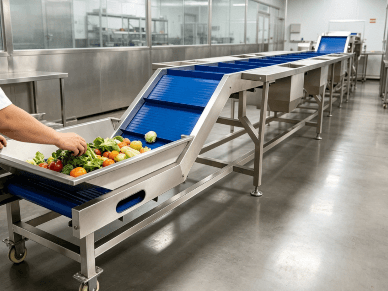
Selecting the right food processing conveyor solutions is not merely about moving a product from point A to point B. In a high-stakes manufacturing environment, the choice of a conveyor system impacts food safety audits, sanitation labor costs, and overall equipment effectiveness (OEE). Whether you are handling raw protein, delicate bakery items, or frozen produce, the mechanical design must align with strict regulatory standards while maintaining high throughput.
The global food industry is shifting toward “Sanitary Design” as a baseline rather than an upgrade. For plant managers and OEM engineers, the challenge lies in balancing the initial capital expenditure (CAPEX) with the long-term operational savings found in reduced water usage and faster cleaning cycles.
Why Sanitary Design Defines the Best Food Processing Conveyor Solutions
In food production, the “best” solution is defined by its ability to prevent bacterial growth and cross-contamination. Traditional conveyors often have “dead zones”—small crevices or hollow frames where organic matter can collect. Modern food processing conveyor solutions prioritize open-frame architectures.
Engineers typically look for:
- T-Joint and Butt-Weld Construction: Minimizing overlapping metal surfaces where Listeria or Salmonella can thrive.
- Self-Draining Surfaces: Ensuring that after a washdown, no standing water remains on the equipment.
- Tool-less Disassembly: Allowing operators to lift belts or remove rollers for deep cleaning without specialized tools.
These features directly influence the “Clean-in-Place” (CIP) efficiency of a facility. If a conveyor requires four hours of sanitation daily versus two hours, the cumulative labor savings and increased production uptime can pay for the equipment within the first year of operation.
Comparing Conveyor Types for Food Grade Applications
Different stages of food processing require specific belt materials and mechanical movements. Selecting the wrong type can lead to product damage or premature belt failure.
| Conveyor Type | Typical Application | Key Advantage | Material Focus |
| Modular Plastic Belt | Meat, Poultry, Seafood | High impact resistance; easy to repair by replacing links. | Food-grade PP, PE, or POM |
| Straight Belt (Fabric/PVC) | Bakery, Light Packaging | High precision; ideal for small product transfers. | FDA-approved PU/PVC |
| Wire Mesh/Stainless Steel | Frying, Baking, Cooling | High temperature and chemical resistance; excellent airflow. | 304 or 316 Stainless Steel |
| Vibratory Shakers | Sorting, Seasoning, Weighing | Minimal moving parts contact the food; very hygienic. | Polished Stainless Steel |
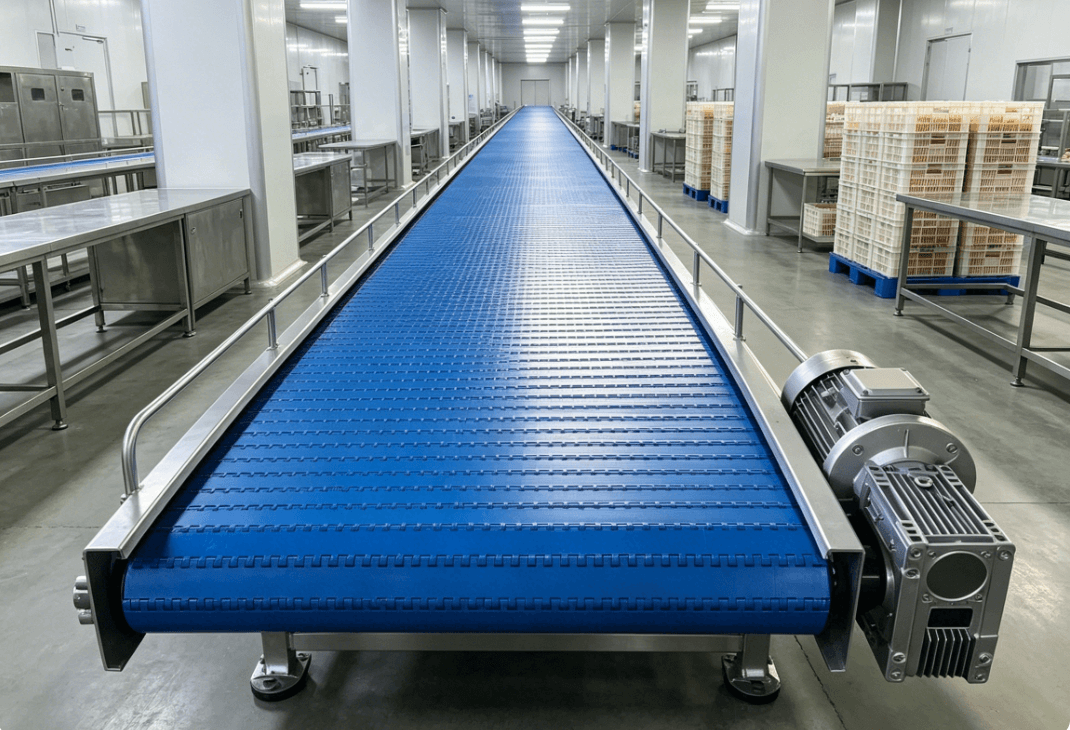
For many high-volume facilities, the straight conveyor serves as the backbone of the production line. These systems are essential for inspection zones, metal detection integration, and high-speed sorting. When sourcing straight conveyors, prioritize those using 304 stainless steel frames and modular belts, as they offer the best balance between structural integrity and sanitation speed.
Material Selection: 304 vs. 316 Stainless Steel
A common point of failure in B2B procurement is the under-specification of materials.
- 304 Stainless Steel: The standard for most food applications. It offers excellent corrosion resistance to common cleaning agents and organic acids found in fruits and vegetables.
- 316 Stainless Steel: Necessary for high-salinity environments (seafood processing) or applications involving heavy brine and acidic sauces. The addition of molybdenum makes it significantly more resistant to pitting and crevice corrosion.
When evaluating food processing conveyor solutions, ask your supplier for the material mill certificates. Using 304 steel in a high-salt environment will lead to “tea staining” or surface rust, which can trigger an immediate failure during a Food Safety Modernization Act (FSMA) or Global Food Safety Initiative (GFSI) audit.
Optimizing Throughput with Straight Conveyor Systems
Straight conveyors are often the most overlooked component of a line, yet they are where most bottlenecks occur. A well-designed straight conveyor must handle varying belt tensions and load weights without tracking issues.
In heavy-duty food processing, such as meat deboning or vegetable washing, the conveyor must withstand high-pressure washdowns (IP69K rating). Modern solutions, like those found in the Leyu Conveyor catalog, utilize modular plastic belts on their straight systems. This allows for:
- Reduced Downtime: If a section of the belt is damaged, only the affected modules are replaced, rather than the entire belt.
- No Tracking Problems: Spatially fixed sprockets ensure the belt stays centered regardless of the load.
- Improved Drainage: Perforated modules allow fluids to fall through, which is critical for fried foods or washed produce.
Factors Influencing Total Cost of Ownership (TCO)
When comparing food processing conveyor solutions, the purchase price is often only 30% of the total cost over five years. Engineering consultants recommend looking at the following variables:
- Motor Efficiency: Permanent magnet motors or high-efficiency gearboxes reduce electricity consumption in 24/7 operations.
- Belt Longevity: Low-friction materials reduce wear on both the belt and the wear strips, extending the replacement interval.
- Water and Chemical Usage: Conveyors designed for “easy-clean” use up to 50% less water during sanitation cycles.
- Integration Ease: Can the conveyor communicate with your PLC (Programmable Logic Controller) for variable speed control and emergency stop synchronization?
Compliance and Certification Requirements
Never finalize a purchase without verifying certifications. Depending on your region and product type, the conveyor system should meet or exceed:
- FDA (Food and Drug Administration): For food-contact surface safety.
- USDA (United States Department of Agriculture): Specifically for meat and poultry equipment.
- EHEDG (European Hygienic Engineering & Design Group): The gold standard for hygienic mechanical design.
- CE Marking: For electrical and mechanical safety in European markets.
Summary for Procurement and Engineering Teams
Selecting the best food processing conveyor solutions requires a cross-functional approach. Maintenance teams prioritize ease of repair; sanitation teams prioritize “no-tool” disassembly; and production teams prioritize speed and reliability.
If your facility focuses on high-speed packaging or raw material transport, starting with a robust straight conveyor platform is the most scalable choice. Look for modularity, stainless steel construction, and a supplier capable of providing custom dimensions to fit your existing floor plan.
FAQ: Food Processing Conveyor Solutions
Q1: What is the best belt material for raw meat processing?
For raw meat, modular plastic belts (specifically POM or PE) are preferred over fabric belts. They do not absorb moisture, resist bacteria growth, and can handle the high-impact nature of deboning and portioning.
Q2: How often should food conveyors be deep-cleaned?
This depends on the “Zone” of the conveyor. Zone 1 (direct food contact) usually requires a full sanitation cycle at every shift change or product changeover. Modern sanitary designs allow this to be done in under 30 minutes.
Q3: Can straight conveyors be customized for inclined use?
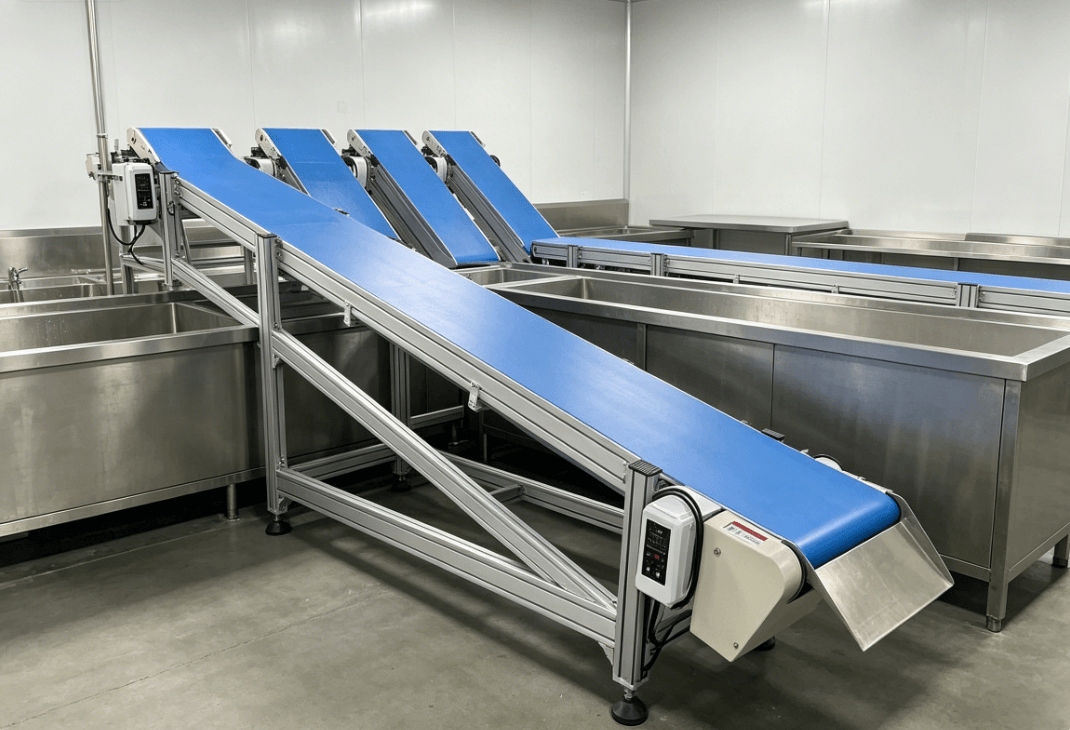
Yes. Many straight conveyor frames can be fitted with “cleats” or “flights” and set at an angle to transport product to different elevations. However, the motor torque and belt tension must be recalculated for the incline.
Q4: What is the typical lead time for custom food-grade conveyors?
Standard straight conveyors usually have a lead time of 4–6 weeks. Highly customized systems with integrated sensors or specialized 316 stainless steel frames may take 10–14 weeks depending on the OEM’s capacity.
Q5: How do I reduce “carry-back” on my conveyor?
Carry-back occurs when product sticks to the belt and travels to the underside of the conveyor. This is solved by installing belt scrapers or choosing a modular belt with a “non-stick” surface finish.
Reference Sources
- EHEDG (European Hygienic Engineering & Design Group): Hygienic Design Principles for Food Processing
- Journal of Food Engineering: “Comparison of Sanitation Efficiency in Modular vs. Fabric Belting Systems.”
- ISO 14159: Safety of machinery — Hygienic requirements for the design of machinery.