How to Prevent Conveyor Chain Wear and Tear: An Engineering Guide

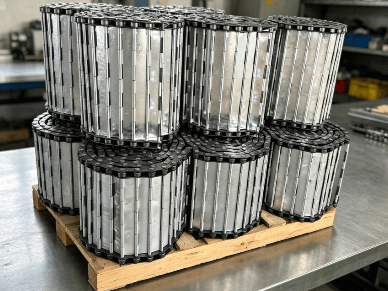
The longevity of an automated production line often hinges on a single, critical component: the conveyor chain. In heavy-duty industrial environments—ranging from automotive assembly to food processing—conveyor chain failure is rarely a sudden event. Instead, it is the culmination of progressive wear and tear that, if left unmanaged, leads to catastrophic downtime and inflated operational costs.
Understanding how to prevent conveyor chain wear is not merely about maintenance; it is about managing the physics of friction, tension, and environmental stressors. For engineers and facility managers, the goal is to shift from reactive repairs to a regime of proactive mechanical integrity.
The Mechanics of Conveyor Chain Wear: Why Elongation Occurs
Before implementing prevention strategies, it is vital to define what “wear” actually means in a technical context. In the industrial sector, “chain stretch” is a common misnomer. Most high-grade steel chains do not actually stretch. Instead, what is perceived as stretching is technically pitch elongation.
Pitch elongation occurs when material is worn away from the pins and bushings through constant articulation. As the metal-to-metal contact points erode, the distance between the pins increases, causing the chain to seat incorrectly on the sprocket teeth. This leads to “climbing” the sprocket, increased vibration, and eventually, link breakage.
Precision Lubrication: The Primary Defense Against Friction
Inadequate or improper lubrication is responsible for over 60% of premature conveyor chain failures. In a moving chain, every joint acts as a journal bearing. Without a consistent lubricant film, these bearings operate in a state of boundary friction, leading to galling and rapid heat buildup.
Selecting the Right Lubricant
The “one-size-fits-all” approach to grease or oil often causes more harm than good. Lubricant selection must be based on the specific operating environment:
- High-Temperature Environments: Use synthetic esters or silicone-based lubricants that maintain viscosity at elevated temperatures without carbonizing.
- Dusty/Abrasive Conditions: Traditional wet oils can act as a “lapping compound” when mixed with dust. In these cases, dry-film lubricants (such as PTFE or Graphite) are preferable as they do not attract contaminants.
- Wash-down/Food Grade: Require H1 certified lubricants that resist water washout and prevent corrosion in humid cycles.
Application Methods
Manual lubrication is often inconsistent. Implementing an automated lubrication system ensures that a metered “micro-dose” of oil reaches the pin-bushing area exactly when the chain is in a slack position, allowing the lubricant to wick into the critical clearances.
Strategic Alignment and Sprocket Synchronization
Even the highest quality chain will fail prematurely if the drive system is misaligned. Misalignment introduces lateral forces that the chain is not designed to handle, resulting in “side-plate wear” and uneven loading on the pins.
Axial and Parallel Alignment
Engineers must verify two types of alignment:
- Sprocket Parallelism: Ensuring the shafts are perfectly parallel to each other.
- Axial Alignment: Ensuring the sprockets are in the same plane. Even a 0.5-degree deviation can increase wear rates by 30% due to the chain rubbing against the sprocket flange.

The “Sprocket-First” Rule
A common mistake is replacing a worn chain while leaving the old sprockets in place. Worn sprockets have a “hooked” profile. When a new chain is fitted to old sprockets, the pitch mismatch causes the chain to be yanked out of the sprocket teeth, leading to immediate damage. Always inspect sprocket tooth profiles using a wear gauge during every chain replacement cycle.
Tension Management and Chordal Action
Correct tension is the “Goldilocks” factor of conveyor maintenance.
- Over-tensioning: Creates excessive bearing pressure on the pins and bushings, stripping away the lubricant film and accelerating elongation. It also places unnecessary load on the motor and drive bearings.
- Under-tensioning: Leads to “whipping” or surging. This erratic movement increases impact loads when the chain engages the sprocket, a phenomenon known as chordal action, which can snap links under high-torque starts.
For most industrial conveyors, a “slack side” sag of approximately 2% to 3% of the center distance is the industry standard for optimal performance.
Environmental Adaptation and Material Selection
The operational environment dictates the required metallurgy and polymer composition of the chain. Preventing wear often starts at the procurement phase by matching the chain’s material properties to the application’s chemical and thermal stressors.
When evaluating high-performance conveyor chains, consider the following material-to-environment pairings:
- Corrosive/Chemical Exposure: Stainless steel (304 or 316 grade) or nickel-plated chains offer the necessary oxidation resistance.
- High-Impact Loading: Through-hardened pins and shot-peened plates are essential for resisting fatigue in heavy manufacturing or mining.
- Low-Noise/Lightweight Needs: Engineering plastic chains (such as Polyacetal) are ideal for packaging and pharmaceutical lines where self-lubricating properties are required to prevent product contamination.
Implementing a Predictive Inspection Protocol
Preventing wear requires a shift from “visual checks” to “quantifiable measurements.” A professional inspection protocol should include:
| Component | Inspection Frequency | What to Look For | Action Threshold |
| Pitch Elongation | Quarterly | Measuring the length over a set number of links | Replace at 1.5% – 2% elongation |
| Sprocket Teeth | Monthly | Hooking or “shark fin” appearance | Replace if teeth are sharp or hooked |
| Side Plates | Weekly | Scoring, polishing, or cracking | Check alignment immediately |
| Lubrication Film | Daily | Dry spots or “brown dust” (fretting) | Increase lubrication frequency |
The Impact of Modern Chain Design on Wear Prevention
Modern manufacturing techniques have introduced features that inherently resist wear. For instance, cold-headed solid bushings provide a perfectly cylindrical bearing surface compared to traditional curled bushings, which have a seam that can trap debris. Furthermore, factory-pre-loading (pre-stretching) the chain eliminates the “initial wear-in” phase, ensuring the chain remains at its nominal pitch for a longer period after installation.
By integrating these technical strategies—precise lubrication, rigorous alignment, and data-driven inspection—facility managers can extend the service life of their conveyor systems by up to 300%. Wear prevention is not a cost center; it is a critical strategy for maintaining the throughput and profitability of the modern factory.
FAQ: Professional Conveyor Maintenance
Q1: How can I tell if my conveyor chain is “stretched” or just loose?
A: Measure the pitch. Take a ruler and measure the distance between the centers of 10 or 20 pins. Compare this to the manufacturer’s original specifications. If the length has increased by more than 2%, the chain has elongated due to internal wear and needs replacement. Simply tightening a worn chain will only accelerate the destruction of your sprockets.
Q2: Is it okay to use WD-40 or similar penetrating oils on industrial conveyor chains?
A: Generally, no. Penetrating oils are often too thin to provide a load-carrying film and can actually wash out the heavier, factory-applied grease from the internal pin-bushing area. Always use a lubricant specifically formulated for “Chain and Cable” use with high-pressure (EP) additives.
Q3: Why are my chain side-plates wearing on only one side?
A: This is a classic symptom of axial misalignment. Your sprockets are likely not on the same plane, forcing the chain to “crab” or tilt as it enters the sprocket. Use a laser alignment tool to ensure the drive and driven sprockets are perfectly flush.
Q4: Can I replace just the damaged links in a conveyor chain?
A: In an emergency, yes. However, for long-term operation, it is discouraged. A new link has a shorter pitch than the rest of the worn chain. This creates an “impact point” every time that specific link hits the sprocket, which can lead to drive motor surges and eventually break the new link or the pins adjacent to it.
Reference Sources
- ISO 606:2015 – Short-pitch transmission precision roller and bush chains, attachments and associated chain sprockets. This is the international standard for dimensions and mechanical properties of chains.
- American Chain Association (ACA) – Chains for Power Transmission and Material Handling. A technical whitepaper on design and maintenance.
- Agri-Industrial Standards (ASABE) – Guidelines on chain tensioning and environmental protection in harsh environments.
- Engineering Handbook (Rexnord/Tsubaki) – Comprehensive data on wear life and lubrication viscosity charts for industrial applications.