Choosing a Heavy Duty Conveyor Chain: An Engineering Guide

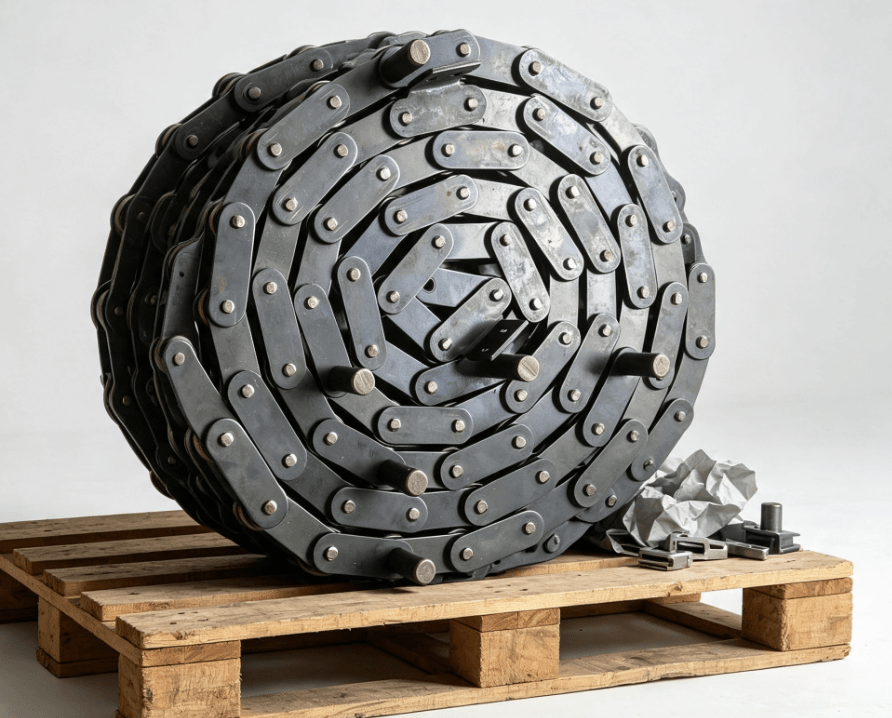
Selecting a heavy duty conveyor chain is a critical decision that impacts the uptime and safety of high-capacity industrial systems. Whether in automotive assembly, heavy-duty mining, or waste management, the chain is the primary point of failure if specified incorrectly.
A “heavy-duty” designation isn’t just about size. It refers to a chain’s ability to withstand shock loads, abrasive environments, and continuous high-tension cycles without premature elongation or fatigue failure. This guide breaks down the technical metrics that project managers and engineers must evaluate to ensure long-term operational reliability.
Understanding the “Heavy Duty” Threshold in Chain Engineering
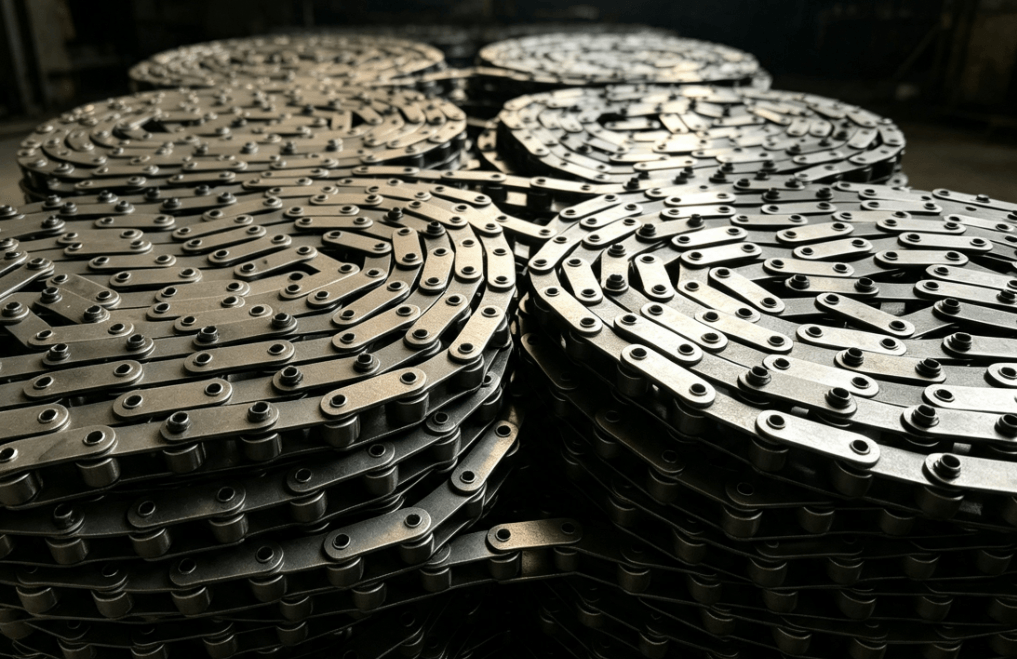
In industrial power transmission, a standard roller chain and a heavy duty conveyor chain differ significantly in plate thickness and heat treatment. Heavy-duty variants often feature thicker side plates (sometimes designated with an “H” suffix, such as 80H or 100H) to provide greater fatigue resistance.
The side plates absorb the repetitive shock of the chain engaging with sprocket teeth. While tensile strength defines the point at which a chain will snap under a single load, the Fatigue Strength determines how long it will last under continuous operation. For heavy-duty applications, fatigue strength is usually the more vital metric. Choosing a chain with a higher tensile rating but low fatigue resistance leads to sudden, catastrophic failures in high-vibration environments.
Core Selection Metrics: Beyond Ultimate Tensile Strength
When reviewing technical data sheets—such as those found in the Leyu Conveyor chain catalog—engineers should focus on three primary mechanical factors:
1. Working Load vs. Breaking Load
The Breaking Load (or Ultimate Tensile Strength) is a laboratory figure representing the force required to destroy the chain in one pull. For heavy-duty operations, the actual Working Load should generally not exceed 1/6th to 1/9th of the Breaking Load. This safety factor accounts for centrifugal forces, start-stop shocks, and the inevitable wear that thins the components over time.
2. Bearing Area and Surface Pressure
Wear in a conveyor chain occurs primarily at the pin-and-bushing joint. In heavy-duty scenarios, the “bearing area” (the projected area of the pin inside the bushing) must be large enough to keep surface pressure within limits that allow for effective lubrication. If surface pressure is too high, the lubricant is squeezed out, leading to metal-on-metal contact and rapid “stretch” (elongation).
3. Hardness Depth of Components
A high-quality heavy-duty chain utilizes case-hardened pins and bushings. The depth of this hardness is crucial. If the hardened “case” is too thin, it will wear through quickly; if the core is too hard, the pin becomes brittle and may snap under shock loads. Look for chains that specify carbonitriding or induction hardening processes.
Comparison of Heavy Duty Chain Materials
The environment dictates the material chemistry. A chain that excels in a dry automotive plant will fail in a corrosive food processing or chemical environment.
| Material | Best Use Case | Pros | Cons |
| Alloy Steel (Heat Treated) | Heavy manufacturing, mining | Highest fatigue resistance and tensile strength | Susceptible to rust without heavy lubrication |
| Stainless Steel (304/316) | Chemical, food, high-temp | Exceptional corrosion resistance | Lower load capacity; prone to galling |
| Plated Carbon Steel | High-moisture packaging | Better corrosion resistance than plain steel | Plating can flake under heavy abrasion |
| Hardened Stainless (600 Series) | Corrosive + high load | Balanced strength and corrosion resistance | Significantly higher initial cost |
Application-Specific Geometry and Attachments
Heavy-duty systems rarely use “naked” chains. They require attachments—tabs, pins, or extended plates—to move the product.
When choosing a conveyor chain with attachments, the method of attachment matters. In high-load applications, “integral” attachments (where the attachment is part of the side plate) are superior to welded attachments, which can create heat-affected zones that weaken the base metal.
Furthermore, consider the Pitch. Large-pitch chains reduce the number of joints per foot, which can decrease the number of wear points. However, larger pitches require larger sprockets and can induce a “chordal effect” (vibration caused by the chain rising and falling as it enters the sprocket), which may be detrimental to sensitive heavy loads.
Total Cost of Ownership: The Maintenance Factor
In heavy-duty applications, the “cheaper” chain is often the most expensive. The cost of a chain is dwarfed by the cost of four hours of unplanned factory downtime.
When evaluating a supplier like Leyu Conveyor, look for specialized features that extend service life:
- Solid Rollers and Bushings: Unlike “curled” bushings, solid components are perfectly cylindrical, ensuring even distribution of pressure and better lubricant retention.
- Pre-Loading (Pre-Stretching): Quality manufacturers pre-load the chain at the factory to seat the components. This eliminates “initial stretch,” which usually requires immediate adjustment after installation.
- Factory Lubrication: Hot-dip lubrication ensures the wax or oil penetrates the critical pin-bushing area, which is impossible to achieve via manual spraying after installation.
Engineering Decision Checklist
Before finalizing your RFQ, verify these four operational realities:
- Is there an abrasive element? If so, specify extra-hardened pins (e.g., chromized pins).
- What is the peak shock load? Ensure the side plate thickness can handle 150% of the nominal motor torque during start-up.
- What are the thermal constraints? Standard lubricants fail above 150°C (300°F). High-temperature alloys may be required for kilns or ovens.
- Is the chain path horizontal, inclined, or vertical? Inclined heavy-duty conveyors require anti-backback features and higher tensile safety factors to account for gravity loads.
FAQ
Q: How do I know if I need a “Heavy Series” (H) chain instead of a standard one?
A: If your application involves frequent start-stops, heavy shock loads (like logs or steel coils being dropped onto the conveyor), or if the conveyor runs 24/7, the thicker side plates of a “Heavy Series” chain are necessary to prevent fatigue cracks.
Q: Can I run a heavy duty chain on standard sprockets?
A: Generally, yes. Most heavy-duty roller chains (like 80H) have the same pitch and roller diameter as standard chains (like 80). However, because the side plates are thicker, you must ensure there is enough lateral clearance in the conveyor frame and that the sprocket teeth are not too wide for the inner link width.
Q: Why does my heavy-duty chain seem to “stretch” even though it hasn’t broken?
A: This is not actual metal stretching; it is wear. Material is being ground away at the pin-and-bushing interface. Once a chain has elongated by 1.5% to 3% (depending on the sprocket size), it will no longer mesh correctly with the teeth and must be replaced to avoid sprocket damage.
Q: Are stainless steel chains considered “heavy duty”?
A: Stainless steel is excellent for corrosion but generally has lower hardness and tensile strength than heat-treated carbon steel. If you need both high load capacity and corrosion resistance, you may need a specialized precipitation-hardened stainless steel or a coated alloy steel chain.
Reference Sources:
- ISO 606: Short-pitch transmission precision roller chains and sprockets.
- ASME B29.1: Precision Power Transmission Roller Chains, Attachments, and Sprockets.
- American Chain Association (ACA): Technical standards for chain life and fatigue calculations.