Spiral Tower Conveyor for Food Processing: Why It Improves Efficiency

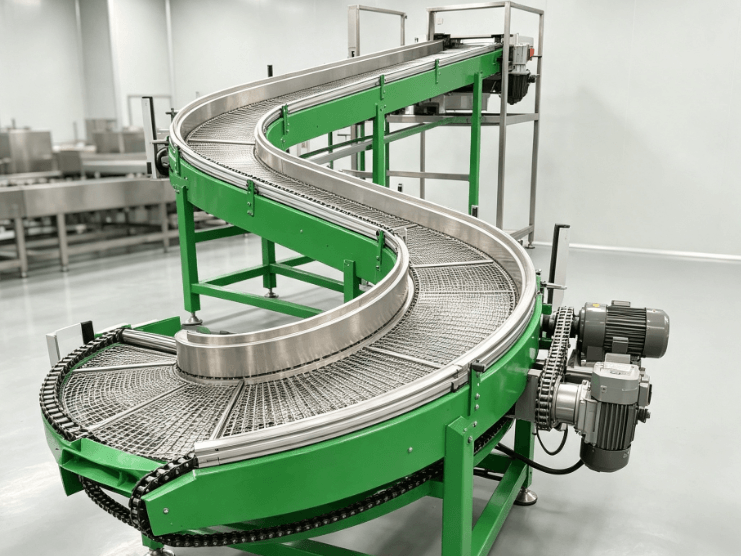
In the high-stakes environment of industrial food processing, the battle for efficiency is fought in square inches. Whether you are managing a commercial bakery, a meat processing plant, or a frozen prepared-meal facility, the layout of your production floor directly dictates your throughput potential.
Linear conveyor systems, while effective for simple transport, often create bottlenecks when processes require dwell time—such as cooling, freezing, or proofing. This is where the spiral tower conveyor for food processing transforms operational logic. By moving production into the vertical plane, manufacturers can achieve significantly higher output without expanding their physical footprint.
Maximizing Vertical Real Estate: The 3D Footprint Advantage
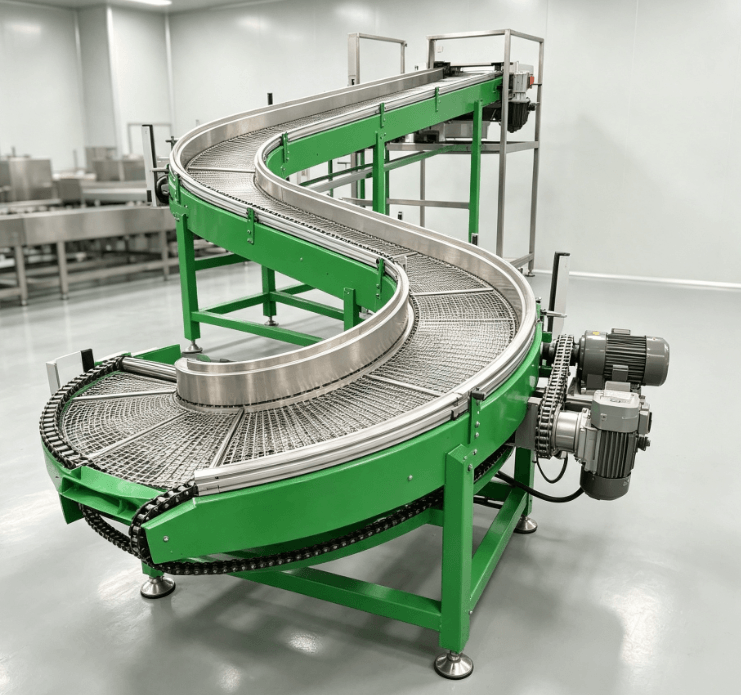
The primary driver for adopting spiral technology is space optimization. In traditional food plant layouts, a cooling line requiring 30 minutes of dwell time might need 100 meters of linear conveyor. In a standard facility, this footprint is often unavailable or necessitates complex, multi-level straight-line systems that are difficult to sync.
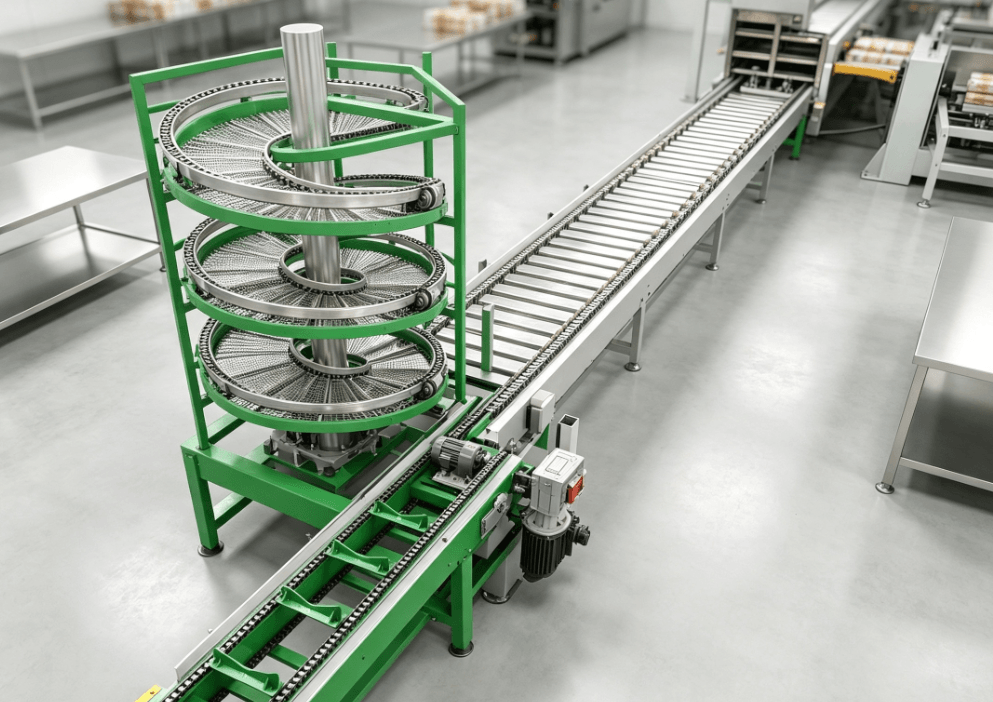
A spiral tower conveyor wraps that 100-meter path into a compact vertical cylinder. By utilizing the overhead space that typically goes to waste, plants can reallocate floor space to high-value equipment like packaging lines or additional processing stations. For engineers, this isn’t just about “saving space”—it’s about optimizing the “flow-per-square-meter” metric, which is a key KPI in modern lean manufacturing.
Precision Thermal Processing: Cooling, Freezing, and Proofing
Efficiency in food processing isn’t just about speed; it’s about controlled environments. Spiral towers are uniquely suited for processes that require a specific residence time under controlled temperatures.
- Uniform Airflow: The circular geometry of a spiral tower allows for more consistent airflow patterns compared to a long straight tunnel. In blast freezing or cooling, this ensures that every product—whether on the inner or outer edge of the belt—reaches the target core temperature simultaneously.
- Reduced Energy Consumption: By concentrating the product in a tighter volume, the energy required to maintain a cryogenic or heated environment is significantly lower. The compact enclosure of a spiral system reduces thermal leakage, a critical factor for facilities aiming for ISO 50001 energy management standards.
- Moisture Retention: For bakery applications, the controlled descent or ascent in a proofing spiral prevents the dough from drying out, maintaining product quality while keeping the line moving continuously.
Engineering for Sanitation: Meeting FDA and HACCP Standards
In the food sector, “efficiency” is a moot point if the system cannot be cleaned rapidly. A spiral tower conveyor for food processing must be engineered with a “hygiene-first” mindset to minimize downtime during washdown cycles.
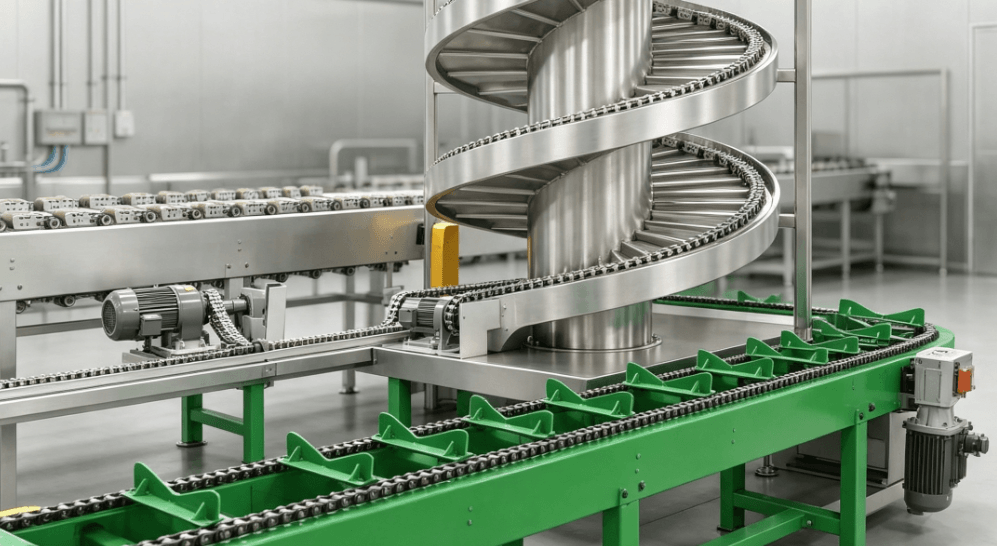
High-tier spiral systems leverage stainless steel construction (typically Grade 304 or 316) and open-frame designs. These designs eliminate “bug traps”—crevices where food particles or moisture can accumulate and breed bacteria. When evaluating a supplier, it is essential to look for features such as:
- Self-Cleaning Systems (CIP): Integrated “Clean-in-Place” spray balls that sanitize the belt and internal structure automatically.
- Modular Plastic Belting: Easier to replace and clean than traditional metal mesh, often featuring antimicrobial properties.
- Direct Drive Motors: Eliminating chains and sprockets reduces the need for lubricants, which are a primary source of contamination in food lines.
Comparing Spiral Systems vs. Straight Line Conveyors
While Leyu Conveyor’s modular straight conveyors are the workhorses of product transport and sorting, the spiral tower serves a different strategic purpose. Choosing between them—or integrating them—depends on your specific process stage.
| Feature | Spiral Tower Conveyor | Straight Modular Conveyor |
| Primary Function | Dwell time (Cooling/Freezing/Proofing) | Transport, Sorting, Packaging Linkage |
| Space Utilization | Vertical (High density) | Horizontal (Requires long runs) |
| Complexity | High (Requires precise tensioning) | Lower (High flexibility in layout) |
| Product Handling | Continuous flow, gentle | Stop-and-go, high-speed accumulation |
| Ideal Use-Case | Post-oven cooling, blast freezing | Transfer between processing stations |
In a high-efficiency facility, these two systems work in tandem. Straight conveyors act as the “arteries,” feeding products from the oven or fryer into the spiral “hub” for thermal treatment, and then whisking them away to the packaging department.
Technical Performance Drivers: Belt Tension and Drive Systems
The efficiency of a spiral conveyor is heavily dependent on its drive mechanism. Historically, spiral towers used “low tension” systems that relied on friction between the center drum and the belt edge. While effective, these systems can suffer from “Christmas treeing” (belt buckling) if not perfectly calibrated.
Modern food-grade spirals often utilize Direct Drive technology. In this configuration, the belt is positively engaged with the drive drum. This eliminates slippage, reduces mechanical wear, and allows for much heavier loads. For a plant manager, this translates to:
- Lower maintenance costs.
- Increased belt lifespan.
- Reduced risk of catastrophic line failure during peak production.
Operational Considerations for B2B Procurement
When selecting a spiral tower conveyor, the decision should be based on more than just the initial capital expenditure (CAPEX). Total Cost of Ownership (TCO) is the more relevant metric for food processors.
- Throughput Requirements: Calculate your peak pieces-per-hour. The spiral’s diameter and number of tiers must be calculated based on the product’s footprint and the required dwell time.
- Material Compatibility: Ensure the belt material is rated for your temperature range (e.g., -40°C for blast freezing to +100°C for cooling hot bread).
- Integration Capability: How will the spiral interface with existing PLC (Programmable Logic Controller) systems? Synchronizing the speed of the spiral with the upstream straight conveyors is vital to prevent product pile-ups.
FAQ
Q: How often does a food-grade spiral tower require deep cleaning?
A: This depends on the product. For “dry” products like bread, a deep clean may be weekly. For “wet” or “high-protein” products like raw meat, a full CIP (Clean-in-Place) cycle is usually required daily to comply with HACCP standards.
Q: Can spiral conveyors handle fragile food items?
A: Yes. Because the product remains stationary on the belt as it travels vertically, there is no vibration or “tumbling” action. This makes spirals ideal for delicate items like pastries, glazed donuts, or breaded seafood.
Q: What is the typical lead time for a custom spiral tower?
A: Due to the engineering requirements and customization of height/diameter, lead times typically range from 12 to 24 weeks. However, utilizing modular components can sometimes shorten this window.
Q: Are spiral conveyors energy-efficient compared to tunnels?
A: Generally, yes. The compact nature of the spiral allows for better containment of the thermal environment, meaning fans and refrigeration units do not have to work as hard to maintain set-point temperatures.
Reference Sources
- FDA (U.S. Food and Drug Administration): Food Safety Modernization Act (FSMA) Guidelines for Equipment Design.
- EHEDG (European Hygienic Engineering & Design Group): Hygienic Design of Belt Conveyors for the Food Industry.
- ISO 14159: Safety of machinery — Hygiene requirements for the design of machinery.
- HACCP International: Certification standards for food-safe equipment.
- ScienceDirect: Analysis of Airflow Uniformity in Spiral Blast Freezers.