Industrial Conveyor Buying Guide: 7 Essential Factors for System ROI

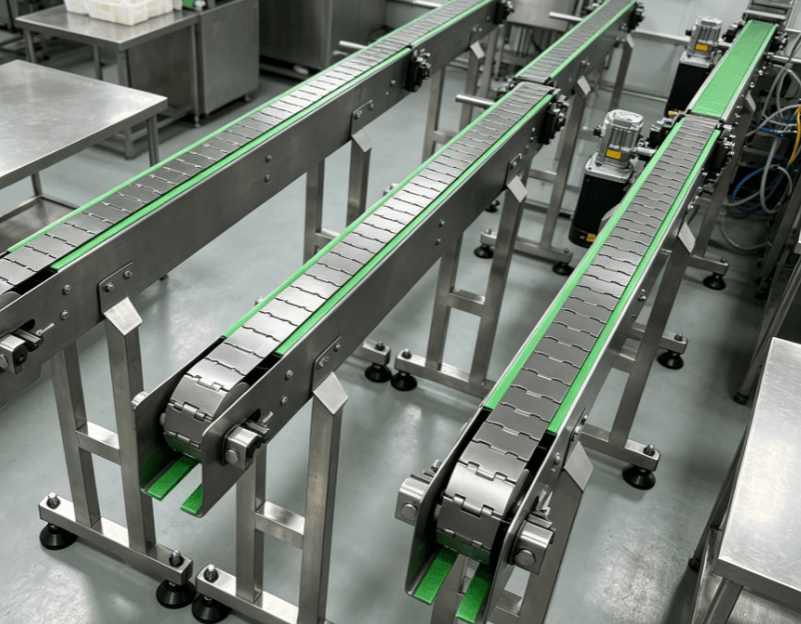
Selecting an industrial conveyor system is a high-stakes engineering decision that dictates the throughput, safety, and long-term profitability of a production line. A common mistake in procurement is viewing a conveyor as a standalone commodity rather than an integrated component of a broader automated workflow. Whether you are upgrading a food processing plant or designing a heavy-duty automotive assembly line, the “one-size-fits-all” approach leads to premature mechanical failure and costly bottlenecks.
This guide moves beyond basic belt descriptions to analyze the critical technical variables that project managers and engineers must evaluate to ensure a high Return on Investment (ROI).
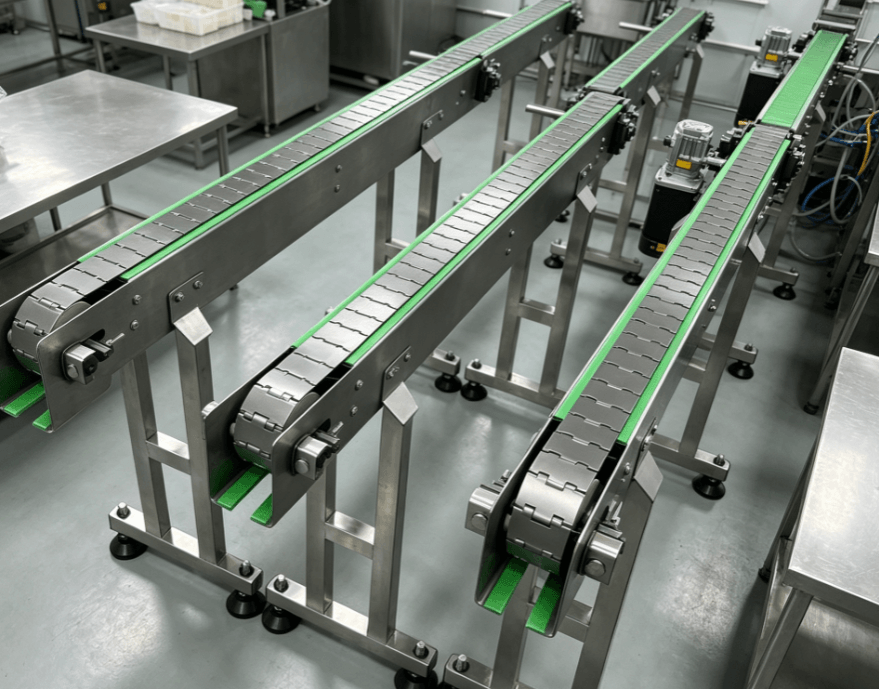
Material Characteristics and Load Dynamics
The physical properties of the product being moved are the primary drivers of conveyor design. Engineers must look beyond simple weight to understand how the material interacts with the conveying surface.
- Weight and Bulk Density: Heavy loads (like automotive parts) require the structural rigidity of chain conveyors or heavy-duty roller systems, whereas lightweight packaging can be handled by high-speed modular belt conveyors.
- Material Fragility: For delicate electronics or pharmaceutical products, smooth acceleration and vibration-free movement are mandatory to prevent product loss.
- Abrasiveness and Chemical Reactivity: If you are moving raw minerals or corrosive chemicals, the belt material—whether stainless steel, specialized polymers, or reinforced rubber—must resist degradation to prevent frequent downtime.
Throughput Requirements and Velocity
System speed is not just about how fast a belt moves; it is about the “rate of flow” required to meet production targets.
When calculating throughput, consider the cycle time of connected machinery. If your conveyor moves faster than the packaging machine can receive items, you create back-pressure and potential product damage. Conversely, a slow conveyor becomes the facility’s primary bottleneck. High-speed sorting environments often utilize vacuum conveyors or precision-timed timing belt conveyors to maintain exact product orientation at speeds exceeding 60 meters per minute.
Spatial Constraints and Incline Logic
Floor space is often the most expensive asset in a factory. Modern conveyor layouts must maximize verticality and minimize “dead zones.”
- Inclines and Declines: When moving products between levels, the “angle of repose” of the material must be considered. If the incline is too steep, products may slide back. In such cases, cleated belt conveyors or spiral conveyors are necessary to maintain grip without increasing the system’s footprint.
- Modular Flexibility: Facilities with evolving production lines should prioritize modular conveyor systems. These allow for easy reconfiguration—adding or removing sections as the workflow changes—without requiring a total system overhaul.
Environmental and Compliance Standards
The operating environment dictates the “survival” rating of the conveyor. A system designed for a climate-controlled warehouse will fail within weeks in a high-moisture washdown environment.
| Environment Type | Key Requirement | Recommended Feature |
| Food & Pharma | Hygiene/Sanitation | FDA-compliant belts, Stainless Steel frames, Washdown motors |
| Foundry/Metalwork | Heat Resistance | High-temperature alloys, specialized chain drives |
| Electronics/Cleanroom | ESD Protection | Anti-static belts, low-particle emission components |
| Cold Storage | Low-Temp Fluidity | Specialized lubricants, thermal-resistant rollers |
Drive Systems and Energy Efficiency
The motor and drive assembly represent the “heart” of the conveyor. For long-distance transport, efficiency is paramount. Direct-drive motors offer higher energy efficiency and lower maintenance compared to traditional chain-and-sprocket drives. In large-scale operations, implementing Variable Frequency Drives (VFDs) allows for soft starts and adjustable speeds, which significantly reduces mechanical wear and energy consumption during low-demand periods.
Maintenance Accessibility and TCO
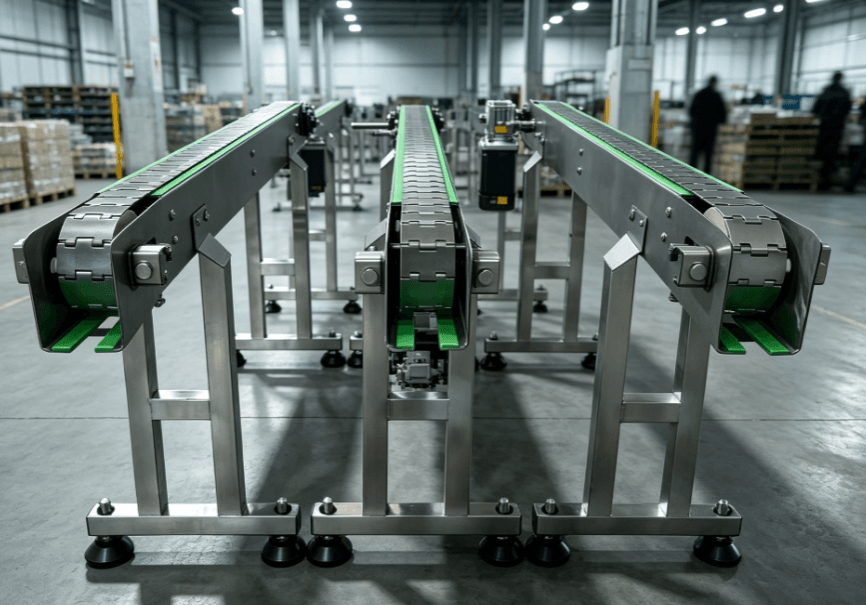
The initial purchase price of a conveyor is often only 30% of its Total Cost of Ownership (TCO). A truly cost-effective system is designed for “Ease of Maintenance.”
Look for features such as:
- Tool-less belt tensioning: Reduces downtime during routine adjustments.
- Standardized components: Ensures that replacement bearings, motors, and sensors are readily available from local suppliers.
- Self-lubricating chains: Vital for reducing manual labor and preventing contamination in sensitive environments.
Safety and Ergonomic Integration
In any industrial setting, the conveyor must comply with international safety standards, such as ISO 12100 or ANSI/ASME B20.1. This includes integrated emergency stops, guarding for nip points, and noise levels that fall within OSHA-approved limits. Furthermore, the height of the conveyor must be ergonomically optimized for human operators to prevent repetitive strain injuries during manual picking or packing stages.
Selecting the Right System Type: Engineering Logic
Based on the diverse range of solutions offered by specialists like Leyu Conveyor, selecting the correct architecture depends on the specific use case:
- Modular Belt Conveyors: Best for food processing or applications requiring frequent cleaning and high durability against sharp objects.
- Screw Conveyors: Essential for moving bulk materials like powders, grains, or industrial sludge where containment is necessary.
- Roller Conveyors: The gold standard for warehouse logistics and heavy pallet movement, offering low-friction accumulation.
- Vacuum Conveyors: Ideal for moving small, lightweight components at high speeds where precision placement is critical.
The Procurement Workflow: From RFQ to Installation
Before finalizing a purchase, ensure your supplier provides:
- Detailed Load Testing: Verified performance under your specific maximum load.
- CAD Integration: 3D models that can be dropped into your existing plant layout to check for clearance.
- Scalability Options: Can the system be expanded as your production volume doubles over the next 24 months?
FAQ: Industrial Conveyor Systems
Q: How do I determine the necessary belt width for my application?
A: The belt width should generally be 50mm to 100mm wider than the largest product dimensions to account for product drift and prevent jams, especially at transition points or curves.
Q: What is the average lifespan of an industrial conveyor belt?
A: This varies wildly based on application. In a clean warehouse, a belt can last 5-10 years. In an abrasive mineral processing plant, it may need replacement every 12-18 months. Proper tensioning and tracking are the biggest factors in extending belt life.
Q: Can I use a standard conveyor for food-grade products?
A: No. Food-grade systems must use FDA-approved materials, feature an open-frame design for washdown accessibility, and use non-toxic, food-safe lubricants to prevent contamination.
Q: What is the “accumulation” feature in a conveyor?
A: Accumulation allows products to stop on the conveyor while the motor is still running. This is usually achieved via “Zero Pressure” roller systems, which prevent products from crashing into each other during downstream delays.
Q: How does incline affect the motor power required?
A: Moving material vertically requires significantly more torque than horizontal transport. You must calculate the “lift” component of the load to ensure the motor does not overheat or stall under full capacity.
Reference Sources
- CEMA (Conveyor Equipment Manufacturers Association): Belt Conveyors for Bulk Materials. cemanet.org
- ISO 12100:2010: Safety of machinery – General principles for design – Risk assessment and risk reduction. iso.org
- ASME B20.1-2021: Safety Standard for Conveyors and Related Equipment. asme.org
- SGS Technical Guides: Industrial Machinery Compliance and Safety Testing. sgs.com