SEO Title: Glass Bottle Conveyor Systems: Engineering Efficiency in High-Speed Plants

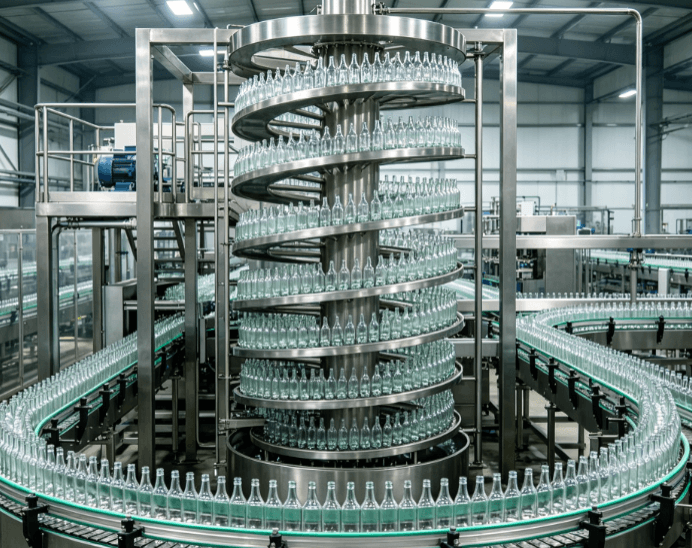
The movement of glass containers through a manufacturing facility is a study in precision logistics. Unlike plastic or metal packaging, glass presents a unique set of engineering challenges: extreme thermal shifts, high fragility, and significant weight. A poorly specified glass bottle conveyor system does more than just move product; it becomes a primary source of “scuffing” (surface damage), structural micro-fractures, and costly line downtime.
For plant managers and OEM project leads, selecting a conveyor system requires a deep understanding of the transition from the “Hot End” to the “Cold End.” This guide breaks down the technical selection criteria, material science, and layout logic essential for high-volume glass production.
The Dual-Environment Challenge: Hot End vs. Cold End
A glass bottle’s journey is divided into two distinct zones, each requiring specialized conveyor architecture.
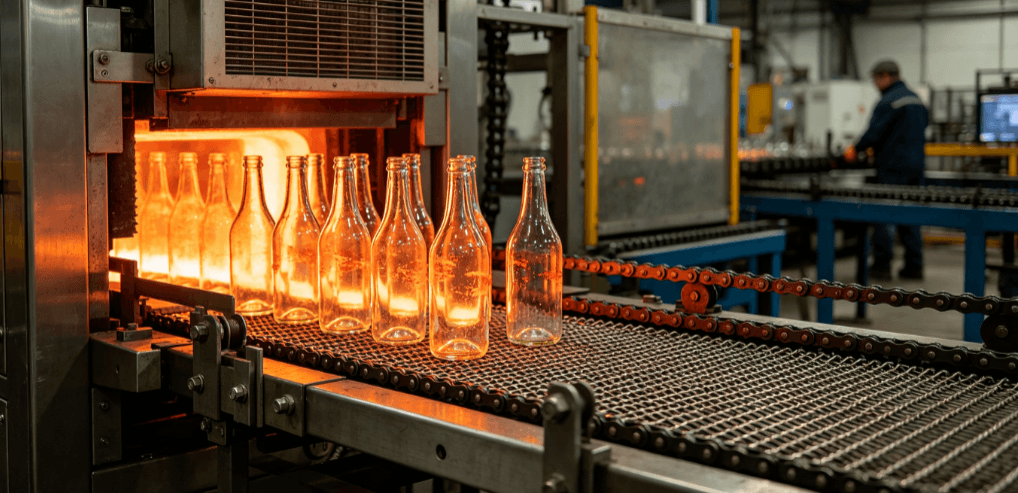
The Hot End (The Annealing Phase)
As glass containers exit the Individual Section (IS) machine, they are often at temperatures exceeding 500°C. At this stage, the glass is still “plastic” and highly susceptible to thermal shock.
- Conveyor Requirements: Systems must utilize heat-resistant metal mesh belts or specialized stainless steel slats.
- Critical Factor: The transfer from the IS machine to the cross-conveyor must be seamless. Any “stumble” here results in deformed bottoms or wall-collapse. Dead plates must be precision-leveled and often air-cooled to prevent the glass from sticking.
The Cold End (Inspection and Packaging)
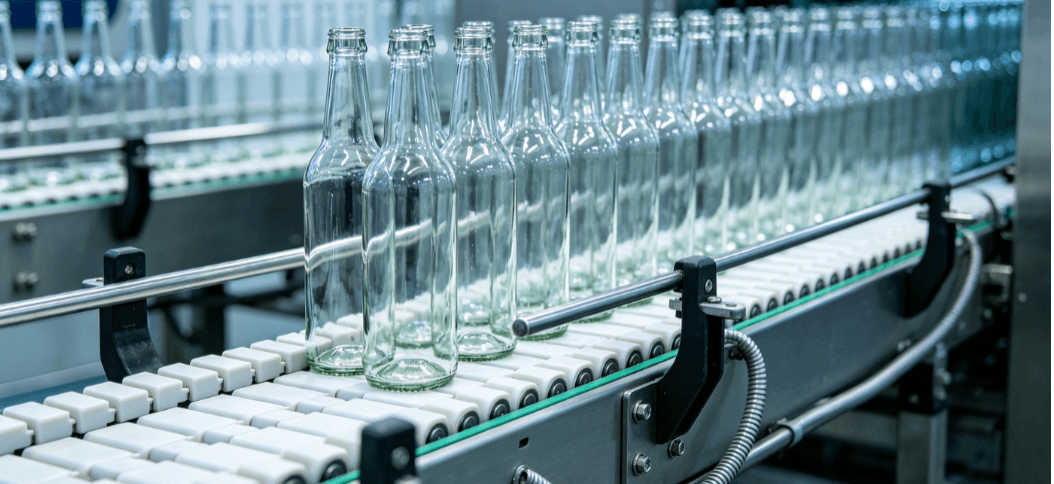
Once the glass has passed through the annealing lehr, the focus shifts to speed and surface protection.
- Conveyor Requirements: This is where modular plastic belts and table-top chains (often found in the Leyu Conveyor inventory) dominate.
- Critical Factor: Reducing “Back-Pressure.” When bottles accumulate before a labeler or palletizer, the friction between the conveyor and the bottle base—and between the bottles themselves—can cause scuffing. High-performance modular belts with low-friction coefficients are non-negotiable here.
Technical Criteria for Selecting a Glass Bottle Conveyor System
When evaluating a supplier or designing a line layout, engineers must prioritize these four technical drivers:
A. Chain and Belt Material Science
In glass manufacturing, the “Coefficient of Friction” (COF) dictates the stability of the bottle.
- Acetal (POM): The industry standard for cold-end conveyors due to its high tensile strength and low friction.
- Specialty Polyamides: Used in high-speed dry-running lines where external lubrication (soap/water) is undesirable to prevent mold or label damage.
- Stainless Steel Chains: Preferred for heavy-duty applications or where glass shards (cullet) are frequent, as plastic belts can be easily scarred by broken glass.
B. Stability and Pitch Precision
Glass bottles have a high center of gravity and a relatively small “footprint.”
- Narrow Pitch: Using a small-pitch chain (e.g., 1-inch or 0.5-inch) reduces the “chordal action” (the vibration caused as the chain moves around the sprocket). This prevents the “chatter” that causes thin-walled bottles to tip at high speeds.
C. Transition Management
The most common point of failure in a glass line is the transfer between conveyor sections.
- Side-to-Side Transfers: Used for merging or diverting flows.
- Nose-over Transfers: Essential for vertical transitions.
- Vacuum Conveyors: Often used in the inspection phase to hold lightweight or unstable bottles firmly against the belt for high-speed camera analysis.
Optimizing Throughput: Accumulation and Mass Flow
High-speed glass lines (often running at 600+ bottles per minute) cannot afford to stop the entire line if one machine (like a labeler) has a 30-second hiccup. This is where accumulation systems become the heart of the plant.
| Feature | Single-File Conveyor | Mass Flow Conveyor |
| Primary Use | Inspection, Labeling, Filling | Annealing Lehr exit, Palletizing |
| Bottle Stability | Lower (Higher speeds per bottle) | Higher (Bottles support each other) |
| Space Efficiency | Linear / Long | Wide / Compact |
| Noise Level | Higher (Bottle-to-bottle impact) | Lower (Stable mass movement) |
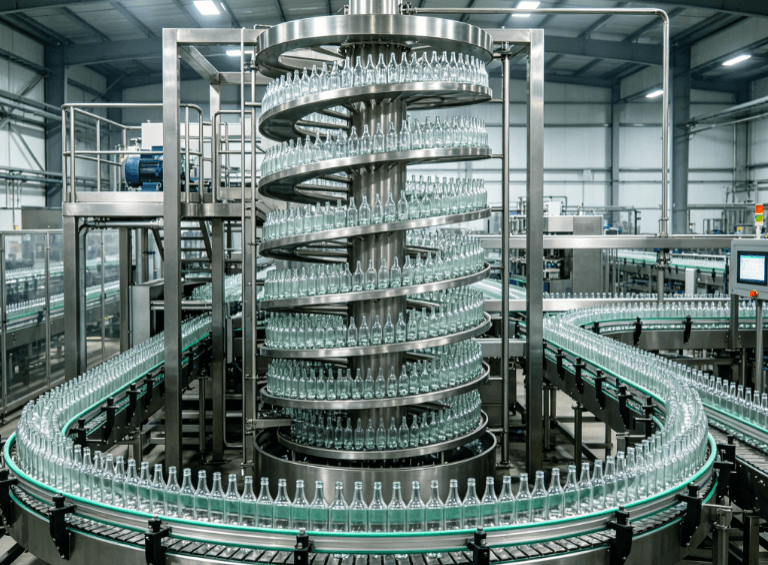
For modern facilities with limited floor space, Spiral Elevators (available through specialized providers like Leyu) offer a way to gain accumulation time by moving product vertically rather than horizontally. This “buffer” ensures that the hot end never has to stop, which would otherwise result in catastrophic cooling of the glass in the kiln.
Impact of Automation and Inspection Integration
A modern glass bottle conveyor system is no longer a “dumb” mechanical asset. It is a data-integrated component of the plant’s Quality Management System (QMS).
- Squeezer Conveyors: These use two parallel side-belts to lift bottles off the main line, allowing for base inspection or date coding without stopping the flow.
- Reject Stations: High-speed pneumatic pushers or “soft-reject” diverted rails must act within milliseconds of a signal from the wall-thickness or optical flaw sensor.
- Variable Frequency Drives (VFDs): Essential for “soft starts” and “soft stops.” Abrupt speed changes in a glass line lead to “down-bottle” chain reactions that can take hours to clear.
Procurement and Compliance: What to Look For
For B2B buyers and OEM engineers, the decision to partner with a conveyor manufacturer should be based on more than just price per linear meter.
- Modular Versatility: Does the supplier offer interchangeable parts? As bottle shapes change (from traditional rounds to square or “flask” shapes), the conveyor side-guides and wear strips must be easily adjustable.
- Maintenance Access: Glass dust is abrasive. Ensure the conveyor frames (preferably Stainless Steel 304 or 316) are designed with “wash-down” or “blow-out” ports to remove glass fines that can grind down drive sprockets.
- Lead Times and Support: In a 24/7 glass plant, a broken drive chain costs thousands of dollars per hour. Choosing a supplier like Leyu Conveyor that understands the balance between robust industrial design and modular flexibility is critical for long-term ROI.
Final Engineering Check-List
Before finalizing your conveyor project, ensure the following parameters are documented:
- Max/Min Bottle Diameter: To set guide rail widths.
- Max Bottle Height: To calculate center-of-gravity for curves.
- Line Speed (BPM): To determine the required chain tensile strength.
- Environmental Factors: Presence of moisture, glass cullet, or high heat.
FAQ
Q1: How do I prevent “scuffing” on premium glass bottles?
A: Scuffing is caused by high back-pressure. Use “Low Back-Pressure” (LBP) rollers or modular belts with high-slip additives. Additionally, ensuring your conveyor speeds are synchronized via VFDs prevents bottles from rubbing against each other during transitions.
Q2: Can plastic modular belts handle the heat of a glass plant?
A: Only in the cold end. For the hot end and annealing lehr transitions, you must use metal mesh or specialized heat-stabilized steel alloys. Once the glass drops below roughly 100°C-150°C, high-temperature plastics like reinforced Polyamide (PA) can be introduced.
Q3: What is the benefit of a “Spiral Conveyor” in glass manufacturing?
A: Spiral conveyors provide a massive amount of accumulation in a very small footprint. In glass manufacturing, if a downstream machine fails, you need a “buffer.” A spiral allows you to store several minutes of production vertically while the issue is resolved, preventing a total plant shutdown.
Q4: How often should wear strips be replaced?
A: In glass plants, wear strips (the material the chain slides on) are sacrificial. Due to glass dust being highly abrasive, these should be inspected quarterly. Using UHMW-PE (Ultra-High Molecular Weight Polyethylene) liners can significantly extend the life of the conveyor frame.
Reference Sources:
- Glass Packaging Institute (GPI) – Design and Manufacturing Standards.
- ISO 21138: Conveyor belts for industrial use.
- Technical Specifications for Modular Belts: Leyu Conveyor Official Documentation.
- Journal of Glass Science & Technology – Thermal Shock and Logistics.