Best Beverage Conveyor Solutions: Optimizing Bottling Lines

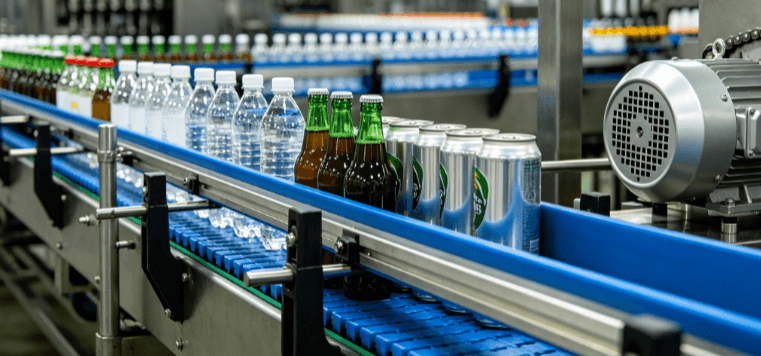
The efficiency of a beverage production line depends almost entirely on the seamless transition of containers between processing stages. Whether handling fragile glass bottles, lightweight PET, or aluminum cans, the conveyor system acts as the “circulatory system” of the plant.
Selecting the right beverage conveyor solutions requires a deep understanding of friction, hygiene standards, and line pressure management. Modern facilities are moving away from generic transport toward application-specific engineering that minimizes product loss and maximizes uptime.
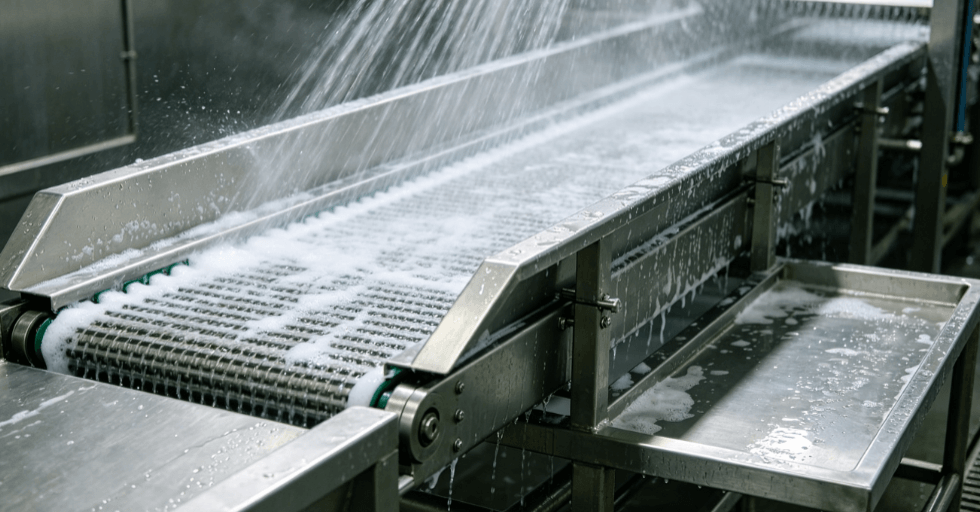
Critical Material Standards for Beverage Environments
Material selection is the foundation of any beverage conveyor system. In bottling, the environment is often characterized by high humidity, frequent washdowns, and potential chemical exposure from cleaning agents.
Stainless steel (AISI 304 or 316) remains the industry standard for frames due to its corrosion resistance. However, the contact surface—the belt or chain—requires more nuance. FDA-compliant acetal and polypropylene are preferred for their low friction coefficients and resistance to high-impact loading.
Engineers must also consider the thermal environment. If a line includes a tunnel pasteurizer, the conveyor materials must withstand consistent temperature fluctuations without losing structural integrity or causing “pulsing” in the line.
Comparison of Beverage Conveyor Types
Choosing between conveyor types involves balancing speed, stability, and footprint. Below is a comparison of the most common solutions used in modern bottling plants.
| Conveyor Type | Best Application | Key Advantage | Limitation |
| Slat Top Chain | Glass & PET Bottling | High-speed stability | Higher maintenance requirements |
| Modular Plastic Belt | Mass Flow & Accumulation | Easy repair (link-based) | Higher friction than air |
| Air Conveyor | Empty PET Bottles | Extremely high speed | High energy consumption |
| Spiral Conveyor | Vertical Elevation | Minimal floor footprint | Fixed throughput capacity |
Optimizing Throughput with Slat Top Chains
Slat top chains are the backbone of high-speed filling lines. These systems allow for precise positioning, which is critical for labeling and capping stations. In glass bottling, “side-flexing” chains are essential for navigating tight curves without causing bottle-to-bottle collisions.
To reduce breakage, engineers focus on friction management. Dry-running chains, which utilize self-lubricating materials, are increasingly popular. They eliminate the need for soap-and-water lubrication, reducing water waste and preventing slip hazards on the factory floor.
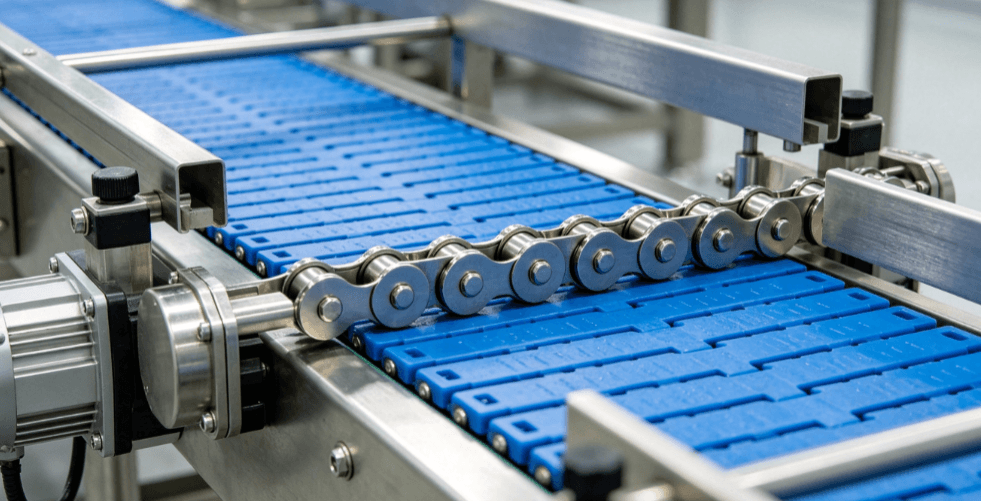
Managing Line Pressure in Accumulation Zones
Bottlenecks are inevitable when a downstream machine—such as a palletizer—stops briefly. Effective beverage conveyor solutions incorporate accumulation tables or “zero-pressure” zones.
Modular plastic belts are ideal for mass flow accumulation. They allow products to gather in a dense block without increasing backpressure, which could otherwise crush PET bottles or cause glass to scuff. These systems provide a buffer, allowing the filler to continue running while downstream issues are resolved.
Engineering for Hygiene and Washdown
Hygiene is non-negotiable in beverage production, particularly for dairy or juice lines. The conveyor design must facilitate “Clean-in-Place” (CIP) processes.
Look for systems with:
- Open Frame Design: Prevents debris buildup and allows easy access for spray nozzles.
- Sloped Surfaces: Ensures water drains quickly after cleaning.
- Hygienic Stand-offs: Minimizes metal-to-metal contact where bacteria can grow.
Strategic Implementation with Leyu Conveyor
Integrating these technical requirements into a cohesive system requires a manufacturer that understands the nuances of B2B production. Leyu Conveyor specializes in modular belt and flexible chain systems designed specifically for high-volume beverage environments.
Their solutions focus on modularity, allowing plants to reconfigure lines as packaging sizes change. For project managers, this means a lower total cost of ownership and reduced downtime during product changeovers. When evaluating a supplier, Leyu’s emphasis on customized sprocket designs and wear-resistant materials matches the needs of 24/7 bottling operations.
Future-Proofing: Automation and VFDs
The best beverage conveyor solutions are now “smart.” Variable Frequency Drives (VFDs) allow for soft starts and stops, which protect the mechanical components and prevent containers from tipping.
Integrating sensors at every transition point allows the system to adjust speeds dynamically. This “modulated speed control” ensures that the line speed matches the output of the filler, preventing excessive gaps or dangerous surges in product density.
FAQ
What is the best conveyor for high-speed glass bottling?
Stainless steel or acetal slat top chains are preferred. They provide the necessary stability for heavy glass containers and can handle the high speeds required by modern fillers.
How do I reduce “scuffing” on my beverage containers?
Scuffing is caused by excessive friction and line pressure. Using low-friction modular belts in accumulation zones and ensuring proper chain lubrication can significantly reduce label and container damage.
Are plastic modular belts better than traditional rubber belts for beverages?
Yes. Plastic modular belts are easier to clean, more resistant to chemical cleaners, and can be repaired by replacing individual links rather than the entire belt.
What maintenance is required for beverage conveyors?
Primary maintenance includes checking sprocket alignment, monitoring chain tension, and inspecting wear strips. In wet environments, ensuring that bearings remain lubricated and clear of moisture is critical for longevity.
Can air conveyors be used for filled bottles?
No. Air conveyors are designed specifically for empty PET bottles. Once a bottle is filled, its weight requires a mechanical support system like a slat chain or modular belt.
Reference Sources
- PMMI (Association for Packaging and Processing Technologies): Guidelines on conveyor safety and efficiency standards. pmmi.org
- FDA (U.S. Food and Drug Administration): Title 21 CFR Part 110 – Current Good Manufacturing Practice in Manufacturing, Packing, or Holding Human Food. fda.gov
- ISO 21102: Standards for light conveyor belts and their technical characteristics. iso.org
- EHEDG (European Hygienic Engineering & Design Group): Best practices for hygienic design of equipment for food and beverage production. ehedg.org