Common Metal Mesh Belt Problems & Expert Troubleshooting Guide

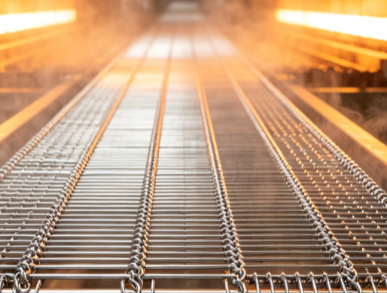
Metal mesh belts are the backbone of high-temperature processing, food automation, and heavy-duty industrial drying. While engineered for durability, these components operate under extreme thermal and mechanical stress, making them susceptible to specific failure modes. Identifying the root cause of a belt malfunction is critical; a misdiagnosis often leads to recurring downtime and expensive premature replacements.
In this guide, we analyze the most frequent technical challenges encountered in metal mesh belt systems and provide engineering-backed solutions to restore operational efficiency.
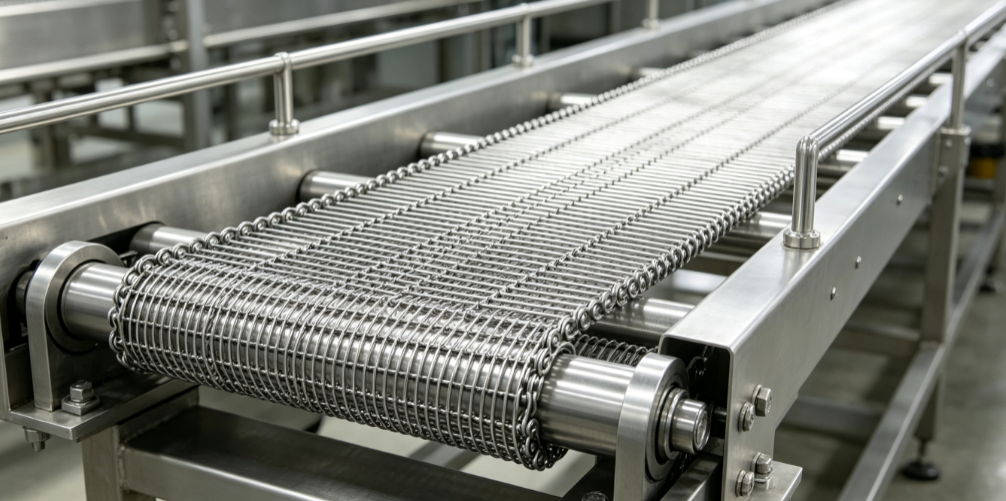
Quick Reference: Troubleshooting Metal Mesh Belt Failures
For rapid diagnostics, the following table summarizes the primary issues observed in manufacturing environments:
| Problem | Likely Cause | Recommended Solution |
| Lateral Tracking/Veering | Misaligned rollers or uneven tension | Adjust snub rollers; verify frame squareness. |
| Belt Stretching/Elongation | Excessive load or over-tensioning | Reduce take-up weight; check drive motor speed. |
| Edge Damage | Interference with conveyor frame | Increase clearance; install edge sensors. |
| Sprocket Jumping | Incorrect pitch or debris buildup | Clean drive teeth; verify pitch compatibility. |
| Premature Fatigue/Cracking | Thermal shock or small pulley diameters | Increase pulley size; implement gradual cooling. |
Lateral Tracking Issues: The Most Common Failure Mode
The most frequent of all metal mesh belt problems is mistracking, where the belt drifts toward one side of the conveyor frame. If left uncorrected, the belt edges will rub against the structure, leading to “selvage” damage and eventual structural failure of the mesh.
Root Causes
Tracking issues rarely stem from the belt itself. Usually, the fault lies in the conveyor hardware. Common triggers include:
- Out-of-Square Frames: If the head and tail pulleys are not perfectly parallel, the belt will naturally track toward the side with less tension.
- Debris Buildup: In food processing or resin-heavy applications, material can accumulate on rollers, effectively changing the roller diameter and pulling the belt off-center.
- Uneven Loading: If product is fed onto only one side of the belt, the center of gravity shifts, causing lateral movement.
Professional Solutions
To resolve tracking, engineers should first verify the squareness of the conveyor frame using a “pi-tape” or diagonal measurement. Adjusting the snub rollers—rather than simply tightening the take-up—is the preferred method. For high-speed lines, installing automatic tracking systems or using a Balanced Weave Belt, which is designed with alternating left and right-hand spirals to neutralize tracking drift, is highly recommended.
Excessive Belt Stretching and “Permanent Set”
All metal belts undergo an initial “break-in” stretch. However, continuous elongation indicates that the material has exceeded its elastic limit, entering a state of plastic deformation.
The Technical Cause
Stretching is usually a result of excessive tension. Operators often over-tighten belts to stop them from slipping on the drive pulley. In high-temperature environments (above 1000°F), the “creep strength” of the stainless steel decreases, making it even more prone to stretching under load.
Engineering Fix
Instead of increasing tension, check the friction between the drive pulley and the belt. Lagging the drive pulley with a high-friction material can provide more grip without requiring higher tension. Furthermore, ensure the “take-up” weight is the minimum required to keep the belt taut. If you are operating in extreme heat, upgrading to a high-nickel alloy or a specialized Chain Link Belt can provide better resistance to thermal elongation.
Premature Fatigue and Cracking
Metal fatigue manifests as small cracks in the wire, usually occurring at the hinge points or where the spiral joins the cross-rod. This is a “silent killer” of productivity, as it often leads to sudden belt breakage.
Why Fatigue Happens
- Bending Stress: If the pulleys or sprockets are too small for the belt’s wire gauge, the metal is subjected to excessive bending stress every time it cycles through the drive.
- Thermal Cycling: Rapidly moving a belt from a 1200°F furnace into a room-temperature zone causes “thermal shock,” which crystallizes the grain structure of the steel.
- Chemical Corrosion: Exposure to acidic cleaning agents or high-sulfur atmospheres can cause “stress corrosion cracking,” particularly in 304-grade stainless steel.
Mitigation Strategies
Consult the manufacturer’s minimum pulley diameter charts. If your pulleys are too small, you must switch to a belt with a finer wire diameter or increase the pulley size. For chemical resistance, switching to SUS 316L or specialized coatings can prevent the microscopic pitting that initiates fatigue cracks.
Sprocket Engagement and “Jumping”
For positive-drive belts, such as Flat Wire Belts or chain-driven mesh, the synchronization between the sprocket and the belt is vital. When a belt “jumps” or makes a clicking sound, it is a sign of pitch mismatch.
Diagnostic Steps
Over time, as a belt wears, its effective pitch increases slightly. Eventually, the belt no longer seats correctly in the sprocket teeth. This causes the belt to ride up on the teeth, creating a jerking motion that can damage the product being conveyed.
The Solution
Check the sprockets for “hooking” or wear patterns. If the belt is old, it likely needs replacement alongside the sprockets. It is a common maintenance error to replace a belt but keep old, worn sprockets—this will destroy the new belt within weeks. Always replace sprockets and belts as a matched set to ensure perfect engagement.
Application-Specific Considerations
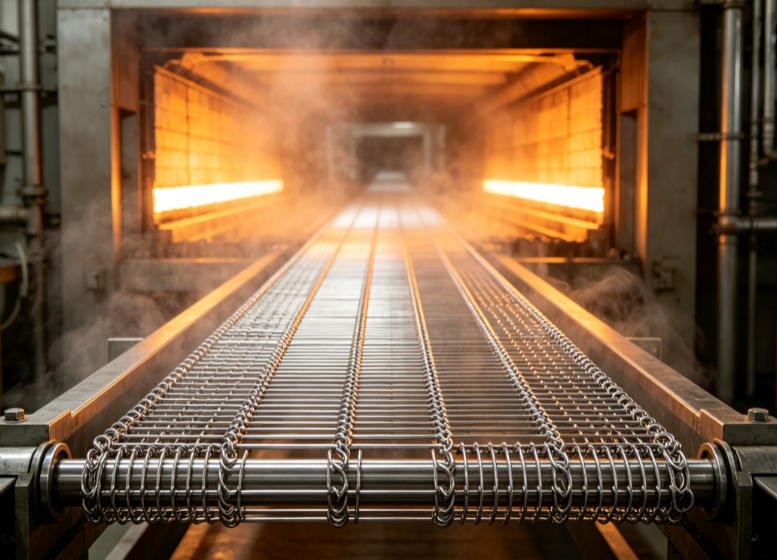
When selecting a solution, the specific belt type found in the Leyu Conveyor product catalog dictates the approach:
- Spiral Grid Belts: These are ideal for cooling towers. If they vibrate, check for “stick-slip” friction on the wear strips.
- Compound Balanced Weave: Because of their dense weave, these are prone to “blind spots” where debris gets trapped. High-pressure air or steam cleaning is required to prevent localized corrosion.
- Flat Wire Belts: Frequently used in canning. If the pickets are bending, the load-per-picket likely exceeds the design limit.
Preventing Metal Mesh Belt Problems: The Proactive Approach
The most effective way to solve belt problems is to prevent them through precise installation and material selection.
- Material Matching: Ensure the alloy matches the environment. SUS304 is standard, but SUS310S or Inconel is necessary for high-heat brazing.
- Regular Cleaning: Metal belts are often self-cleaning, but fine particles can act as abrasives in the “hinge” areas of the mesh.
- Tension Monitoring: Implement a routine to check take-up travel. If the take-up is at its limit, the belt has stretched beyond its functional life.
By understanding the mechanical and thermal stresses at play, maintenance teams can shift from reactive repairs to predictive maintenance, significantly lowering the total cost of ownership for their conveyor systems.
FAQ: Troubleshooting Metal Mesh Belts
Q: Why is my stainless steel belt rusting?
A: This is likely “tea staining” or surface contamination. If the belt is exposed to chlorides (salt) or if non-stainless tools were used during installation, the surface “passive layer” breaks down. Use a citric acid-based cleaner to passivate the surface.
Q: How tight should a metal mesh belt be?
A: A belt should only be tight enough to prevent slipping on the drive pulley. Over-tensioning is a primary cause of premature bearing failure and belt stretching.
Q: Can I repair a small section of a damaged belt?
A: Yes. Most mesh belts allow for “splicing.” You can remove the damaged section and weave in a new piece using a connecting rod. However, if the damage is due to general wear, the rest of the belt will likely fail soon after the repair.
Q: How do I know when to replace my sprockets?
A: Inspect the teeth. If they look like “shark fins” (curved on one side) or if the belt does not sit flush at the bottom of the tooth gap, the sprockets are worn and will damage any new belt installed.
Reference Sources
- ASTM A580/A580M: Standard Specification for Stainless Steel Wire. View Standard
- ISO 15190: Safety requirements for conveyor belts in industrial applications. ISO Documentation
- ASM International: Failure Analysis of Stainless Steels in Thermal Processing. Technical Paper