Straight Conveyor vs Turning Conveyor: A Full Guide

Modern industrial facilities rely heavily on automated transport systems to move goods efficiently. Choosing between a straight conveyor vs turning conveyor is a critical decision for facility managers in 2026. Each system offers unique benefits tailored to specific spatial and operational needs.
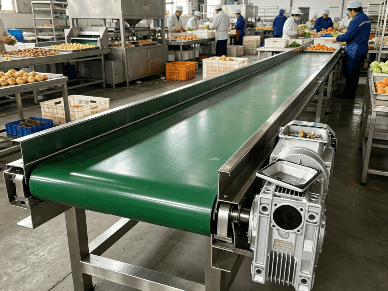
A straight conveyor moves items along a linear path without changing direction. It remains the most common type used in manufacturing and packaging lines today. These systems offer high speed and simple maintenance for long-distance transport.
Turning conveyors allow production lines to navigate corners and change directions within a limited footprint. They are essential for complex facility layouts where space is at a premium. Understanding their technical differences ensures you select the right equipment for your specific workflow.
Understanding the Fundamentals of Straight and Turning Conveyors?
A straight conveyor consists of a continuous belt or rollers moving in a single longitudinal direction. These systems typically utilize a head drive or center drive motor configuration. They are ideal for connecting two points in a direct and unobstructed line.
Turning conveyors, often called curved conveyors, utilize specialized belts or tapered rollers to facilitate direction changes. They can provide turns ranging from 30 to 180 degrees within a single module. These units maintain product orientation while preventing jams during the direction transition.
Data from 2026 logistics reports show that linear systems often reach speeds exceeding 65 meters per minute. Curved systems usually operate at lower speeds to maintain stability during centrifugal shifts. Most industrial curves maintain a speed range of 20 to 45 meters per minute.
| Feature | Straight Conveyor | Turning Conveyor |
| Path Direction | Linear (Fixed) | Curved (Variable) |
| Common Angles | 0 Degrees | 45, 90, 180 Degrees |
| Mechanical Complexity | Low | Moderate to High |
| Maintenance Needs | Minimal | Regular (Belt Alignment) |
| Space Requirement | Long and Narrow | Compact and Angular |
| Average Speed (2026) | 35–75 m/min | 20–45 m/min |
Why Choose a Straight Conveyor for Your Facility?
The primary advantage of a straight conveyor is its simplicity and cost-effectiveness. Since the mechanical design involves fewer moving parts, the initial investment is generally lower. Maintenance costs are also significantly reduced over the lifespan of the equipment.
Straight systems excel in high-speed sorting and long-distance transportation within large warehouses. They provide consistent tension across the belt, reducing the risk of slippage. This stability makes them perfect for fragile items or heavy palletized loads.
Industry studies suggest that straight conveyor systems have an uptime of approximately 99.2% in standard conditions. The lack of complex joints or tapered rollers reduces potential points of mechanical failure. This reliability is vital for 24/7 production environments that demand constant throughput.
High-Speed Efficiency in Linear Transport
Linear systems are optimized for maximum throughput in a single direction. In 2026, advanced motor controllers allow these systems to accelerate and decelerate with extreme precision. This reduces product impact and energy consumption by up to 15%.
Most straight modules use standardized parts that are easy to replace. This interchangeability reduces the need for a large spare parts inventory. It also simplifies the training required for on-site maintenance teams.
Cost Considerations and Return on Investment
A straight conveyor vs turning conveyor analysis reveals that linear units are 40% cheaper on average. This price gap accounts for the specialized engineering required for curved belts. For businesses on a strict budget, straight lines offer the fastest path to automation.
The long-term ROI is enhanced by lower power requirements. Straight conveyors experience less friction than curved systems. Over five years, the energy savings can represent a significant portion of the original purchase price.
How Does a Turning Conveyor Optimize Space in Logistics?
Turning conveyors are the ultimate solution for facilities with restricted floor space or irregular shapes. They allow engineers to design serpentine paths that maximize every square foot of available area. This flexibility is essential in urban distribution centers or older manufacturing plants.
By using a turning conveyor, you can route products around structural pillars or existing machinery. This prevents the need for costly building renovations or inefficient manual handling between stations. The ability to change direction keeps the workflow continuous and automated.
Modern curved modules in 2026 often feature an inner radius as small as 300mm for lightweight applications. For heavy-duty logistics, a 90-degree turn might require a radius of 1000mm. These dimensions allow for tight loops and efficient U-turn configurations in sorting zones.
Navigating Complex Floor Plans
Complex facilities often require multiple turns to connect different processing stations. A turning conveyor eliminates the need for manual transfer points. This reduces labor costs and minimizes the risk of worker injury during heavy lifting.
Engineers can stack curved conveyors to create spiral elevators. These systems move products vertically while simultaneously changing their horizontal direction. This 3D approach to material handling is a hallmark of high-tech 2026 facilities.
Maintaining Product Orientation
One of the biggest challenges in direction changes is keeping the product aligned. A well-designed turning conveyor uses tapered rollers to ensure the inner and outer belt speeds match. This prevents the product from rotating as it moves through the curve.
Maintaining orientation is critical for downstream processes like automated labeling or scanning. If a product rotates, sensors may fail to read barcodes correctly. Turning conveyors solve this problem by providing a smooth, controlled transition.
Technical Comparisons: Straight Conveyor vs Turning Conveyor?
When comparing a straight conveyor vs turning conveyor, mechanical drive requirements vary significantly. Straight sections use standard cylindrical rollers or flat pulleys for belt tracking. These components are easy to replace and widely available across different brands.
Turning conveyors often require tapered rollers to maintain a consistent linear speed across the belt width. The outer edge of a curve travels a greater distance than the inner edge. Tapered designs ensure that the product does not drift toward the side rails.
Energy consumption is another factor where the straight conveyor vs turning conveyor comparison matters. Straight lines are more energy-efficient due to lower friction and simpler drive mechanics. Curved sections experience higher lateral forces, which can increase the load on the motor by 12%.
Belt Material and Friction Management
Straight conveyors typically use standard PVC or rubber belts. These materials offer excellent grip and durability for linear movement. In 2026, anti-static coatings are standard for electronic component transport.
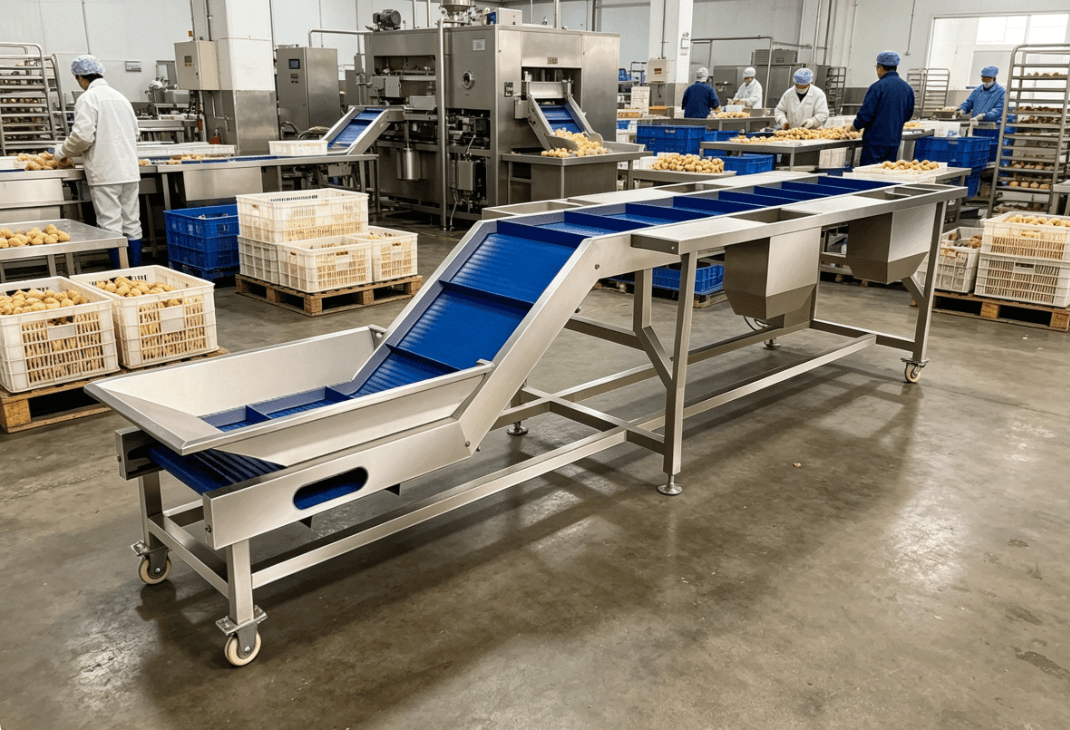
Turning conveyors often require modular plastic belts or specialized elastic materials. These belts must flex laterally without stretching or losing their shape. High-friction inserts are sometimes added to curves to prevent products from sliding outward.
Drive System Configurations
Straight conveyors often use a single end-drive motor for sections up to 30 meters. This keeps the design clean and reduces the number of electrical connections. Center drives are used for reversible applications or longer spans.
Turning conveyors usually require independent drives or complex chain-coupled systems. The torque requirements are higher because the motor must overcome centrifugal resistance. Advanced 2026 systems use variable frequency drives (VFDs) to synchronize curved and straight sections.
Performance Standards and Load Capacities in 2026?
The load capacity of a straight conveyor can range from 10kg to over 2500kg per meter. This range depends on whether the system uses a light-duty belt or heavy-duty rollers. They are the standard choice for transporting heavy machinery parts or filled pallets.
Turning conveyors generally have lower maximum load capacities compared to their linear counterparts. The centrifugal forces exerted on the belt during a turn can cause stress at high weights. Most standard industrial curves in 2026 support loads between 30kg and 120kg per unit.
For heavy-duty turning, engineers often specify reinforced modular belts or heavy-duty chain-driven rollers. These specialized components increase the cost but ensure safety during directional changes. Choosing the right belt material is crucial for preventing heat buildup during constant friction on curves.
Impact of Centrifugal Force
As products enter a turn, they experience lateral force pushing them toward the outer rail. In a straight conveyor vs turning conveyor comparison, this force is only present in the latter. Designers must calculate the maximum safe speed to prevent tipping.
In 2026, simulation software allows engineers to predict product behavior on curves precisely. This ensures that even top-heavy items remain stable at high speeds. Guard rails are often reinforced on the outer radius to provide an extra layer of safety.
Throughput and Cycle Times
Straight conveyors allow for the highest possible throughput in a warehouse. They can maintain tight product spacing, also known as “slug” loading. This maximizes the number of units moved per hour.
Turning conveyors require slightly larger gaps between products to prevent collisions during the turn. If products are too close, the inner edges may touch as they navigate the radius. This gap management is handled by automated induction systems upstream of the curve.
How to Determine the Best Conveyor Strategy for Your Facility?
Determining whether you need a straight conveyor vs turning conveyor depends on your current floor plan. Start by mapping out your production flow and identifying any physical obstacles. If your path is clear, a straight system provides the highest ROI through speed and simplicity.
If your process requires multiple stages in a confined area, turning units become mandatory. You must evaluate the “footprint-to-throughput” ratio of your facility before making a purchase. Often, a hybrid system combining both types offers the most balanced performance for modern logistics.
When selecting equipment, it is important to choose straight conveyor solutions that offer modularity. High-quality linear modules allow you to extend your line as your business grows. This adaptability ensures that your initial investment remains valuable even as facility needs change.
Consider the nature of your product when selecting between a straight conveyor vs turning conveyor. Very long items may struggle on tight curves without specialized side guides. Conversely, small, uniform packages transition through turns easily, allowing for more complex and compact routing.
A critical factor is the required exit orientation of the product for the next machine. If a product must enter a labeler in a specific direction, a 180-degree turn might be necessary. Straight conveyors maintain orientation, while curves can be designed to either maintain or modify it.
Finally, evaluate your long-term scalability and potential for facility relocation in the 2026 market. Straight modules are easier to reconfigure for different buildings than custom-engineered curved sections. However, modern modular turning conveyors now offer improved flexibility for changing industrial environments.
Summary
The choice between a straight conveyor vs turning conveyor depends on balancing space, budget, and speed. Straight conveyors offer maximum efficiency and lower costs for linear transport. Turning conveyors are essential for optimizing complex layouts and navigating obstacles, providing the flexibility needed in modern, compact industrial environments in 2026.
FAQ
1. Can a straight conveyor be converted into a turning conveyor later?
No, the frame and drive mechanics are fundamentally different. Converting one to the other is generally not cost-effective compared to buying a new module. The tensioning systems and roller shapes are designed for specific path geometries.
2. Which system is better for heavy-duty automotive parts?
The straight conveyor is typically better for heavy loads due to its robust frame and simple drive. Turning units for heavy parts require expensive, specialized engineering to handle the lateral stress. Most 2026 automotive lines use straight sections for main assembly.
3. Do turning conveyors cause more product damage?
Not if they are properly designed with tapered rollers and appropriate side guards. However, the centrifugal force in a turning conveyor requires careful speed management to prevent fragile items from tipping. Straight conveyors are inherently safer for tall, unstable items.
4. How much more expensive is a turning conveyor?
On average, a 90-degree turning unit can cost 1.6 to 2.2 times more per foot than a straight section. This reflects the complexity of the drive system and the custom belt requirements. The price difference also includes the more intensive engineering and installation labor.
5. Is maintenance for a turning conveyor difficult in 2026?
It requires more precision but is not necessarily difficult for trained technicians. Regular inspection of the belt tracking on the curve is the most important task. Most 2026 models include self-aligning features to simplify this process.