Guide to Industrial Conveyor Chains: Types and Applications

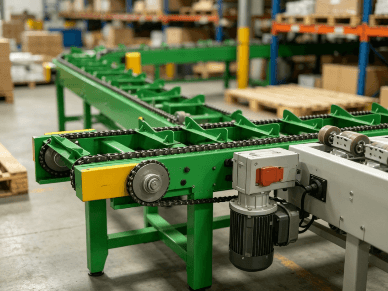
The movement of heavy loads, precise synchronization of assembly lines, and the vertical lift of bulk materials all depend on a single critical component: the industrial conveyor chain. Unlike standard drive chains designed solely for power transmission, conveyor chains are engineered for durability under constant tension, environmental resistance, and the ability to interface with various attachments.
Understanding the nuances of chain geometry and material science is essential for engineers and project managers designing efficient material handling systems. This guide breaks down the primary types of industrial conveyor chains and the mechanical logic behind their specific applications.
The Mechanics of Power: Understanding the Industrial Conveyor Chain
At its core, an industrial conveyor chain is a series of journal bearings held together by constraining link plates. Each bearing consists of a pin and a bushing on which the chain roller revolves. This design minimizes friction during engagement with sprocket teeth, allowing for high-efficiency energy transfer and long-term wear resistance.
In industrial environments, these chains are selected based on their “breaking load” (tensile strength) and “fatigue strength.” While the breaking load indicates the maximum force a chain can withstand before snapping, fatigue strength determines how many cycles the chain can endure under operational stress. High-quality manufacturing processes, such as shot-peening of parts and precision heat treatment of pins, significantly enhance these performance metrics.
Technical Classifications of Conveyor Chains
The diversity of industrial tasks has led to the development of several distinct chain architectures. Each is optimized for specific mechanical stresses and environmental conditions.
1. Standard Roller Chains (ISO/ANSI)
These are the most common chains found in manufacturing. They consist of alternating roller links and pin links. Precision-engineered roller chains, such as those compliant with ISO 606 or ANSI B29.1, offer high speed and quiet operation. They are frequently used in automated assembly lines where timing and smooth movement are critical.
2. Double Pitch Conveyor Chains
Double pitch chains have the same internal dimensions as standard roller chains but feature twice the pitch (the distance between pin centers). By using fewer components over the same length, these chains are lighter and more cost-effective for long-distance conveying. They often feature “large rollers” that allow the chain to roll along a track, further reducing friction and power requirements.
3. Leaf Chains (BL and LH Series)
Leaf chains are unique because they do not have rollers or bushings; they consist only of pins and link plates stacked in a specific lace pattern (e.g., 2×3 or 4×4). This design provides an incredibly high strength-to-weight ratio. You will typically find leaf chains in tensioning applications rather than continuous loops—common in forklifts, lift masts, and counterweight systems.
4. Hollow Pin Chains
Hollow pin chains feature a cylindrical pin with a hole through the center. This architectural choice allows engineers to insert “cross rods” or specialized attachments without needing to disassemble the chain. This flexibility makes them a staple in the packaging and food processing industries where custom spacing for product carriers is frequently required.
5. Stainless Steel and Corrosion-Resistant Chains
In environments involving high humidity, chemical exposure, or extreme temperatures, standard carbon steel fails due to oxidation. Stainless steel chains (often SUS304 or SUS316) provide the necessary corrosion resistance, though they generally offer lower tensile strength than heat-treated carbon steel. For applications requiring both strength and resistance, “Dacromet” or nickel-plated coatings are often applied.
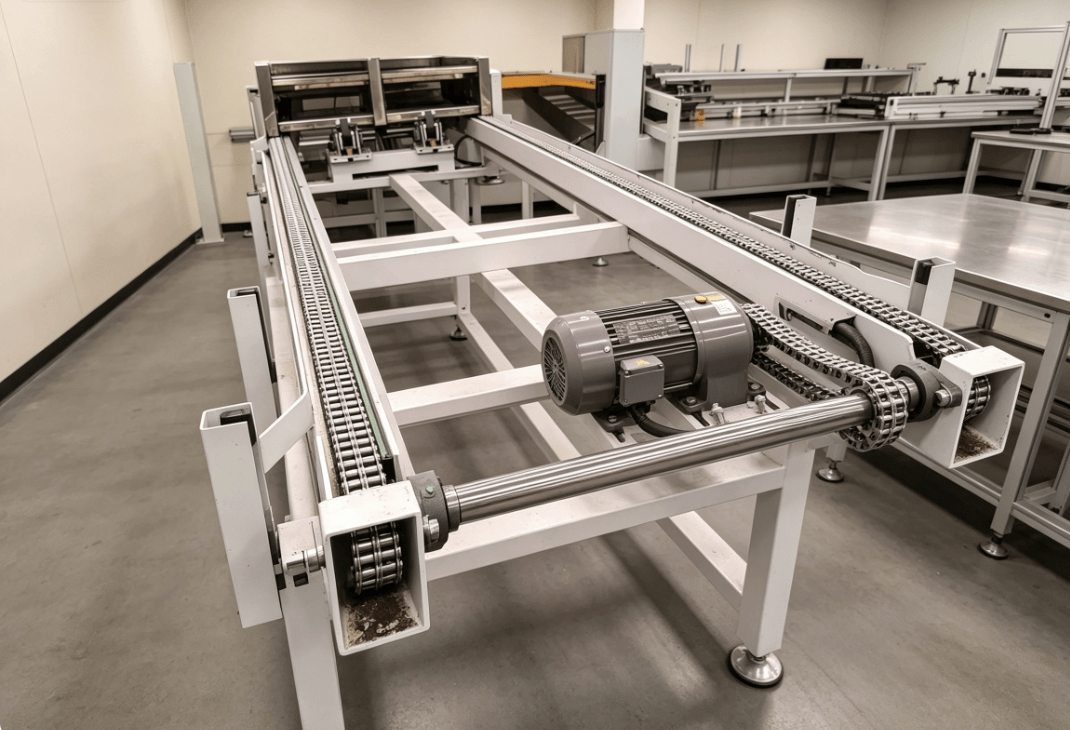
Comparison of Chain Performance Characteristics
| Chain Type | Load Capacity | Speed Capability | Versatility | Primary Advantage |
| Standard Roller | Medium-High | High | High | Precision & Timing |
| Double Pitch | Medium | Medium | High | Cost-effective for length |
| Leaf Chain | Extremely High | Low | Low | Tensile strength (Lifting) |
| Hollow Pin | Low-Medium | Medium | Extremely High | Easy attachment mounting |
| Stainless Steel | Medium | High | Medium | Corrosion/Heat resistance |
Strategic Applications Across Industry Sectors
The selection of an industrial conveyor chain is rarely about “one size fits all.” The application environment dictates the metallurgy and geometry of the chain.
- Automotive Assembly: In car manufacturing, chains must support heavy chassis while maintaining sub-millimeter precision. Heavy-duty roller chains with reinforced side plates are standard here to prevent “stretching” (wear-induced elongation) over thousands of operating hours.
- Food and Beverage Processing: This sector requires chains that can withstand “washdown” procedures using caustic cleaning agents. Stainless steel or lubricant-free chains are preferred to prevent food contamination. Hollow pin chains are often used here to carry specific trays or molds through industrial ovens or freezers.
- Logistics and Warehousing: High-speed sorting systems utilize double pitch chains with plastic rollers to reduce noise levels in large fulfillment centers. The lighter weight of the double-pitch design allows for lower energy consumption in systems that may run for 24 hours a day.
- Heavy Construction and Mining: Leaf chains and heavy-series roller chains are employed in earth-moving equipment and lift systems where the failure of a component could result in catastrophic load drops. These chains undergo rigorous non-destructive testing (NDT) to ensure integrity.
Engineering Considerations for Chain Longevity
To maximize the lifespan of an industrial conveyor chain, engineers must account for several operational variables:
- Elongation Limits: Chains are considered “worn out” once they have elongated by approximately 1.5% to 3% of their original length. Beyond this point, they will no longer mesh correctly with the sprocket, leading to system vibration and potential breakage.
- Lubrication Logic: Proper lubrication reduces the friction between the pin and bushing. In “clean” industries, self-lubricating chains with oil-impregnated sintered bushings are used to eliminate the need for external oiling.
- Sprocket Alignment: Even the highest quality chain will fail prematurely if the sprockets are misaligned. Parallelism between shafts is vital to ensure that the load is distributed evenly across the width of the link plates.
- Environmental Factors: A chain operating in a cement plant faces “abrasive wear” from dust, requiring induction-hardened pins. Conversely, a chain in a cryogenic freezer must be made of materials that do not become brittle at sub-zero temperatures.
Integration with Modern Systems
For those sourcing components for OEM projects or facility upgrades, looking at comprehensive catalogs—such as the specialized offerings from Leyu Conveyor—reveals how specific chain types are evolved for modern automation. From A-series and B-series standard rollers to specialized side-bow chains for curved tracks, the variety available ensures that mechanical solutions can be tailored to the specific torque and spatial constraints of a project.
Conclusion
The industrial conveyor chain remains a cornerstone of modern manufacturing due to its reliability and adaptability. By understanding the mechanical differences between roller, leaf, and hollow pin designs, and by accounting for the environmental stresses of the application, engineers can ensure system uptime and operational safety. As automation continues to advance, the demand for precision-engineered, high-fatigue-strength chains will only continue to grow.
FAQ
What is the difference between a transmission chain and a conveyor chain?
Transmission chains are primarily designed to transfer torque over short distances at high speeds (like a motorcycle chain). Conveyor chains are designed to carry loads over longer distances, often at slower speeds, and frequently include attachments for material handling.
How do I know when my conveyor chain needs replacing?
The most reliable method is measuring chain elongation. Use a caliper or a specialized chain wear gauge to check the distance over a set number of pitches. If the elongation exceeds 2% of the nominal length, replacement is usually recommended to prevent sprocket damage.
Can I use a standard roller chain in a high-temperature oven?
Standard carbon steel chains lose their tempered hardness at high temperatures (usually above 150°C/300°F). For ovens, you must use specialized heat-resistant steel alloys or stainless steel chains designed to maintain structural integrity at elevated temperatures.
What causes a chain to “jump” on the sprocket?
This is typically caused by either excessive chain wear (elongation) or incorrect chain tension. When the pitch of the chain no longer matches the pitch of the sprocket teeth, the chain will ride up the tooth profile and eventually jump.
Reference Sources
- ISO 606:2015 – Short-pitch transmission precision roller and bush chains, attachments and associated chain sprockets.
- ANSI B29.1 – Precision Power Transmission Roller Chains, Attachments, and Sprockets.
- American Chain Association (ACA) – Technical engineering standards for chain drive and conveyor applications.
- SGS Technical Reports – Material fatigue and tensile strength testing for industrial alloys.