Conveyor Sprocket Selection Guide: Types, Materials & Specs

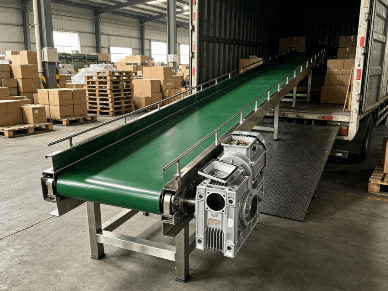
The efficiency of a conveyor system depends entirely on the interface between the drive mechanism and the carrying medium. At the heart of this interface lies the conveyor sprocket. While often viewed as a simple mechanical component, selecting the wrong sprocket geometry or material can lead to premature belt wear, catastrophic pulsation, and unplanned downtime in high-throughput environments.
This guide explores the engineering principles behind conveyor sprockets, detailing the technical nuances of material selection and design configurations required for modern industrial automation.
Understanding the Role of the Conveyor Sprocket
A conveyor sprocket is a profiled wheel with teeth that mesh with a chain, modular belt, or linked carrier. Unlike a standard power transmission gear, a conveyor sprocket is designed to handle linear motion and specific load distribution.
Its primary functions include:
- Power Transmission: Converting rotational torque from the motor into linear force.
- Synchronization: Ensuring the belt moves at a constant speed without slipping.
- Tracking: Keeping the conveyor belt centered on the frame through tooth engagement.
In complex systems, you will encounter two primary roles:
- Drive Sprockets: Mounted on the drive shaft, these provide the motive force.
- Idler/Tail Sprockets: These rotate freely, guiding the belt back through the return path and maintaining proper tension.
Key Types of Conveyor Sprocket Designs
Industrial requirements vary from high-load automotive assembly to hygienic food processing. Consequently, sprocket designs have evolved into several distinct categories.
1. Solid vs. Split Sprockets
- Solid Sprockets: Machined or molded as a single piece. These offer maximum structural integrity but require the removal of the entire shaft for replacement.
- Split Sprockets: These are designed in two halves that bolt together around the shaft. They are preferred in large-scale operations because they significantly reduce “Mean Time to Repair” (MTTR). Technicians can replace a worn sprocket without dismantling the drive assembly.
2. Modular Belt Sprockets
Specific to modular plastic belts, these sprockets often feature unique tooth profiles (such as square or hex bores) to accommodate high-torque plastic shafts. They must account for the “chordal action”—the slight rise and fall of the belt as the pins move around the sprocket.
3. Tabletop Chain Sprockets
Common in bottling and canning lines, these are designed for narrow chains. They often feature high tooth counts to minimize the “pulsation effect,” ensuring that unstable containers (like tall glass bottles) do not tip during transit.
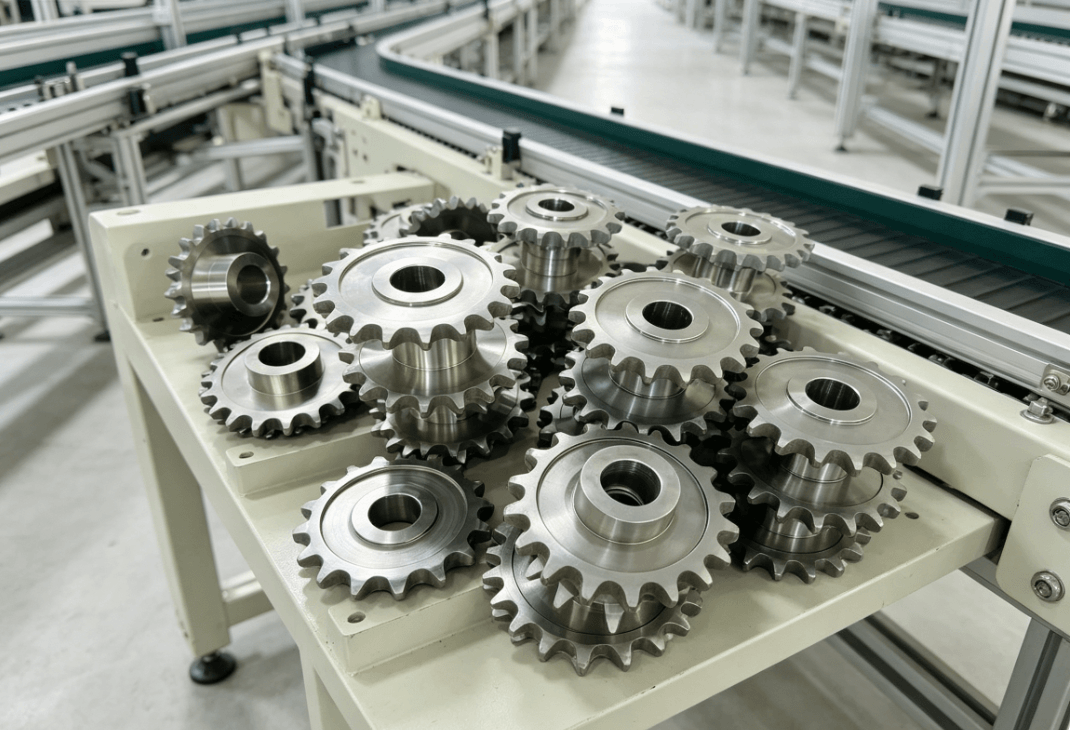
Material Selection: Performance Trade-offs
The environment dictates the material. A sprocket that thrives in a dry warehouse will fail rapidly in a chemical washdown facility.
| Material | Key Advantages | Best Use Case |
| POM (Acetal) | High strength, low friction, excellent dimensional stability. | Standard packaging, modular belts, and high-speed sorting. |
| Reinforced Nylon | High impact resistance and wear-to-weight ratio. | Heavy-duty logistics and abrasive environments. |
| Polypropylene (PP) | Superior chemical resistance to acids and bases. | Chemical processing and high-moisture environments. |
| Stainless Steel (304/316) | Maximum hygiene, heat resistance, and load capacity. | Food Grade (FDA), pharmaceutical, and high-temperature ovens. |
| Cast Iron/Carbon Steel | Highest durability and torque capacity. | Mining, heavy automotive, and raw material handling. |
Technical Selection Criteria for Engineers
When specifying a conveyor sprocket for an OEM project or a maintenance overhaul, four technical parameters are non-negotiable:
Tooth Count (Z) and Pitch Diameter
The number of teeth directly affects the smoothness of the conveyor. Fewer teeth (e.g., 6 to 10) lead to higher chordal action, which can cause vibration. For high-speed or precision applications, engineers generally specify a minimum of 12 to 18 teeth to ensure a smoother transition of the belt links.
Bore Configuration
Sprockets must be matched to the drive shaft.
- Round Bores: Typically include a keyway and setscrew to lock the sprocket in place.
- Square Bores: Common in modular plastic conveyors. They allow the sprocket to “float” axially, accommodating the thermal expansion and contraction of the plastic belt.
Environmental Compatibility
In food-grade environments, the sprocket must be “open-structured” to prevent food particles from being trapped between the teeth and the belt (a common cause of belt “jumping”). For washdown areas, materials must withstand high-pressure water and caustic cleaning agents without degrading.
Thermal Expansion Factors
In cold storage or high-heat drying tunnels, plastic sprockets will expand and contract at different rates than steel shafts. Engineers must calculate the “float” required on the shaft to prevent the sprockets from binding or warping the belt.
Common Failure Modes and Maintenance
Understanding how a sprocket fails is critical for predictive maintenance.
- Tooth Hooking: As a sprocket wears, the teeth develop a “hook” shape. This prevents the belt from releasing cleanly, causing a “snapping” sound and increasing belt tension.
- Bore Rounding: Common in plastic sprockets under high torque. The square or keyed bore rounds out, leading to shaft slippage.
- Misalignment: If the drive and tail sprockets are not perfectly parallel, the belt will track to one side, leading to edge damage and uneven tooth wear.
Industry Application: High-Performance Solutions
For specialized conveying needs, manufacturers like Leyu Conveyor provide a range of precision-engineered sprockets designed for modular belts and plastic chains. Their product line emphasizes material purity and geometric accuracy, which are essential for reducing friction and extending the lifespan of the entire conveyor assembly.
Whether the application involves 400-series modular belts or specialized tabletop chains, choosing a sprocket that matches the specific pitch and lateral movement requirements of the belt is the only way to ensure operational reliability.
FAQ
Q: How do I know when to replace my conveyor sprockets?
A: Inspect the tooth profile. If the teeth appear pointed or “hooked,” or if the belt is making a popping sound as it leaves the sprocket, it is time for a replacement. Ideally, sprockets should be replaced whenever a new belt is installed to ensure even wear.
Q: Can I use a metal sprocket with a plastic modular belt?
A: Yes, but with caution. While stainless steel sprockets offer longer life, they are more abrasive. If the belt is the “sacrificial” part of your system, plastic sprockets (like POM) are usually preferred to minimize belt wear.
Q: What is the benefit of a square bore over a round bore?
A: Square bores are excellent for high-torque applications where you want to avoid the stress concentrations of a keyway. They also allow the sprocket to slide along the shaft, which is necessary for the thermal expansion of wide modular belts.
Q: How does tooth count affect conveyor speed?
A: While the motor RPM determines the shaft speed, the pitch diameter (determined by the tooth count) determines the linear speed of the belt. A larger sprocket will move the belt faster at the same RPM but will require more torque from the motor.
Reference Sources
- ISO 606: International standard for short-pitch transmission precision roller chains and sprockets.
- ANSI B29.1: Precision Power Transmission Roller Chains, Attachments, and Sprockets.
- Engineering Data: Mechanical Properties of Acetal (POM) in Power Transmission, DuPont Engineering Plastics.
- CEMA (Conveyor Equipment Manufacturers Association): Belt Conveyor Standards and Design Fundamentals.