How to Choose a Straight Conveyor for Your Production Line

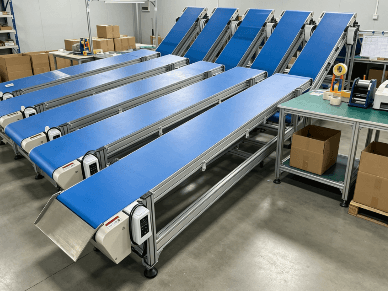
Selecting the right straight conveyor for your production line is more than a simple procurement task; it is a critical engineering decision that dictates the throughput, safety, and operational longevity of your entire facility. A mismatched conveyor often leads to unnecessary downtime, premature motor failure, and product damage during transit.
In high-volume manufacturing, the “straight run” acts as the backbone of the assembly process. Whether you are transporting delicate electronic components or heavy automotive parts, the configuration must align with your specific load dynamics and environmental constraints.
Why the Straight Conveyor is Essential for Production Scalability
A straight conveyor for your production line serves as the primary link between processing stations. Unlike curved or inclined systems, straight conveyors offer the highest mechanical efficiency and the lowest cost-per-meter for material transport.
Engineers favor these systems because they minimize lateral forces on the belt, reducing tracking issues and mechanical wear. For project managers looking to scale, the modular nature of modern straight conveyors allows for rapid reconfiguration as production needs evolve.
Technical Comparison: Belt Materials and Drive Systems
The performance of your production line is largely determined by the interaction between the belt material and the drive mechanism. Choosing the wrong combination can lead to slippage or hygiene failures in regulated industries.
| Feature | PVC/PU Belt Conveyor | Modular Plastic Belt | Stainless Steel Chain Plate |
| Best For | Lightweight parts, electronics | Heavy loads, drainage needs | Glass bottles, high-heat |
| Durability | Moderate (prone to cuts) | High (impact resistant) | Very High (abrasion resistant) |
| Maintenance | Requires tensioning | Easy segment replacement | Periodic lubrication |
| Cleaning | Surface wipe only | High-pressure washdown | Chemical resistant |
For most automated assembly lines, PVC belts provide a cost-effective, smooth surface. However, if your process involves sharp metal fragments or requires frequent washdowns, a modular plastic belt is superior due to its puncture resistance and self-draining capabilities.
Key Engineering Factors to Evaluate Before Purchase
When auditing a conveyor supplier’s proposal, focus on these technical parameters to ensure the system handles your real-world production stresses.
1. Load Capacity and Torque Requirements
Calculate the “Static Load” (total weight on the belt) and the “Impact Load” (force of items being dropped onto the belt). A common mistake is under-specifying the motor torque, leading to overheating during frequent start-stop cycles.
2. Frame Material and Rigidity
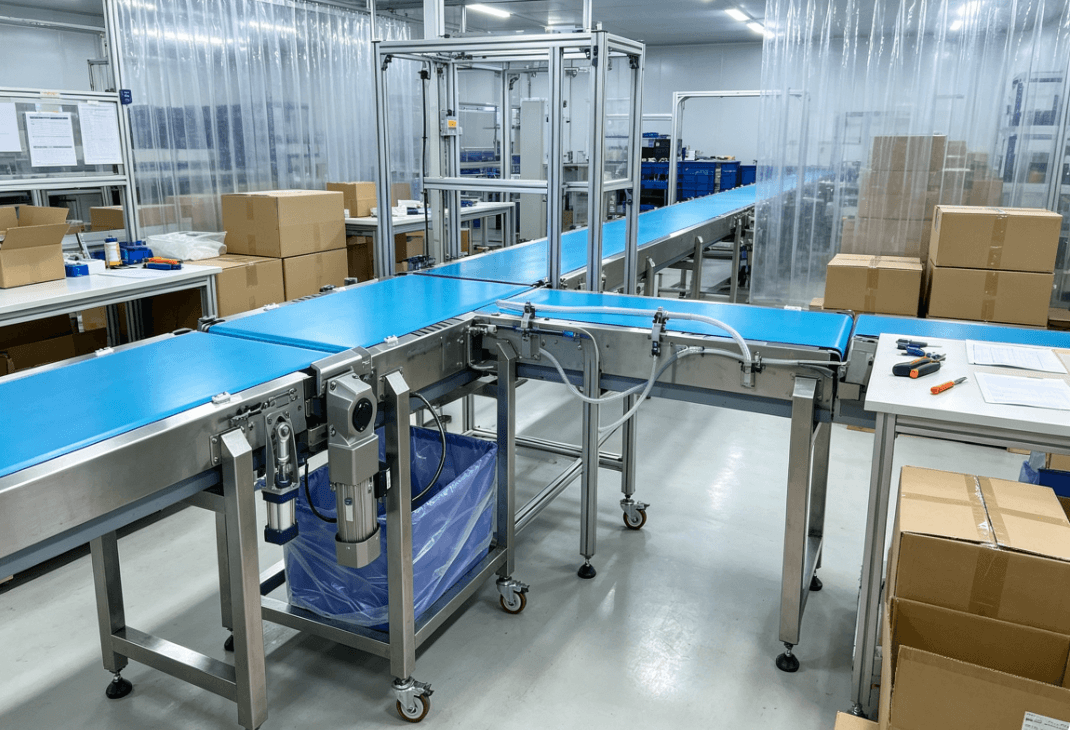
- Anodized Aluminum: Ideal for cleanroom environments, electronics, and lightweight packaging. It is modular and easy to modify.
- Stainless Steel (304/316): Mandatory for food processing (FDA compliance) and pharmaceutical lines to prevent corrosion during sanitization.
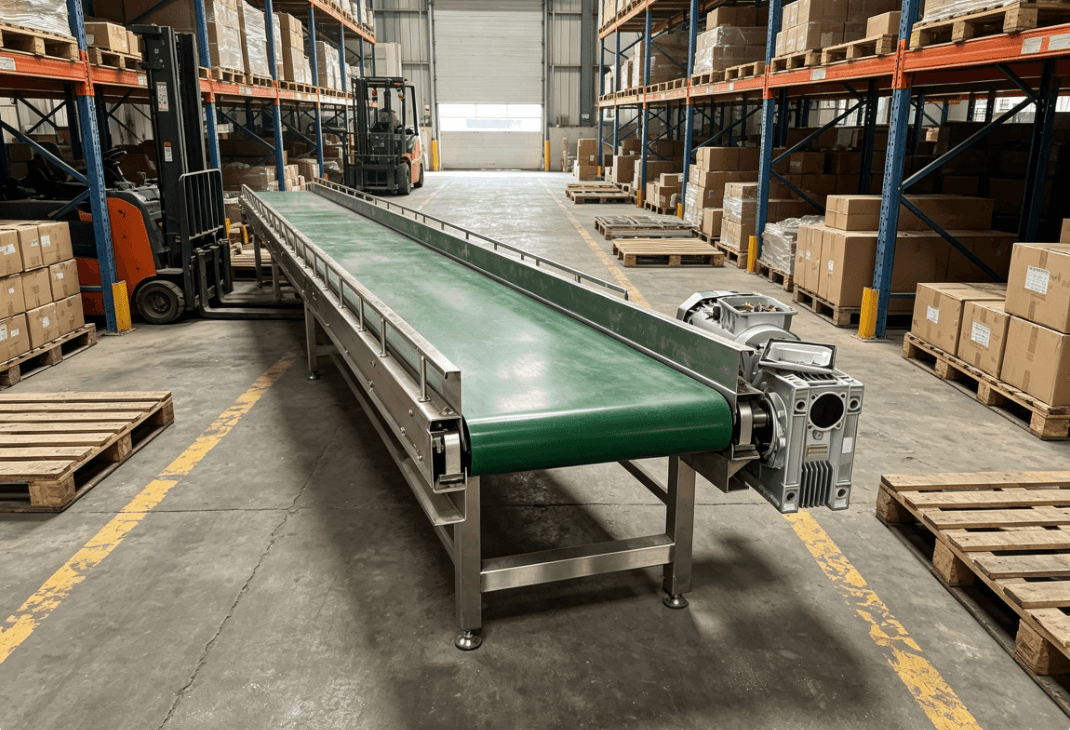
- Powder-Coated Steel: The standard for heavy industrial warehouses where impact resistance is the priority.
3. Control Integration (VFDs and Sensors)
Modern straight conveyors must “talk” to the rest of the line. Ensure the drive system is compatible with Variable Frequency Drives (VFDs) for precise speed matching. Integration of photo-eye sensors is critical for accumulation logic, preventing product collisions.
Industry-Specific Selection Logic
The “right” conveyor changes depending on what is moving across it.
- Electronics Manufacturing: You require ESD (Electrostatic Discharge) safe belts and frames to prevent damage to sensitive PCBAs.
- Food and Beverage: Look for “Blue Belt” technology and “Tool-less” disassembly. The conveyor must meet ISO 22000 or EHEDG standards for hygienic design.
- E-commerce & Logistics: Focus on high-speed rollers or friction-top belts that can handle varied packaging types—from polybags to corrugated boxes—at speeds exceeding 60 meters per minute.
Identifying Cost Drivers and ROI
While initial purchase price is a factor, the Total Cost of Ownership (TCO) is the metric that matters to stakeholders. Cheap conveyors often hide costs in:
- Energy Consumption: Low-efficiency motors increase utility bills in 24/7 operations.
- Belt Tracking Issues: Poorly machined rollers lead to constant manual adjustments and downtime.
- Spare Part Availability: OEM parts for generic systems can have lead times that paralyze a production line.
Investing in a precision-engineered system, such as those found in the Leyu Conveyor straight conveyor range, ensures high stability and reduced vibration. Their focus on modular design allows for “plug-and-play” integration, which significantly reduces installation labor costs.
Final Checklist for Procurement Managers
Before issuing an RFQ (Request for Quote), ensure you have defined the following:
- Product Dimensions: Minimum and maximum length, width, and height.
- Throughput Speed: Target pieces-per-minute or meters-per-second.
- Environmental Conditions: Temperature, humidity, or presence of oils/chemicals.
- Transfer Points: How the product enters and exits the conveyor (e.g., gravity chute, robotic pick-and-place, or side-transfer).
By addressing these technical nuances, you move from simply “buying equipment” to “optimizing a process,” ensuring your production line remains competitive and resilient.
FAQ: Straight Conveyors for Production Lines
Q: How do I know if I need a modular belt or a continuous PVC belt?
A: Use a continuous PVC belt for small, lightweight items where a perfectly smooth surface is needed. Choose a modular belt if you need to go around curves, require drainage, or if the belt is likely to be damaged—modular belts allow you to replace a single link rather than the whole belt.
Q: What is the typical lead time for a custom straight conveyor?
A: Standard modular designs can often be shipped in 2–4 weeks. Fully customized systems with specific sensor integrations or food-grade certifications typically range from 6–10 weeks depending on the complexity of the drive system.
Q: Can straight conveyors be used on an incline?
A: Yes, but only to a certain degree (typically under 15 degrees). If the incline is steeper, you will need a “cleated belt” or a high-friction “supergrip” material to prevent product backflow.
Q: Are these conveyors compatible with Industry 4.0 standards?
A: Most professional-grade straight conveyors can be fitted with IO-Link sensors and smart motors that provide real-time data on belt speed, motor temperature, and vibration levels for predictive maintenance.
Reference Sources
- CEMA (Conveyor Equipment Manufacturers Association): Standard 402-2003 for Unit Handling Conveyors.
- ISO 21102: Material handling equipment – Safety requirements for continuous handling equipment.
- FDA CFR 21: Guidelines for materials in contact with food (applicable to food-grade straight conveyors).
- OSHA 1910.212: General requirements for all machines (Covers guarding and emergency stops for conveyors).