Turning Conveyor vs Straight Conveyor: Optimizing Factory Layout

Selecting the right conveyor geometry is rarely a matter of preference; it is a calculation of floor space, throughput requirements, and the physical characteristics of the product being moved. In a high-volume manufacturing environment, the decision between a turning conveyor and a straight conveyor directly impacts the facility’s overall equipment effectiveness (OEE) and long-term maintenance overhead.
While straight conveyors represent the backbone of traditional assembly lines, modern factory footprints often demand the agility of turning modules to navigate structural pillars or to link disparate production stages. Understanding the engineering trade-offs between these two systems is critical for project managers and OEM engineers.
Fundamental Differences in Material Handling Dynamics
The primary distinction lies in how the system handles directional changes and belt tension.
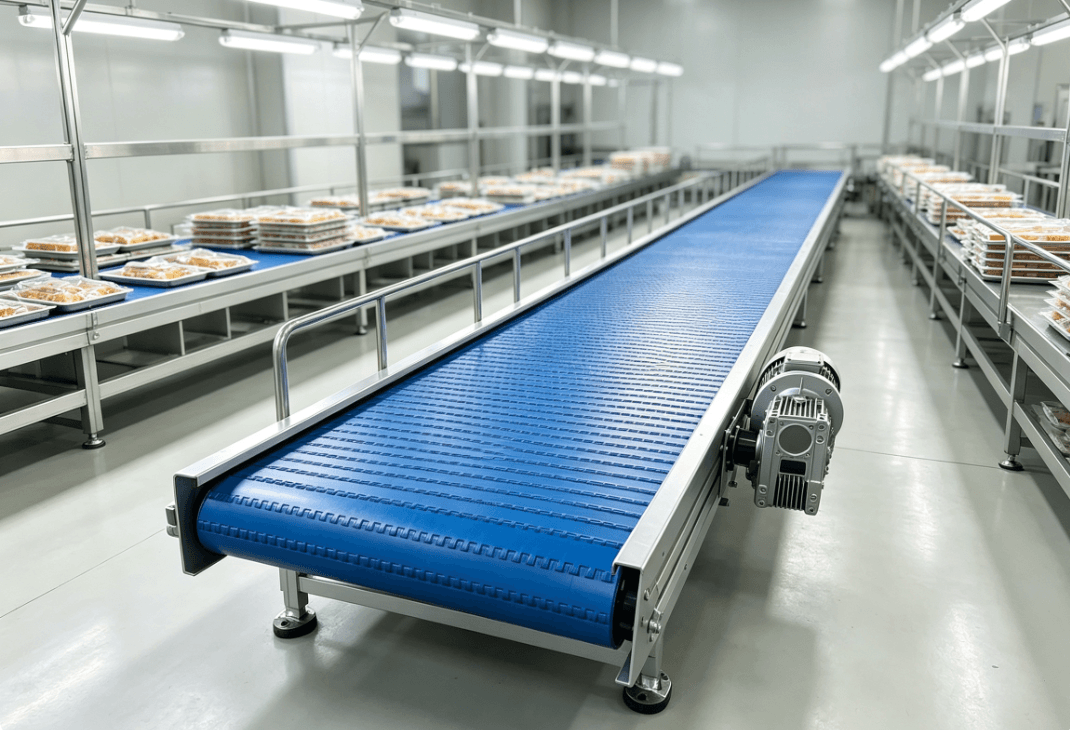
Straight conveyors operate on a linear axis. The drive and tail pulleys are parallel, ensuring uniform belt tension across the entire width. This simplicity allows for higher speeds and heavier load capacities without the risk of belt mistracking.
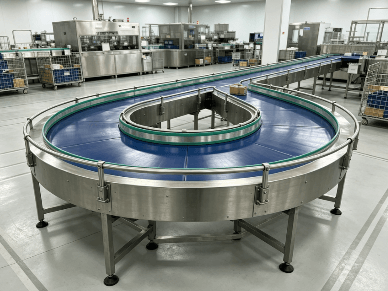
Turning conveyors (often 90-degree or 180-degree modules) must account for the difference in travel distance between the inner and outer radii. To prevent the belt from bunching or slipping, these machines typically utilize tapered rollers or specialized modular plastic chains with side-flexing capabilities. This complexity is necessary to maintain the orientation of the product—an essential requirement for downstream processes like inkjet coding or robotic pick-and-place.
Comparison: Technical Specifications and Performance
| Feature | Straight Conveyor | Turning Conveyor (Curve) |
| Footprint Requirement | High (Requires long linear runs) | Low (Optimizes corners and tight spaces) |
| Mechanical Complexity | Low (Standard pulleys/motors) | High (Tapered rollers, guide rails) |
| Product Orientation | Fixed | Maintained through the curve |
| Maximum Speed | Very High (Up to 100+ m/min) | Moderate (Limited by centrifugal force) |
| Maintenance Frequency | Low | Moderate (Belt tracking and edge wear) |
| Primary Material | PVC, PU, or Rubber | Modular Plastic or Fan-shaped PVC |
Spatial Efficiency: When to Implement Turning Modules
In the context of modern “Lean Manufacturing,” floor space is viewed as a premium asset. A straight conveyor line is efficient but rigid. If your production line must return to a central packaging area or bypass a structural obstacle, a straight line may require an impractical amount of square footage.
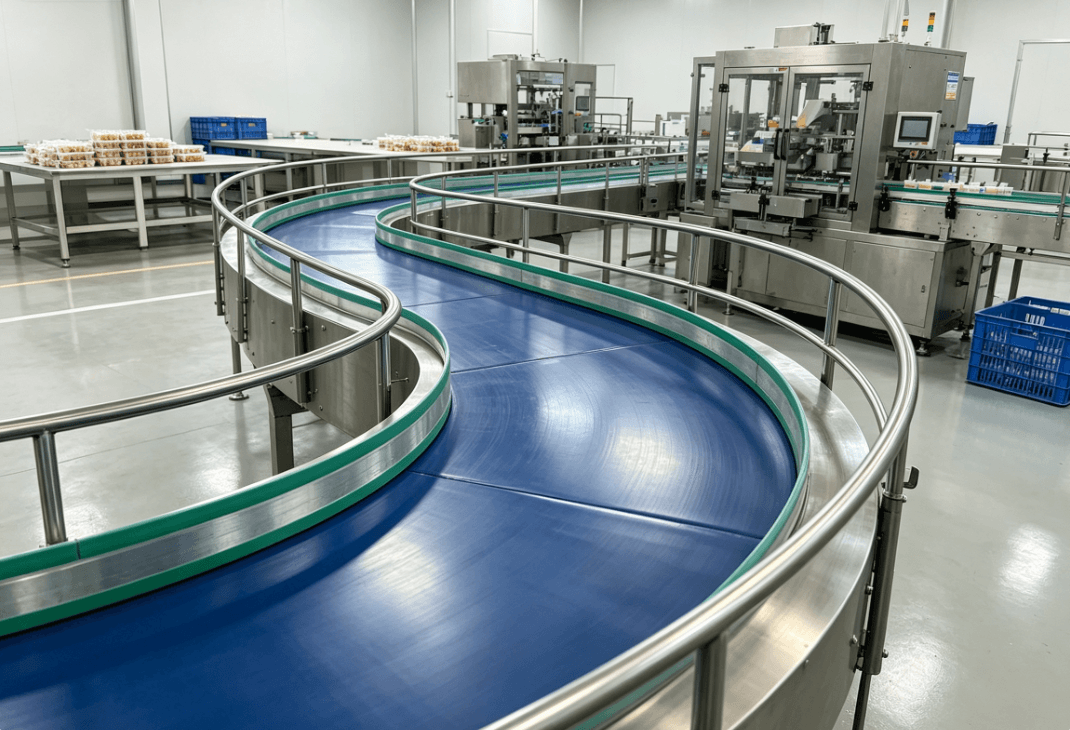
Turning conveyors allow for “S-curve” or “U-shape” configurations. This is particularly valuable in:
- Cleanroom Environments: Where space is limited and controlled airflow is essential.
- End-of-Line Packaging: Where products from multiple lines must converge into a single palletizer.
- Multi-Stage Processing: Integrating heating, cooling, or drying tunnels that require a specific dwell time within a compact footprint.
Load Stability and Centrifugal Force Considerations
A common engineering oversight in conveyor selection is failing to account for the physics of the turn. On a straight conveyor, the center of gravity remains constant relative to the belt.
In a turning conveyor, centrifugal force acts upon the product. If the speed is too high or the turn radius is too tight, top-heavy products (like tall bottles or narrow electronics components) may tip. Engineers must specify the Minimum Inner Radius based on the product’s footprint and height. For unstable loads, side guards or high-friction modular belts are often required, which can be found in specialized turning machine categories designed for high-precision transfers.
Maintenance and Lifecycle Cost Drivers
From a procurement perspective, the Total Cost of Ownership (TCO) differs significantly between these two types.
Straight Conveyors:
The maintenance profile is predictable. Standard straight conveyor systems usually require simple belt tensioning and occasional bearing lubrication. Parts are generally “off-the-shelf,” reducing lead times for repairs.
Turning Conveyors:
The “pull” on a curved belt is non-uniform. This places higher stress on the outer edge of the belt and the guide bearings. Modular plastic turns are more robust but carry a higher initial price point. If a fan-shaped PVC belt is used, precise tracking is mandatory to prevent edge fraying. When evaluating suppliers, it is vital to check for reinforced frame designs and high-quality guide rollers that can withstand continuous 24/7 operation.
Strategic Selection: Which One Fits Your Factory?
Choose a Straight Conveyor if:
- Speed is the priority: You are moving high volumes of goods where throughput exceeds 60 meters per minute.
- Budget is constrained: You have the floor space to accommodate long runs and want to minimize initial CAPEX.
- Heavy Loads: You are transporting heavy pallets or bulk materials that require high-torque, linear drives.
Choose a Turning Conveyor if:
- Space is a bottleneck: You need to maximize the utility of a non-linear factory floor.
- Workflow Integration: You are connecting two machines that are not aligned on the same axis.
- Product Orientation is Critical: You cannot allow the product to tumble or change its leading edge during a direction change.
Evaluating Manufacturer Capability
When sourcing these components, especially for OEM projects, the focus should shift toward customization. Standard dimensions rarely fit a bespoke production line perfectly.
A reliable manufacturer should provide CAD drawings for integration testing and offer material options—such as anti-static belts for electronics or FDA-compliant materials for food processing. Quality systems like ISO 9001 certification in the factory and the use of reputable motor brands (like Nord or SEW) are key indicators of a conveyor’s long-term reliability.
FAQ
Q: Can I use two straight conveyors at a 90-degree angle instead of a turning conveyor?
A: Yes, this is called a “dead plate transfer” or “cross-transfer.” However, the product will change its orientation (the side becomes the front), and small or unstable items may get stuck in the gap between the two conveyors. A turning conveyor is superior for maintaining continuous flow and orientation.
Q: What is the standard angle for turning conveyors?
A: The most common angles are 45°, 90°, and 180°. Custom angles are possible but usually require bespoke frame fabrication and specialized belt cutting.
Q: Are turning conveyors louder than straight ones?
A: Generally, yes. The friction of the belt against the side guides and the use of modular plastic chains in curves tend to generate more decibels than a smooth-running PVC straight belt.
Q: How do I calculate the turn radius needed for my product?
A: The radius is typically determined by the product width. A general rule of thumb is that the inner radius should be at least 1.5 times the width of the widest product to ensure smooth passage without jamming.
Reference Sources
- CEMA (Conveyor Equipment Manufacturers Association): Standards for belt tension and conveyor design safety.
- ISO 2110:2020: Guidelines for the design and calculation of light conveyor belts.
- Hytrol Material Handling Systems: Technical whitepapers on gravity and powered curve dynamics.
- FDA CFR 21: Requirements for materials used in food-contact conveyor belts (relevant for PU/PVC selection).