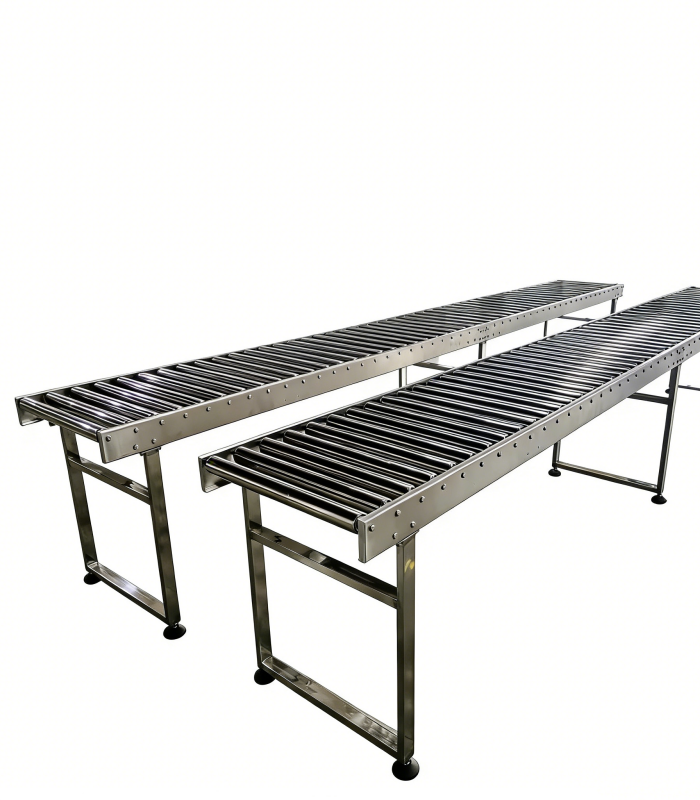
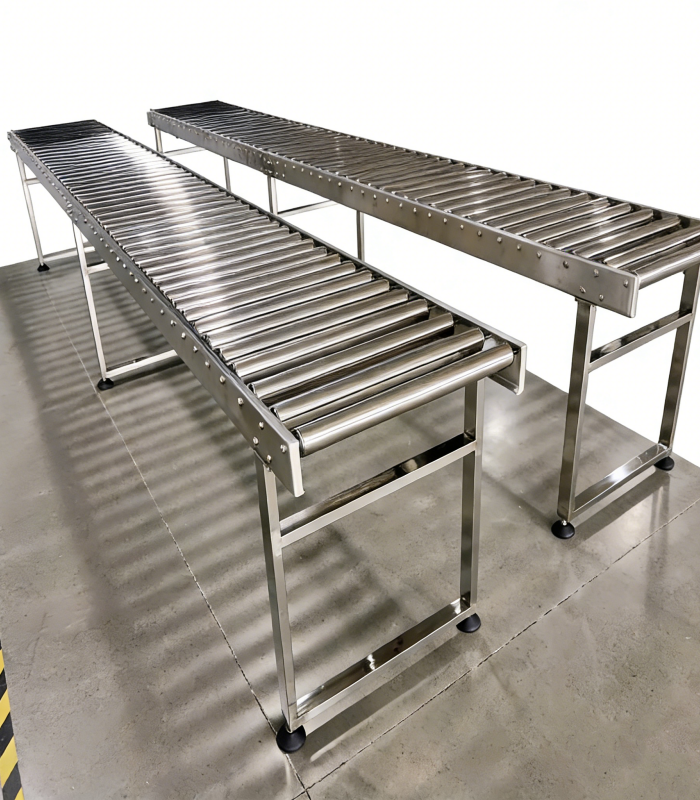
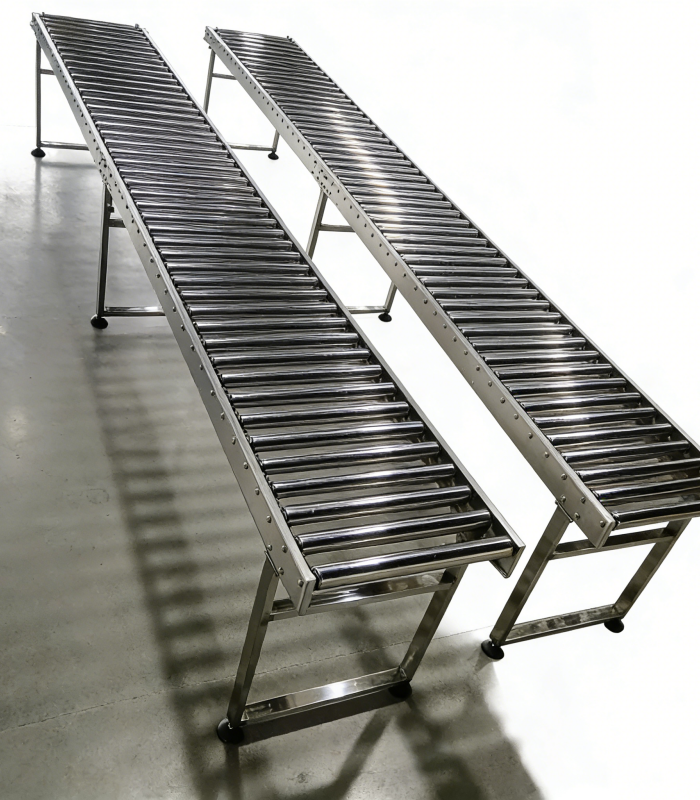
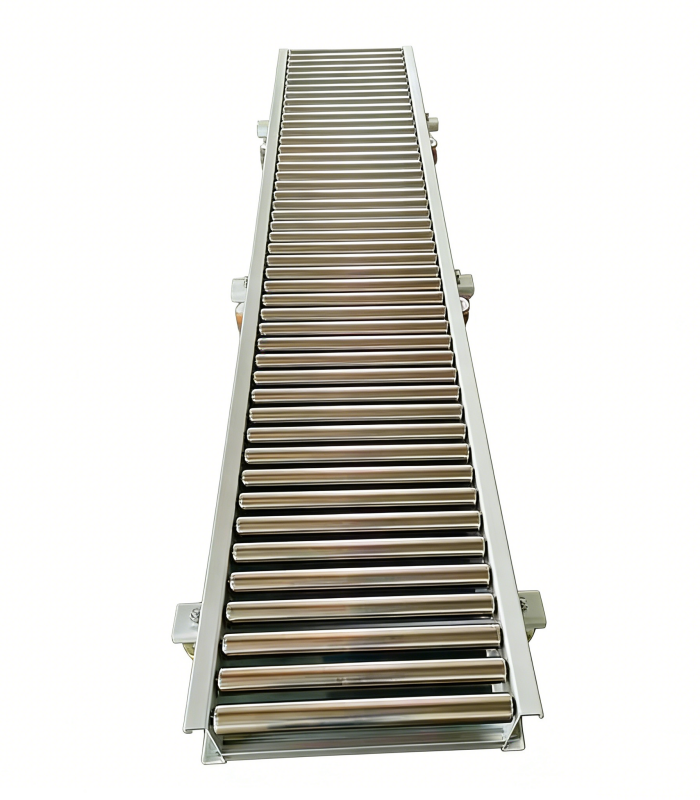
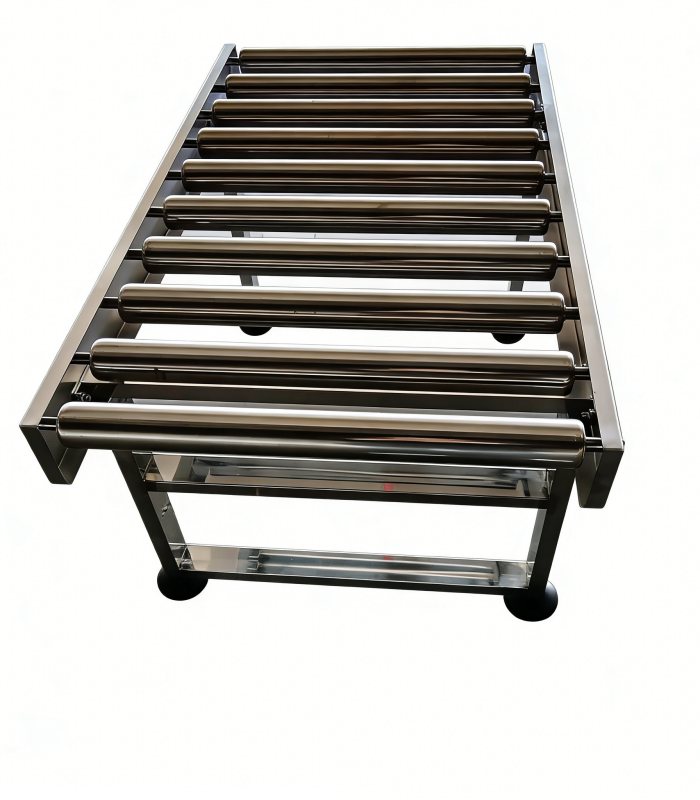
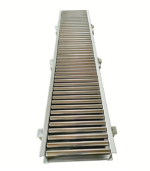
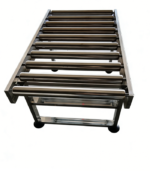
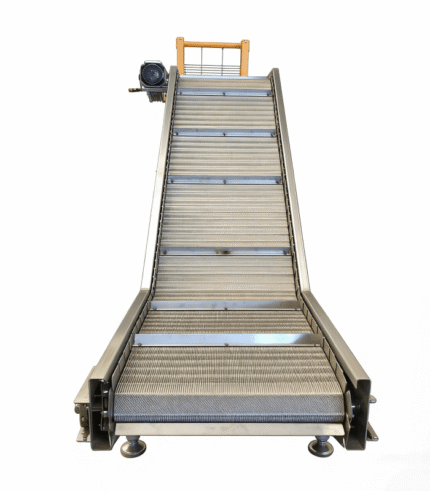
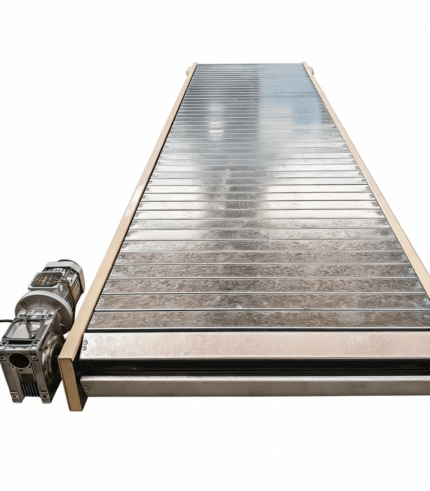
Roller conveyors, floor-mounted roller conveyors, non-powered conveyors
A roller conveyor is a high-capacity, modular conveying system that relies on friction between the rollers and the bottom of the cargo to propel it forward; it is suitable for materials with flat bottoms, such as boxes, bags, and pallets.
A roller conveyor is a device that drives forward through friction between the rollers and the bottom of the cargo or via a meshing drive mechanism. It is suitable for conveying unitized materials with flat bottoms, such as various types of boxes, bags, and pallets.
I. Product Applications
Roller conveyors are widely used in various production and logistics scenarios that require high efficiency and automated integration:
1. Logistics and Warehousing Centers: Used for sorting, merging, and diverting express parcels and cartons; often integrated with lift-and-transfer conveyors to achieve 90° and 180° directional changes.
2. Production Assembly Lines: In industries such as electronics, home appliances, and automotive parts, they serve as the main conveyor body, carrying workboards for assembly operations.
3. Automated Packaging Lines: Integrated with case openers, case sealers, and palletizers to complete end-of-line packaging and conveying of products.
4. Heavy-Duty and Special Applications: Capable of conveying materials with very high individual weights (such as pallets and motors) and withstanding significant impact loads. For soft-bag packaging or small loose items, these are typically conveyed inside pallets or returnable containers.
5. Complex System Integration: Easily interfaces with other conveying equipment (such as belt conveyors and chain conveyors) or specialized machinery to form complex automated logistics systems.
II. Product Advantages
Roller conveyors are among the most common pieces of equipment in industrial assembly lines, with their core advantages lying in standardization, high load capacity, and flexibility:
1. Simple structure and high reliability: Primarily composed of rollers, frames, and drive units, they have few potential failure points and are easy to maintain.
2. High Throughput and Load Capacity: Compared to belt conveyors, roller conveyors are more impact-resistant and suitable for heavy loads; they offer fast single-line conveying speeds and support the diversion of multiple product types on a single line.
3. Flexible Layout and Modular Design: Supports various layouts including horizontal, inclined, and curved configurations (with a minimum turning radius of R300mm). Frames can be selected based on the environment, such as carbon steel (powder-coated), stainless steel (corrosion-resistant), or aluminum profiles (lightweight and aesthetically pleasing).
4. Accumulation function: Accumulation rollers can be used to achieve batch conveying, where the rollers continue to rotate freely beneath the goods when they stop, preventing surface scratches without halting the entire line, making it suitable for buffer stations.
5. High degree of standardization: Roller diameters, frame widths, and other specifications are available in standardized series, enabling quick selection, good interchangeability, and lower costs.
III. Product Manufacturing Process
The manufacturing of roller conveyors involves precision machining of components and modular assembly of the complete system. The core process flow is as follows:
1. Design and Selection Phase
Key parameters are determined based on customer requirements, including: dimensions of the conveyed items, unit weight, bottom surface condition, conveying speed, layout type (straight/curved/inclined), and environmental requirements (humidity/corrosion/food-grade), etc. The design principle ensures that the goods are in contact with at least three rollers at all times to guarantee smooth operation.
2. Component Machining
· Roller Machining: This is the core component. High-quality seamless steel tubes are typically selected, which undergo cutting, turning (to machine the shaft position and bearing seats), welding (welding the tube body to the shaft ends, ensuring weld quality to prevent cracks), surface treatment (galvanizing, rubber coating, or powder coating), and bearing assembly. For special requirements (such as anti-static, high-temperature resistance, or noise reduction), corresponding materials and processes must be adopted.
· Frame Machining: C-channel steel, square tubing, or aluminum profiles are used, undergoing laser cutting (high-precision blanking), CNC punching (ensuring roller mounting hole accuracy of ±0.05 mm), bending, and welding to form the structure. After welding, carbon steel frames undergo vibration aging treatment to relieve internal stresses, followed by powder coating or baking paint for rust prevention.
· Sprocket/Pulley Machining: Sprockets or pulleys are machined according to the drive type (chain drive, O-belt, V-belt), typically using 45# steel that undergoes gear hobbing and high-frequency quenching.
3. Final Assembly and Commissioning
· Assembly: Insert the rollers into the holes on the frame side panels at the designed spacing, securing them with springs or screws; install the drive motor (gear motor or electric drum), transmission chain/O-ring/V-belt; install the legs and leveling feet.
· Commissioning:
· No-Load Testing: Power on and run the system to check if the rollers rotate smoothly, with no jamming or abnormal noises, and verify that the drive belt/chain is not misaligned or too loose.
· Load Testing: Place cargo on the conveyor to test whether it moves smoothly without slipping or shifting, and verify that the motor current is normal.
· Noise Testing: Operating noise is typically required to be ≤70 dB.
4. Special Design (Curved Sections)
For curved roller conveyors, tapered rollers must be used. The taper of the rollers must be precisely calculated and designed based on the dimensions of the goods, the turning radius, and the conveying speed to ensure that the goods maintain the correct orientation when passing through the curve.
Summary
Thanks to their modular design and high load-bearing capacity, roller conveyors have become one of the most widely used conveying systems in modern logistics and production lines. Their manufacturing process emphasizes precision machining of the rollers, robust welding of the frames, and the smooth operation of the drive system.
When selecting a model, the following parameters typically need to be specified:
1. Conveyed items (length/width/height), unit weight, and bottom surface condition
2. Roller diameter (commonly 38, 50, 60, 76, 89 mm), frame width (= cargo width + 50 mm allowance)
3. Power type (non-powered/geared motor drive/electric roller), transmission method (sprocket/O-belt/V-belt)
The key features of roller conveyors lie in their modular roller-frame structure and diverse drive configurations. By combining different roller diameters, spacing, and materials, they can flexibly accommodate a wide range of conveying needs, from light-duty cartons to heavy-duty pallets (up to 2,000 kg). The following provides detailed specifications and descriptions:
—
I. General Core Parameter Ranges
Parameter Item General Range Notes
Roller Diameter 38mm, 50mm, 60mm, 76mm, 89mm Select 38–50mm for light loads; select 60–89mm for heavy loads
Roller Spacing 75mm, 100mm, 120mm, 150mm Principle: Cargo must contact at least 3 rollers simultaneously
Frame Width 200mm ~ 1200mm (customizable) = Cargo width + 50~100mm clearance
Conveyor Speed: 10–30 m/min (standard), 15–80 m/min (high-speed); Variable frequency drive or stepless speed control
Single-Item Load Capacity: ≤30 kg (light duty) to 2000 kg (heavy-duty pallet); depends on roller specifications and material
Operating Temperature: -20°C to +300°C (special heat-resistant type); standard type suitable for ambient temperatures
Curve Radius: R300mm, R600mm, R900mm, R1200mm (standard); parameters specific to curved conveyors
II. Key Component Details and Specifications
1. Rollers (Core Load-Bearing Components)
Rollers are the components that come into direct contact with the cargo, and their specifications determine the equipment’s scope of application:
Roller Type | Material Options | Applicable Scenarios
Non-powered Rollers | Galvanized, Aluminum-coated, Stainless Steel, PVC | Driven by manual force or gravity; suitable for inclines or auxiliary sections
Powered Rollers | Rubber-coated carbon steel, Stainless Steel, Aluminum Alloy | Driven by chains, O-belts, or multi-v-belts; suitable for main conveyor lines
Electric Roller: Integrated structure with built-in motor; compact design, suitable for space-constrained environments
Tapered Roller: Carbon steel/stainless steel tapered body; specifically for curved conveyors; taper angle designed based on cargo dimensions and turning radius
Special Roller Design Options:
· Anti-static: Incorporates conductive rings or conductive material (10⁻⁷) added to the plastic-steel cover
· High-temperature resistant: Withstands temperatures up to 300°C
· Accumulation type: Rollers idle when goods are stationary; suitable for buffering stations
· Wear-resistant/impact-resistant: Features outer tubes made of polyurethane, nylon, or 45# steel
2. Drive Methods (Core of Powered Conveyor Lines)
Drive Type | Features | Suitable Applications
O-ring belt | Low noise, low cost | Light-duty, clean environments (e.g., electronics, food)
Multi-v belt | Smooth operation, high efficiency | Medium-duty loads, mainstream choice
Single sprocket/double sprocket | High load capacity, impact-resistant | Heavy-duty loads, frequent starts and stops
Synchronous belt | Precise synchronization | Applications requiring precise positioning
3. Frame and Legs
Component | Material Options | Description
Frame Side Panels | C-channel steel (powder-coated), stainless steel, aluminum profiles | CNC punching ensures roller installation accuracy of ±0.05 mm
Legs | Carbon steel square tubing, stainless steel | Adjustable feet, height-adjustable
Coating | Thermosetting epoxy powder, coating thickness 60 μm | Complies with GB61007-86 standard
4. Drive System
Drive Type Description
Geared Motor Drive Motor + gearbox, drives rollers via chain/belt; most commonly used
Electric Roller Drive Motor built into the roller; compact structure; suitable for curved sections
Group Drive vs. Individual Drive Group Drive: Multiple rollers in a group driven by a single motor (lower cost); Individual Drive: Each roller driven separately (easy to disassemble)
III. Detailed Parameters by Type
1. Roller Conveyor (Carton/Pallet)
Parameter Specifications
Typical Applications: Express sorting, packaging lines, electronics assembly
Roller Diameter: 38 mm, 50 mm
Roller Spacing: 75 mm, 100 mm
Single-Item Load Capacity: ≤30 kg
Conveyor Speed: 10–30 m/min (adjustable)
Drive Type: Multi-V-belt, O-ring belt
Frame Material: Aluminum extrusions, powder-coated C-channel steel
2. Roller Conveyor
Parameters & Specifications
Curve Radius ≥300 mm (Standard: 300, 600, 900, 1200 mm)
Load Capacity ≤50 kg (Standard Type); Heavy-duty models available upon request
Conveyor Speed 15–80 m/min
3. Heavy-Duty/Pallet Roller Conveyors
Parameters & Specifications
Typical Applications: Pallet conveying, warehouse inbound/outbound operations, heavy industry manufacturing
Roller Diameter: 60 mm, 76 mm, 89 mm
Load Capacity: 50–2,000 kg
Conveying Speed: 12–18 m/min
Drive Type: Dual-sprocket chain drive
Frame Material: Powder-coated carbon steel, stainless steelIV. List of Key Selection Parameters
The following information must be specified during procurement or design:
1. Material Handling Parameters
· Item type (cartons/reusable containers/pallets/flexible packaging), unit weight
· Dimensions (L × W × H)
· Base condition: flat / even weight distribution / protrusions / uneven weight distribution due to irregular edges
· Packaging: Unpackaged / Canned / Cartons / Wooden Crates / Pallets
2. Operating Conditions
· Conveying speed, conveying length
· Layout: Horizontal / Inclined / Curved (angle, radius) / Multi-level
· Operating environment: Indoor/outdoor, temperature, humidity, chemical corrosion, cleanliness requirements
· Conveying conditions: Impact forces, rough loading/unloading
3. Functional Requirements
· Drive Type: Non-powered / Geared Motor / Electric Roller
· Transmission Method: V-belt / Multi-V-belt / Sprocket / Timing Belt
· Special Requirements: Accumulation Function / Anti-static / High-Temperature Resistance / Low-Noise / Anti-entanglement (Soft-pack Conveying)
4. Principles for Determining Dimensions
· Roller Length = Cargo Conveying Width + 50–100 mm (allowance)
· Roller Spacing ≤ Cargo Length / 3 (to ensure at least 3 rollers are in contact simultaneously)
· Turning Radius: Calculate the taper based on cargo dimensions and line speed


评价
目前还没有评价